

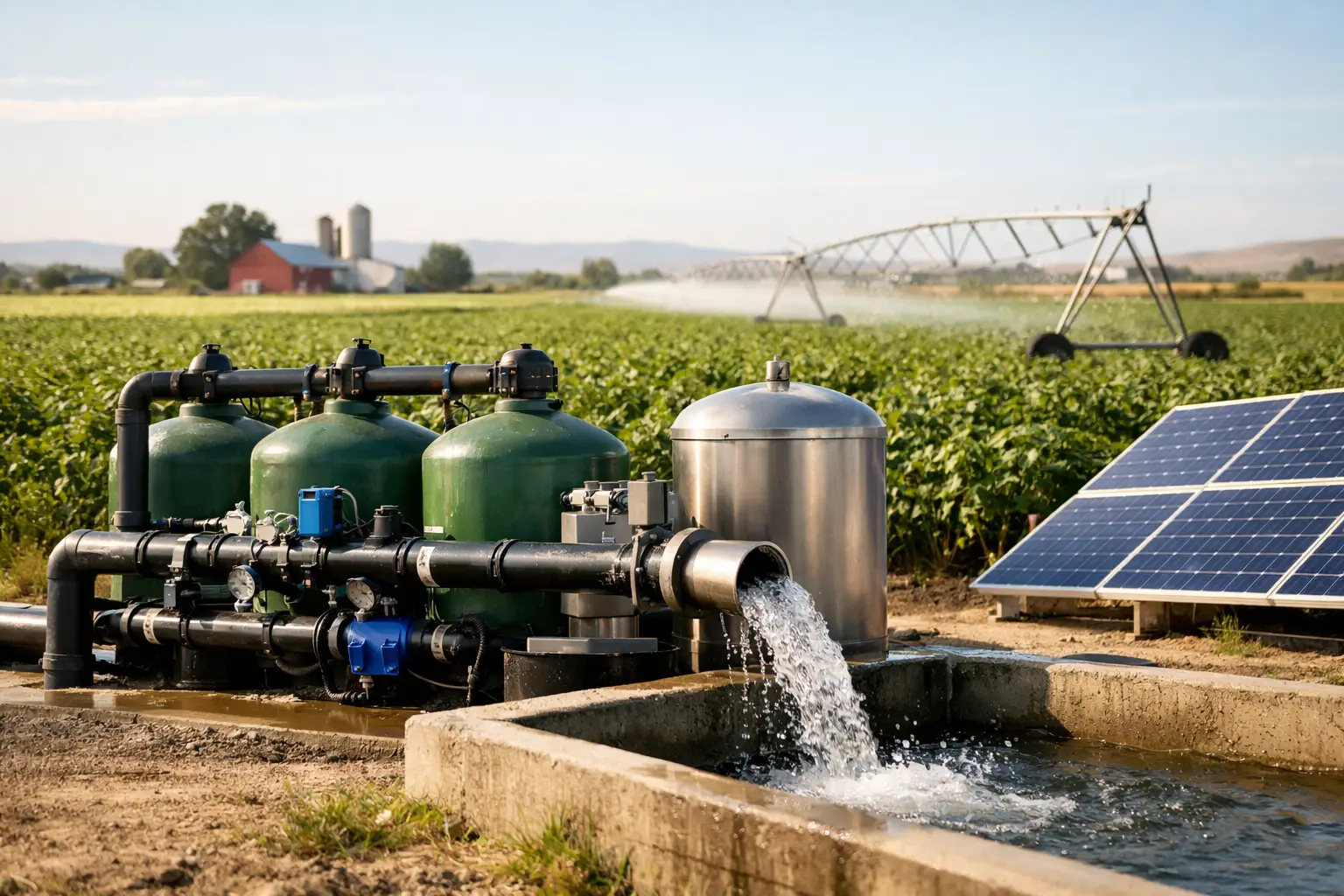
Best Agricultural Water Treatment Methods
A fertigation tank that keeps plugging emitters, a reservoir with algae pressure, or a well source carrying bicarbonates and iron can erase irrigation efficiency faster than most teams expect. The best agricultural water treatment methods are not defined by what sounds advanced. They are defined by source water, irrigation system design, crop sensitivity, and the economic cost of poor water quality across the season.
For commercial agriculture, water treatment is not a side issue. It affects emitter uniformity, nutrient availability, disease pressure, labor demand, and the lifespan of pumps, pipes, valves, and filters. In high-value crops, weak water quality management can reduce yield and packout even when fertigation and irrigation scheduling are otherwise well designed. That is why method selection should start with diagnosis, not equipment shopping.
How to choose the best agricultural water treatment methods
The right treatment train depends on four variables: the contaminants present, the irrigation delivery system, the crop, and the operational objective. A greenhouse tomato operation using recirculated irrigation water has very different needs than an almond orchard on a deep well or a vegetable farm using surface water with seasonal sediment loads.
Start with a complete water analysis. At a minimum, that means pH, EC, alkalinity, hardness, sodium, chloride, bicarbonates, iron, manganese, suspended solids, and microbiological risk if the source is surface water, recycled water, or stored water. If fertigation is part of the program, compatibility between water chemistry and fertilizer materials must be reviewed as carefully as the source itself.
Treatment selection should also match the failure mode you are trying to prevent. Some operations need to remove particles. Others need to suppress biofilm, reduce scaling, control pathogens, or make marginal water usable through desalination or blending. These are different problems, and no single technology solves all of them well.
Filtration is the foundation of most agricultural water treatment methods
In practice, filtration is the first line of defense in most systems because suspended solids damage irrigation uniformity quickly. Sand, silt, organic debris, algae, and precipitated minerals can all reduce flow and increase maintenance costs. In drip irrigation, this is especially costly because partial emitter plugging may go unnoticed until crop variability appears.
Media filters are often the best fit for surface water or reservoirs with high organic load and algae. They provide depth filtration and handle variable particle loads better than many screen-only systems. Screen and disc filters are common for groundwater or as secondary filtration after media filters. Disc filtration performs well where particle loads are moderate and consistency matters, while screen filters can be effective in cleaner water but may struggle with organic contaminants.
The trade-off is operational. Media filters require backwash management and proper sizing. Disc and screen systems are simpler in some settings, but if the source water carries fine organic matter, they can become a maintenance bottleneck. For enterprise-scale farms, filter selection should be based on particle type and loading pattern, not just nominal micron rating.
Chemical treatment for scale, precipitation, and clogging
Many irrigation problems are chemical before they become mechanical. High bicarbonate water raises pH and contributes to carbonate precipitation, especially when calcium fertilizers are injected. Iron and manganese can also oxidize and form deposits, while hard water accelerates scale formation in lines and emitters.
Acidification is one of the most effective methods where alkalinity drives precipitation risk. By reducing bicarbonate concentration and lowering water pH to a managed target, acid injection can improve fertilizer compatibility and reduce scale buildup. Sulfuric, phosphoric, and nitric acids may all be used, but the choice depends on safety, fertilizer program, crop nutrition goals, and local handling capability.
This is where agronomic and engineering decisions overlap. Nitric acid, for example, contributes nitrate nitrogen, which may or may not fit the crop stage and fertility plan. Phosphoric acid contributes phosphorus, but in hard water systems it can create its own compatibility constraints. The method works well when integrated into fertigation planning. It performs poorly when treated as a stand-alone fix.
Oxidation and sequestration may also be used for iron and manganese issues, but results depend heavily on concentration, pH, and whether precipitated material is removed effectively afterward. Treating dissolved metals without adequate downstream filtration often shifts the problem rather than solving it.
Disinfection and biological control in irrigation water
Where microbial contamination is a concern, disinfection becomes essential. This is especially relevant in recirculating systems, greenhouse production, surface water irrigation, and operations with pathogen-sensitive crops. Biofilm control also matters in drip systems because biological growth narrows flow paths and protects other clogging materials.
Chlorination remains common because it is practical and relatively cost-effective. Used correctly, it helps suppress microbial loads and manage biofilm. Used poorly, it can create inconsistent results, corrosion risk, and worker safety issues. Performance depends on pH, contact time, organic load, and dosing discipline. It is not enough to inject chlorine and assume control has been achieved.
Ultraviolet treatment is attractive in controlled systems because it leaves no residual and can be highly effective against many microorganisms when water clarity is good. However, UV does not perform well in turbid water, and it provides no residual protection in the distribution system. Ozone is powerful and fast acting, but system complexity, safety, and capital cost limit its use to operations with strong technical management.
Hydrogen peroxide and related oxidizing products are also used to reduce biofilm and organic buildup, sometimes in combination with other approaches. Their value depends on water chemistry and application precision. For biological treatment, there is no universal best method. The source, water cleanliness, and distribution system determine what is realistic.
Reverse osmosis and desalination for high-salinity water
When EC, sodium, or chloride levels exceed crop and soil tolerance, conventional treatment may not be enough. Reverse osmosis is one of the few methods that can materially improve poor-quality saline water for agriculture. In high-value protected cropping, nursery production, or regions with severe water constraints, it can make production possible.
But RO is not a routine answer for every farm. It requires significant capital, energy, pretreatment, membrane maintenance, and brine disposal planning. Recovery rates and total cost per acre-foot matter. In open-field agriculture, blending treated water with better-quality sources is often more economical than full desalination. Crop value, water scarcity, and long-term salinity risk should drive the decision.
This is one of the clearest examples of why the best agricultural water treatment methods depend on context. RO may be indispensable in one system and financially unjustified in another. A precise partial-treatment strategy can sometimes outperform a full-treatment system on return per acre.
Recycled and tailwater systems need a treatment train, not a single fix
Water reuse is becoming more common as availability tightens and sustainability targets become more operational. Yet recycled water introduces a more complex treatment challenge because the contaminant profile is broader. Suspended solids, pathogens, nutrient residues, and organic matter may all be present, and they vary over time.
In these systems, treatment typically needs to be sequential. Settling or solids separation may come first, followed by filtration, then disinfection. In some cases, storage design itself becomes part of treatment by reducing sediment carryover or exposure to contamination. Success depends on system design, monitoring, and operating discipline rather than one piece of equipment.
For food and beverage supply chains and large agribusiness operations, reused water programs must also align with crop risk, buyer requirements, and regulatory standards. Agronomic feasibility is only one part of the decision.
Monitoring matters more than many treatment upgrades
A common mistake is installing treatment hardware without building a monitoring protocol. Water quality shifts seasonally. Reservoirs change biologically. Wells change chemically. Fertilizer programs alter precipitation risk. If the team is not tracking what matters, treatment performance will drift until field symptoms appear.
At minimum, monitor source and post-treatment pH, EC, pressure differential across filters, chlorine residual where relevant, and periodic lab analyses for the main chemical risks. In drip systems, flushing records and emitter discharge checks should be routine. The most effective operations connect water quality data to irrigation performance, maintenance logs, and crop response rather than treating each area separately.
This is where training and advisory support add real value. Many farms do not need more equipment first. They need a clearer diagnostic process, tighter operating thresholds, and better alignment between irrigation management and water chemistry. That approach is often what turns treatment spending into measurable improvement.
The right water treatment strategy is rarely the most complicated one. It is the one that removes the specific constraints limiting uniform irrigation, clean fertigation, and dependable crop performance. When treatment decisions are grounded in water analysis, system design, and crop economics, they stop being reactive maintenance and become part of a stronger production strategy.











About Post Author
