

How to Design Farm Irrigation Systems
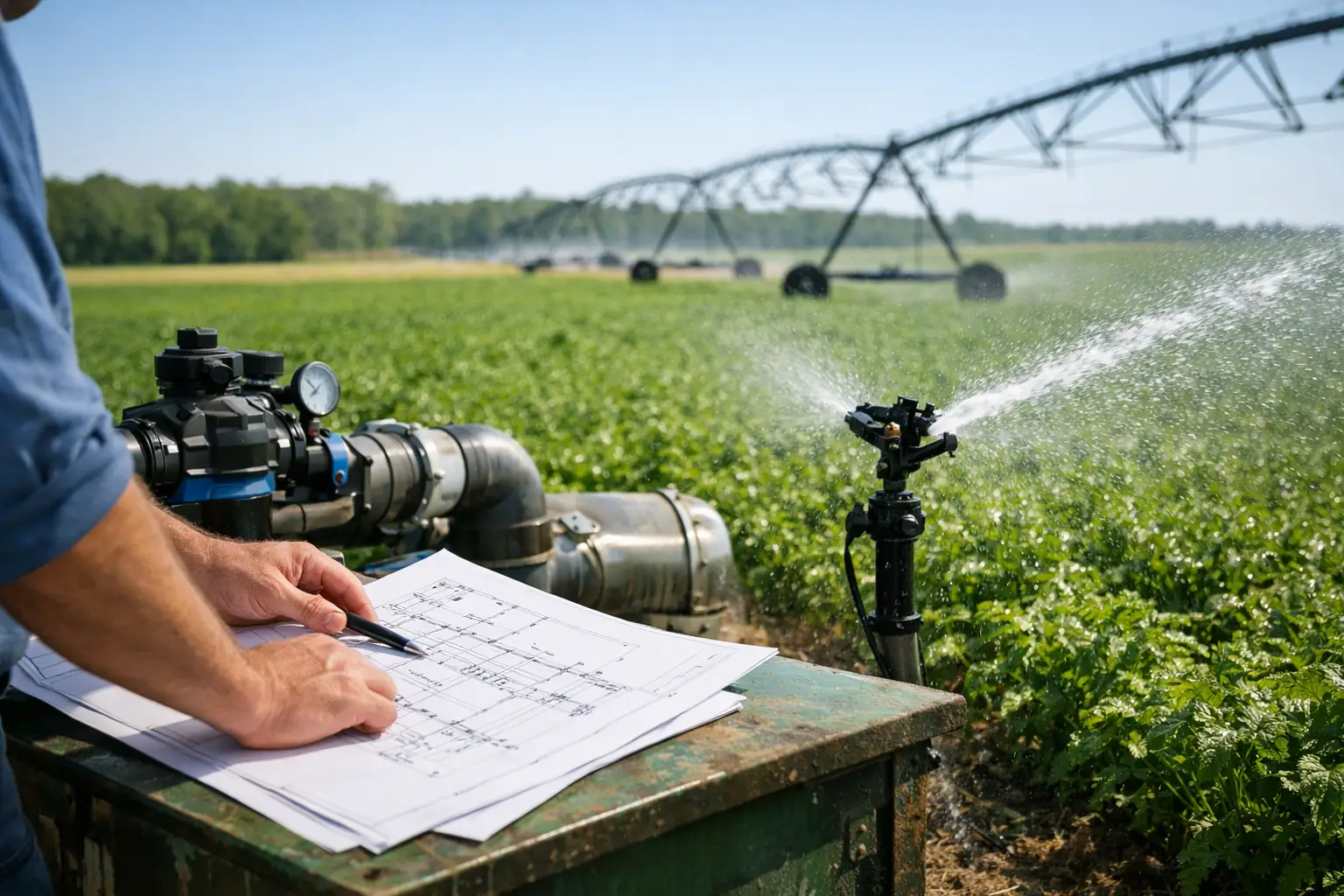
A farm irrigation system usually fails on paper before it fails in the field. The warning signs are familiar – uneven blocks, low pressure at peak demand, clogged emitters, runoff, waterlogged zones, and energy costs that keep climbing. Knowing how to design farm irrigation systems means starting with agronomy and hydraulics together, not treating irrigation as a piping exercise after planting decisions are already made.
How to design farm irrigation systems from the field backward
Good irrigation design starts with the crop, the soil, and the operational reality of the farm. The system has to match root depth, infiltration rate, climate, water quality, labor capacity, and the level of control the farm can realistically maintain. A well-designed system is not simply one that delivers water. It is one that applies the right amount, at the right time, with acceptable uniformity and manageable operating costs.
This is why design decisions should begin with a field assessment rather than equipment selection. Start by mapping field size, shape, elevation changes, water source location, and power availability. Then evaluate the agronomic conditions that will govern irrigation performance: crop type, planting geometry, rooting characteristics, soil texture, restrictive layers, salinity risk, and local evaporative demand.
The key design question is straightforward: what application method gives the crop reliable access to water while fitting the farm’s constraints? The answer depends on trade-offs. Drip offers high control and supports fertigation well, but it demands filtration discipline and more technical oversight. Sprinklers can serve a wide range of crops and soils, but wind drift and evaporation losses may reduce efficiency. Surface irrigation may have lower capital cost in some settings, yet it requires suitable land shaping and careful water management to avoid non-uniformity.
Start with water demand, not pipe diameter
The hydraulic design should be built around crop water demand. Estimate peak crop evapotranspiration for the location and season, then convert that demand into gross irrigation requirements after accounting for application efficiency, leaching needs, and operational scheduling. Designing for average demand is a common mistake. The system must perform during peak periods, when the crop is least forgiving.
Once you know how much water the crop needs, define how often the system should irrigate. Frequency depends on soil water holding capacity, rooting depth, allowable depletion, and the farm’s management strategy. Sandy soils with low storage require more frequent applications. Clay soils can store more water, but intake rate becomes a limiting factor, especially under sprinklers or surface methods. In perennial crops, rooting volume and wetted soil pattern often matter more than field capacity alone.
From there, calculate the required flow rate. This is where many designs become either oversized and expensive or undersized and operationally stressful. Required flow is a function of irrigated area per set or zone, net depth per irrigation, irrigation interval, and available operating hours. If the system can only run 16 to 18 hours per day because of labor, tariff, or power limitations, design around that reality. A design that works only on a 24-hour operating assumption may fail in commercial practice.
Soil, topography, and water quality shape the design
Soil texture does more than influence irrigation frequency. It determines how quickly water can be applied without runoff or deep percolation, and how wide the wetting pattern spreads under drip. Coarse soils generally need lower application depths per event and closer emitter spacing. Fine-textured soils may allow wider lateral spacing in some crops, but they are also more vulnerable to saturation and poor aeration if irrigation timing is mismanaged.
Topography affects pressure distribution, drainage, and zoning. Even moderate elevation changes can create significant pressure variation, especially in drip systems. If slopes are ignored during design, one end of the field may be over-irrigated while another remains under-supplied. Pressure regulation, submain layout, and block size should all be reviewed with elevation in mind.
Water quality is equally decisive. Sediment load, organic contamination, bicarbonates, iron, manganese, pH, and salinity influence filtration, chemical treatment, emitter performance, and crop response. A system supplied by poor-quality water can still perform well, but only if the treatment and maintenance strategy are designed from the outset. Retrofitting filtration after clogging problems begin is costly and often incomplete.
Selecting the right irrigation method
When deciding between drip, sprinkler, micro-sprinkler, or surface irrigation, the correct choice is rarely universal. It depends on crop value, field uniformity, water cost, labor skill, and management intensity.
Drip irrigation is often the preferred option where water efficiency, fertigation precision, and reduced foliar wetting are priorities. It is especially effective in orchards, vineyards, vegetables, and high-value row crops. But drip only performs as designed when filtration, flushing, and pressure management are handled properly.
Sprinkler systems may be better suited where broader wetting is required, germination depends on surface moisture, or crop spacing makes drip less practical. Center pivots and linear systems can be efficient on large, regular fields, while solid-set or portable systems fit other operational models. The limitation is that wind, nozzle wear, and pressure variation can reduce distribution uniformity if not carefully managed.
Micro-sprinklers are common in tree crops where a larger wetted area is useful, especially during establishment or in coarse soils. Surface irrigation can still be viable where land slope, soil intake, water availability, and farm economics align, but it requires proper field leveling and strong water control.
Hydraulic design is where performance is won or lost
A sound hydraulic design balances flow, pressure, and acceptable variation across the system. The pump must match the required duty point, not just provide a high nominal capacity. Mainlines, submains, and laterals should be sized to keep friction losses within acceptable limits while maintaining economic feasibility. Oversizing every pipe increases capital cost without guaranteeing better irrigation. Undersizing creates chronic pressure deficits that no scheduling software can fix.
Uniformity targets should be explicit. In drip irrigation, emitter flow variation caused by pressure differences, slope, and manufacturing variability must stay within acceptable limits. In sprinkler systems, nozzle spacing, operating pressure, wind conditions, and precipitation rate all affect how evenly water is applied. If the application rate exceeds the soil intake rate, the system may appear adequate hydraulically while still causing runoff in practice.
Zoning deserves special attention. Blocks should be grouped not only by size, but also by crop, age, rooting conditions, soil type, and topography. Farms often inherit zones based on construction convenience rather than agronomic logic. That creates scheduling conflicts from the first season onward. One zone should represent an area that can be irrigated as a unit without compromising part of the field.
Filtration, fertigation, and control strategy
Filtration should be selected according to water source and emitter sensitivity. Screen filters may be adequate for relatively clean groundwater. Media filtration is often necessary for surface water with organic load. In many systems, a combination is required. The goal is not just to install filters, but to ensure they can handle peak flow, backflush correctly, and maintain stable downstream pressure.
Fertigation design should be integrated into the irrigation plan, especially where nutrient delivery is part of the production strategy. Injection capacity, chemical compatibility, mixing quality, and safety devices all matter. A weak fertigation setup can limit the value of an otherwise well-built irrigation system.
Control level should match farm scale and management capacity. Automated valves, pressure sensors, flow meters, and remote monitoring can improve response time and visibility, especially across multiple blocks or sites. But automation is not a substitute for design quality. If the hydraulics are poor, digital control simply helps you monitor poor performance more precisely.
Commissioning and field validation
Design is not finished when installation ends. The system should be tested under operating conditions to verify pressure, flow, distribution, and flushing performance. Measure pressure at representative points, check emitter or nozzle discharge, confirm pump output, and compare actual results against the design assumptions.
This step is often skipped, and that is where expensive underperformance begins. A system may be technically complete yet agronomically misaligned. Field validation connects engineering with crop response.
For farms managing expansion, renovation, or multi-field projects, the most reliable path is a design process that combines hydraulics, crop physiology, soil behavior, and practical farm operations. That is where unbiased technical guidance adds measurable value – not by promoting a specific product, but by building a system the farm can operate successfully year after year.
The best irrigation design is the one that still works well on a difficult week in midsummer, when demand peaks, labor is stretched, and the crop cannot wait.











About Post Author
