


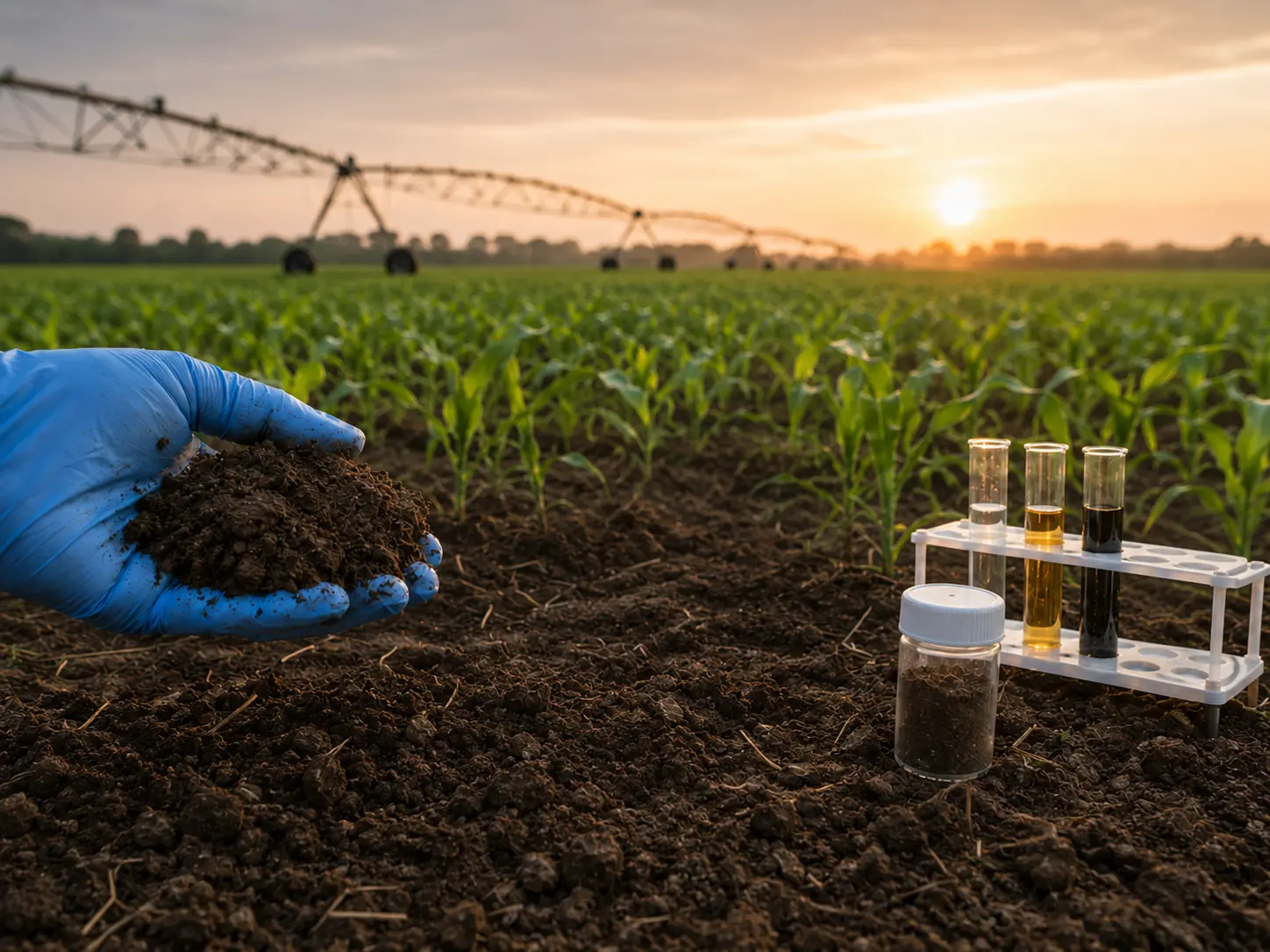
Soil Nutrient Management for High Yield
A field can look uniform from the road and still carry three different yield potentials within the same irrigation set. That is why soil nutrient management for high yield cannot be reduced to applying more fertilizer. High yield comes from matching nutrient supply with crop demand, soil conditions, water movement, and realistic production targets.
When any one of those factors is out of line, efficiency drops quickly. Nitrogen may be present but unavailable at the wrong moisture level. Phosphorus may test high yet remain poorly accessible in a cold or compacted root zone. Potassium may be adequate in the lab report but insufficient under heavy fruit load or rapid vegetative growth. Good nutrient management is not about chasing a single number. It is about building a system that supports uptake throughout the season.
What soil nutrient management really means
At a practical level, soil nutrient management for high yield means supplying essential nutrients in the right amount, form, placement, and timing to support the crop without creating avoidable losses. That sounds straightforward, but in the field it becomes a balancing act between agronomy and operations.
The first challenge is that soils do not supply nutrients evenly. Texture, organic matter, pH, salinity, drainage, rooting depth, and microbial activity all shape nutrient availability. The second challenge is that crop demand changes fast. Early establishment, canopy development, flowering, fruit set, grain fill, or tuber bulking each place different demands on the plant. The third challenge is that fertilizer efficiency depends heavily on irrigation and weather. A technically correct fertilizer plan can still fail if water management is poor.
This is why yield-focused programs rely on integrated decision-making rather than product selection alone. Fertility plans work best when they are built around soil data, crop stage, irrigation method, expected yield, and known field variability.
Start with realistic yield targets and field history
A nutrient program should begin with a realistic yield goal, not an aspirational one. If a field has historically produced 8 tons per acre under known constraints, building a nutrient budget for 12 tons per acre without addressing those constraints usually wastes money. Nutrients can support yield, but they do not replace drainage correction, salinity management, root health, or irrigation uniformity.
Field history often explains more than a single soil report. Previous crops, manure use, residual nitrogen, liming, gypsum applications, irrigation water quality, and known deficiency patterns all matter. A grower who has seen recurring potassium deficiency in peak demand periods, despite acceptable preseason soil levels, is already holding valuable information. The same is true for fields where phosphorus has accumulated over time, or where zinc problems appear after pH rises.
A good program uses this history to define both opportunity and risk. It also helps separate chronic constraints from seasonal issues.
Soil testing is essential, but interpretation matters more
Soil testing is the starting point for any serious nutrient plan, yet the value lies in interpretation. A lab report provides numbers. Agronomy turns those numbers into decisions.
Sampling method matters. Composite samples taken across highly variable zones can hide major differences. In many commercial operations, zone-based sampling is far more useful than treating the entire field as a single unit. Depth also matters, especially where nitrate leaching, stratification, shallow rooting, or salts are concerns.
The most useful interpretation connects test results to crop sensitivity and site conditions. For example, a marginal zinc level means something different in a high-pH calcareous soil than in a neutral loam. The same phosphorus level may be sufficient in one soil and limiting in another because of fixation chemistry, root conditions, or temperature effects.
Soil pH deserves special attention because it influences the availability of multiple nutrients at once. When pH is too high, micronutrient availability often declines. When pH is too low, toxicity and root stress can become yield-limiting. In either case, simply adding more fertilizer may not solve the problem.
Match nutrient supply to crop demand curves
One of the most common reasons for poor fertilizer efficiency is poor timing. Crops do not need all nutrients at the same rate from planting to harvest. Applying too much too early can increase losses, while applying too little during peak demand can limit yield even if total seasonal fertilizer looks adequate.
Nitrogen is the clearest example. It must be available when the crop is building canopy and later when yield components are being filled, but excess early nitrogen can push weak growth, delay maturity, or increase disease pressure. Too much late nitrogen may reduce quality in some crops, even where biomass increases.
Phosphorus is especially important early, when roots and establishment are developing. Potassium demand often rises sharply during periods of strong growth, fruit sizing, or stress regulation. Calcium requires continuous delivery through active transpiration and soil moisture management, which means irrigation practices can influence calcium disorders as much as fertilizer choice.
This is where split applications and fertigation become valuable. They allow nutrient delivery to follow crop uptake more closely. Still, the best strategy depends on soil type, rainfall pattern, irrigation system, and operational capacity. On sandy soils, smaller and more frequent applications are often safer. On heavier soils, the timing window may be wider, but waterlogging and root restriction can reduce the benefit.
Water management and nutrient management are inseparable
No high-yield fertility program is reliable if irrigation is poorly managed. Nutrients move with water, roots respond to water, and most uptake problems become worse under moisture stress or saturation.
Under-irrigation reduces nutrient mobility and root activity. Over-irrigation leaches mobile nutrients such as nitrate and can move salts into the active root zone depending on local conditions. Uneven irrigation creates uneven nutrient access, which often shows up as variable growth long before it appears in harvest data.
This is particularly important in Fertigation. Fertigation improves control, but only if the irrigation system is uniform, the injection process is accurate, and the schedule reflects root zone dynamics. Without that, nutrients may be distributed inconsistently across the field. Learn how to implement precision soil nutrient management in high-yield crops with our online course.
Irrigation water quality also needs to be accounted for in the nutrient budget. Water can contribute calcium, magnesium, sulfur, bicarbonates, chloride, sodium, and sometimes nitrate. Ignoring those contributions can distort both fertilizer rates and soil chemistry over time.
Do not ignore secondary nutrients and micronutrients
High-yield systems often expose hidden limitations. Once nitrogen, phosphorus, and potassium are reasonably managed, deficiencies in sulfur, calcium, magnesium, zinc, boron, iron, or manganese can become more visible.
This does not mean every field needs a broad micronutrient package. It means the program should be based on evidence. Tissue analysis, crop symptoms, soil chemistry, and known local patterns should guide decisions. Blanket applications can raise costs without improving yield, and some micronutrients have a narrow margin between deficiency and excess.
Sulfur is a frequent example because cleaner air and low-sulfur fertilizers have reduced incidental supply in many regions. Boron also deserves careful management in crops with known sensitivity or high reproductive demand. Calcium management is often misunderstood because deficiency symptoms can appear even when soil calcium is not low, especially when water movement to the target tissue is limited.
Use in-season monitoring to correct the program
A preseason plan is necessary, but it should not be treated as fixed. Weather, root health, crop load, and irrigation performance can all shift nutrient demand during the season. In-season monitoring helps the grower adjust before yield is lost.
Tissue analysis is especially useful when it is sampled consistently and interpreted in context. A single low value does not always justify immediate correction, but repeated trends tied to growth stage and field conditions can be highly informative. Visual symptoms can support diagnosis, though by the time they are obvious, some yield loss may already be underway.
For many operations, the best results come from combining soil tests, tissue data, irrigation records, and field observations. This creates a feedback loop that improves future recommendations instead of repeating the same assumptions each season.
High yield depends on efficiency, not maximum fertilizer use
The goal is not to apply the most fertilizer. The goal is to produce the most marketable yield per unit of nutrient applied, per unit of water used, and per acre managed. That distinction matters financially and agronomically.
Excess fertilizer can increase vegetative growth at the expense of quality, raise salinity, reduce root efficiency, and create environmental losses. Insufficient fertilizer can cap yield long before symptoms become obvious. The right program usually sits between those extremes, and finding that point requires disciplined measurement rather than guesswork.
For commercial growers and agronomy teams, this is where unbiased technical planning has the greatest value. A nutrient recommendation should reflect crop need and field conditions, not product pressure. The strongest programs are built on diagnosis, tested against field performance, and refined over time.
Better soil nutrient management for high yield is rarely the result of one major correction. More often, it comes from a series of smaller improvements – better sampling, tighter irrigation control, more accurate timing, and a clearer understanding of what is actually limiting the crop. That is how yield becomes more predictable, not just occasionally higher.
FAQs
Why is fertilizer efficiency critical for high yield crops?
Fertilizer efficiency ensures crops use nutrients effectively, reducing losses, improving yield, and optimizing soil fertility management across the field.
How can I optimize crop nutrient uptake during the season?
Crop nutrient optimization requires aligning nutrient supply with growth stages, soil conditions, and irrigation, using tools like tissue analysis and fertigation.
What role does soil fertility management play in yield prediction?
Accurate soil fertility management supports reliable yield prediction by balancing macronutrients, micronutrients, and organic matter for consistent crop performance.
When should secondary nutrients and micronutrients be applied?
Apply based on evidence from soil tests, tissue analysis, and crop stage to address hidden limitations without over-application, maintaining fertilizer efficiency.











About Post Author
