

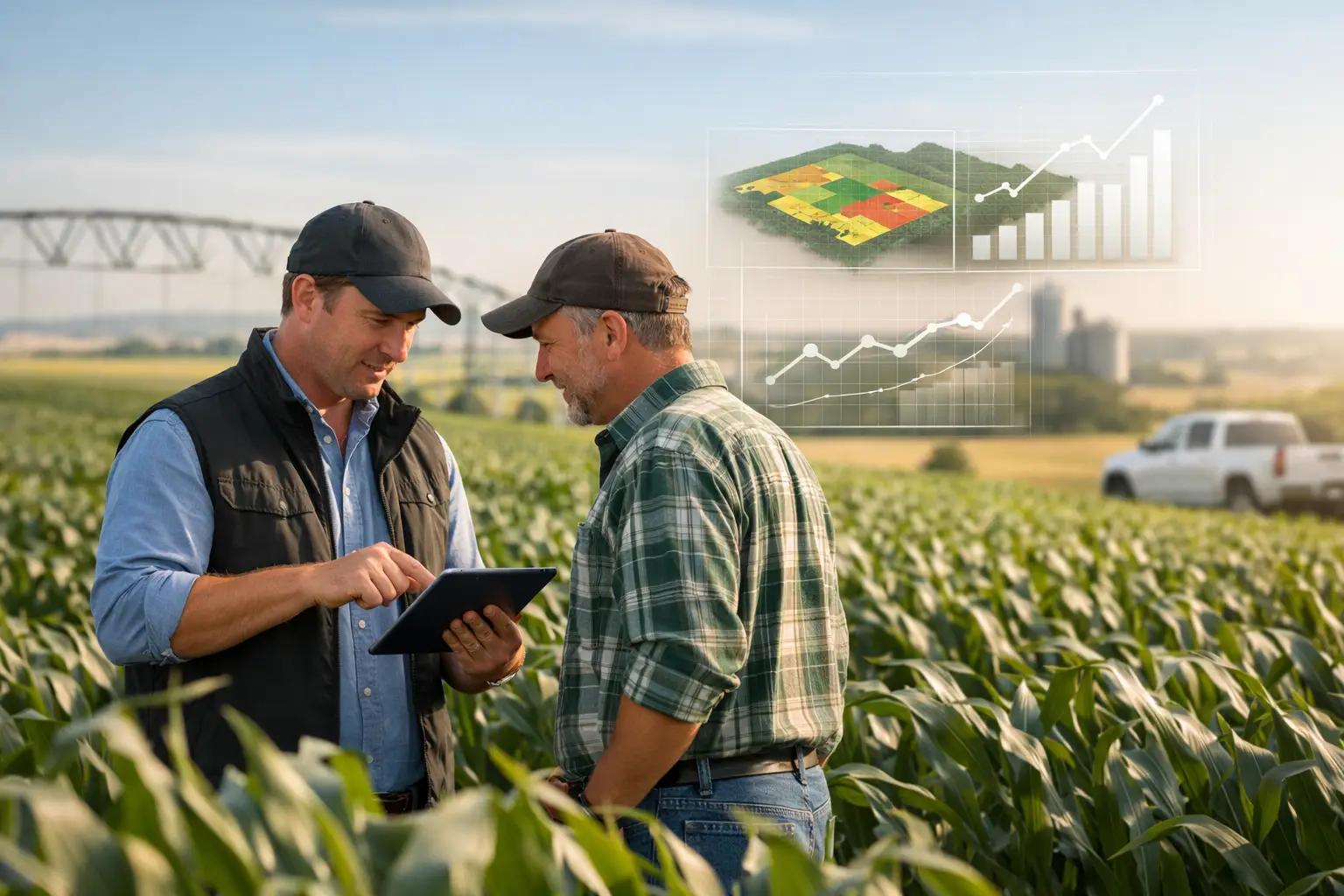
Ag consulting: when to hire an agricultural consultant
Ag consulting is outside agronomic support – someone brought in to help a farm, agribusiness, food company, or ag program make better crop production calls. It becomes worth considering the moment a problem stops being something you can explain with a quick theory over coffee.
Yield is 10-15% below what the block should be doing. Fertilizer spend keeps climbing and the crop response doesn’t track with it. Irrigation runs on the same schedule it ran three years ago because nobody’s confident enough in the data to change it. A disease shows up in the same weeks every season no matter what’s sprayed. In bigger operations it looks different – one region runs fertigation by feel, another runs it by spreadsheet, and nobody at the top can say which growers are actually following the program.
Almost none of this comes down to missing data. Most operations already have soil tests, water analysis, weather records, spray logs, fertilizer plans, and often satellite or sensor feeds sitting in a folder somewhere. What’s usually missing is someone who can look at all of it at once and say which piece is actually driving the problem.
That’s the job. Not more monitoring. A working diagnosis and a recommendation that survives contact with the field.
Not sure this applies to you? If the same production problem has shown up more than once this season, or you’re running decisions across more than one field or region and can’t say for certain everyone’s following the same logic, keep reading. If you already know you need help, go straight to our ag consulting services page.
What ag consulting usually covers
Fertilizer and fertigation planning, irrigation scheduling, soil and water interpretation, crop diagnostics, pest and disease timing, field scouting, digital monitoring, sustainability program support, and training for agronomic staff.
Scope depends on who’s asking. A single farm usually wants a poor-response problem diagnosed. An agribusiness with 40 growers wants a recommendation system that doesn’t fall apart the moment it leaves the office. A food company with a sustainability target on paper needs someone who can turn “reduce nitrogen 20%” into an actual field program that doesn’t tank yield.
None of these areas sit alone. A fertigation program is only as good as the irrigation system delivering it – distribution uniformity below 85% will wreck even a well-calculated nutrient plan. Irrigation timing depends on root depth, soil texture, and crop stage, not a fixed calendar. Disease pressure tracks canopy density, humidity, and field history as much as the spray schedule. Treat these as separate line items and you get a report that looks fine and doesn’t hold up in the field.
When ag consulting becomes necessary
Usually when the operation can no longer pin down what’s actually limiting performance – or the same problem keeps resurfacing no matter what changes.
A common one: a tissue test comes back low on potassium, so the answer looks obvious – apply more K. But if the soil test already shows adequate K, the real constraint might be salinity tying it up, root damage from compaction, poor irrigation uniformity, or an antagonistic magnesium level. Apply more fertilizer and you’ve spent money without touching the actual problem.
At the operation level it’s usually a decision-consistency issue, not a technical one. Fertilizer programs get copied from last year without checking whether last year’s conditions still apply. Irrigation runs on calendar intervals instead of crop demand. Spray decisions get triggered by habit instead of scouting data. The data might be there, but nobody’s built the discipline to actually use it to change a decision mid-season.
What a good ag consultant should actually do
Start with diagnosis, not a product recommendation. If someone shows up with a fixed program before they’ve looked at your soil, water, and crop stage together, that’s a sales call, not a consult.
A useful consultant reads soil tests, water analysis, tissue or sap results, irrigation records, scouting notes, and fertilizer history together – not as separate reports stapled to each other. A soil test showing adequate potassium doesn’t mean the crop is getting it: salinity, root damage, poor emitter uniformity, excess magnesium, low root-zone oxygen, or bad timing can all block uptake even when the number on the test looks fine. A satellite NDVI map will show you a stressed zone; it won’t tell you if that’s water stress, a nutrient problem, disease, drainage, or just inconsistent management between two crews. A fertilizer plan can be mathematically correct and still fail if the drip system can’t actually deliver it evenly.
The job is turning scattered data into one decision you can act on this week.
Ag consulting has to be crop-specific
Generic agronomy is where most consulting falls apart.
Almond nutrition doesn’t run on the same logic as processing tomatoes. Banana potassium management isn’t citrus potassium management – different uptake curves, different sensitivity to chloride, different root architecture. Onion, corn, and table grape have different rooting depths, different salinity tolerance, different irrigation timing windows, and different disease pressure entirely.
A tissue value that’s perfectly acceptable in one crop can be marginal in another. The same leaf symptom can mean deficiency in one crop and root damage or salinity stress in another. Broad best-practice guidance is a reasonable starting point for a new grower, but it’s not a substitute for a recommendation built around the actual crop, the actual field, and the actual production system.
Where ag consulting often fails
Generic advice is the most common failure – standard fertilizer rates and broad irrigation comments that ignore crop stage, water quality, soil behavior, and what the farm can realistically execute. It sounds reasonable in a meeting and breaks down the first week it’s applied.
Product-led advice is close behind – every diagnosis conveniently ends in a product recommendation. That’s a red flag, not a coincidence.
Data without interpretation is another one. A dashboard showing a stressed field doesn’t tell you why it’s stressed. Satellite imagery, sensors, and monitoring platforms are useful for deciding where to look – they don’t replace someone walking the field and connecting what they see to soil, water, and crop stage.
And execution gets ignored more than people admit. A recommendation that’s technically correct but can’t be applied on time, with the labor and equipment the farm actually has, isn’t a recommendation – it’s a wish.
If any of that sounds familiar, it’s usually not a knowledge gap on your team – it’s a structure problem. See how Cropaia’s ag consulting approaches diagnosis before recommendation.
Ag consulting for farms
For a single farm, ag consulting earns its keep when a decision is too consequential or too tangled to handle by routine – fertigation adjustment, irrigation scheduling, salinity management, pH correction, a persistent yield problem, or evaluating whether a new product or technology is actually worth the cost.
The questions that matter are practical: what should change this week, what’s actually worth measuring, what’s the most likely cause, what correction is realistic given the equipment and labor you have, and what changes next season based on what you learned this one. A good consultant leaves you with rates, timing, and monitoring points you can act on – not a report that reads well and sits in a drawer.
Ag consulting for agribusinesses and grower networks
For agribusinesses, the problem is rarely one field – it’s consistency across many. One agronomist interprets a field one way, another interprets the same symptoms differently. Some growers follow the recommendation closely, others run their own version. Data gets collected but never standardized enough to compare across regions, and management usually finds out about a problem after it’s already hit supply or quality.
Ag consulting here means building the structure that’s missing – crop-specific protocols, a shared recommendation framework, field monitoring that’s consistent between regions, training for the technical team, and reporting that actually reaches management before the problem does. The value isn’t fixing one field. It’s making sure the same problem doesn’t get diagnosed five different ways by five different agronomists.
Ag consulting for food companies and sustainability programs
Food and beverage companies run into this when a sustainability target written at the corporate level has to survive contact with an actual grower’s field.
Cutting fertilizer use sounds straightforward on a slide. It’s not automatically good agronomy – if the reduction isn’t grounded in crop demand, soil nutrient supply, and irrigation behavior, it costs yield or quality instead of just costing less. Cover crops, organic amendments, reduced tillage, and other regenerative practices only work if they fit the specific crop, soil, climate, equipment, and the grower’s actual capacity to execute them.
Ag consulting is what turns the corporate target into a field program the grower can actually run – and that both the company and the grower can trust the numbers on.
Digital tools in ag consulting
Software, satellite imagery, sensors, and dashboards support the work. They don’t replace it.
A dashboard flagging a stressed field tells you where to look, not why it’s stressed. Digital crop monitoring is genuinely useful for spotting patterns across a large number of fields – but you still need someone walking the field, checking irrigation performance, and connecting what they see to the agronomy. The question isn’t whether to use the tool. It’s whether the tool is actually changing what gets decided.
How to evaluate an ag consulting firm
Ignore the size of the claims and the polish of the deck. Pay attention to the questions they ask before they say anything.
A firm worth hiring wants to understand your crop, your production target, your irrigation system, your water quality, your soil limitations, your fertilizer history, your disease pattern, and how decisions currently get made – before offering an opinion. They should be upfront about what they don’t know yet and what needs to be checked before a recommendation is safe to act on. Agriculture has too many variables for anyone to claim certainty on day one.
Watch for independence. If every recommendation traces back to a product they also sell, the diagnosis is compromised before it starts.
Before hiring: do they understand your specific crop and system, not agronomy in general? Can they read soil, water, and tissue data together instead of one at a time? Do they understand fertigation, not just fertilizer rates? Will they help implement, not just hand you a PDF? Can they train your team so you’re not dependent on them forever? Does their approach hold up across multiple farms or regions if you need that? And how will you both know if it worked?
When ag consulting is worth the cost
It’s worth paying for when the cost of another season of the same guesswork is higher than the cost of getting it diagnosed properly. That’s usually true when a problem keeps repeating, fertilizer response has gone inconsistent, irrigation decisions feel like guesswork, or a growing operation has outgrown its own internal decision process.
At scale, small inconsistencies compound. One wrong recommendation is a bad week. A hundred fields making slightly different decisions off the same data is a structural cost that shows up every season until someone fixes the system, not just the symptom.
If that’s where you are right now, it’s worth a conversation before another season runs on the same pattern. See how Cropaia’s ag consulting works →
Training is part of serious ag consulting
If the knowledge stays with the consultant, the client stays dependent – and that’s not a sustainable arrangement for either side.
This is why training is usually part of doing this properly: how to read soil and tissue results together, how to adjust a fertilizer program by crop stage instead of by calendar, how to troubleshoot an irrigation system instead of just re-running the same schedule, how to avoid overreading a satellite map, and how to keep recommendations consistent when more than one agronomist is making them. For larger organizations, this is also what gets management, sustainability teams, procurement, and field staff working off the same picture instead of five different ones.
Ag consulting should improve decisions, not produce more reports
The point isn’t more documentation. It’s a better decision, made faster, by the person who actually has to act on it.
That comes down to six questions, asked in order: what’s happening in the field, why is it happening, what needs to change, who’s responsible for making that change, when does it need to happen, and how will you know it worked. Answer those honestly and you’re managing the crop. Skip past them into a spreadsheet of observations and you’re just collecting information.
FAQ about ag consulting
What is ag consulting?
Professional agronomic support brought in to help farms and agricultural organizations make better decisions on crop production, irrigation, fertilization, pest management, and soil and water issues – and to help those decisions actually get executed in the field.
When should a farm hire an agricultural consultant?
When the same production problem keeps coming back, yield or quality sits below what the field should be doing, fertilizer or irrigation decisions feel uncertain, or you’ve got the data but it’s not translating into a clear next step.
Is ag consulting the same as crop consulting?
Crop consulting is usually field-level support for one crop or a narrow group of crops. Ag consulting is broader – it can include crop consulting alongside irrigation and fertilization strategy, training, sustainability program support, and building decision systems across a farm, agribusiness, or grower network.
What should an ag consulting firm provide?
A crop-specific diagnosis, a recommendation you can actually implement, clear priorities on what to do first, and a way to check whether it worked. If it’s generic or every answer leads back to a product, that’s not a diagnosis.
Cropaia ag consulting
Cropaia provides ag consulting and agronomic training for farms, agribusinesses, food companies, and agricultural programs that need practical support in irrigation, fertilization, crop diagnostics, soil and water interpretation, and field-level decision making.
The work is built on crop-specific agronomy and what can actually be executed in the field – not generic advice.
If you need structured agronomic support for a farm, crop program, grower network, or agricultural project, visit our ag consulting services page to see how Cropaia works with clients – and whether it’s the right fit for what you’re dealing with right now.










About Post Author
