

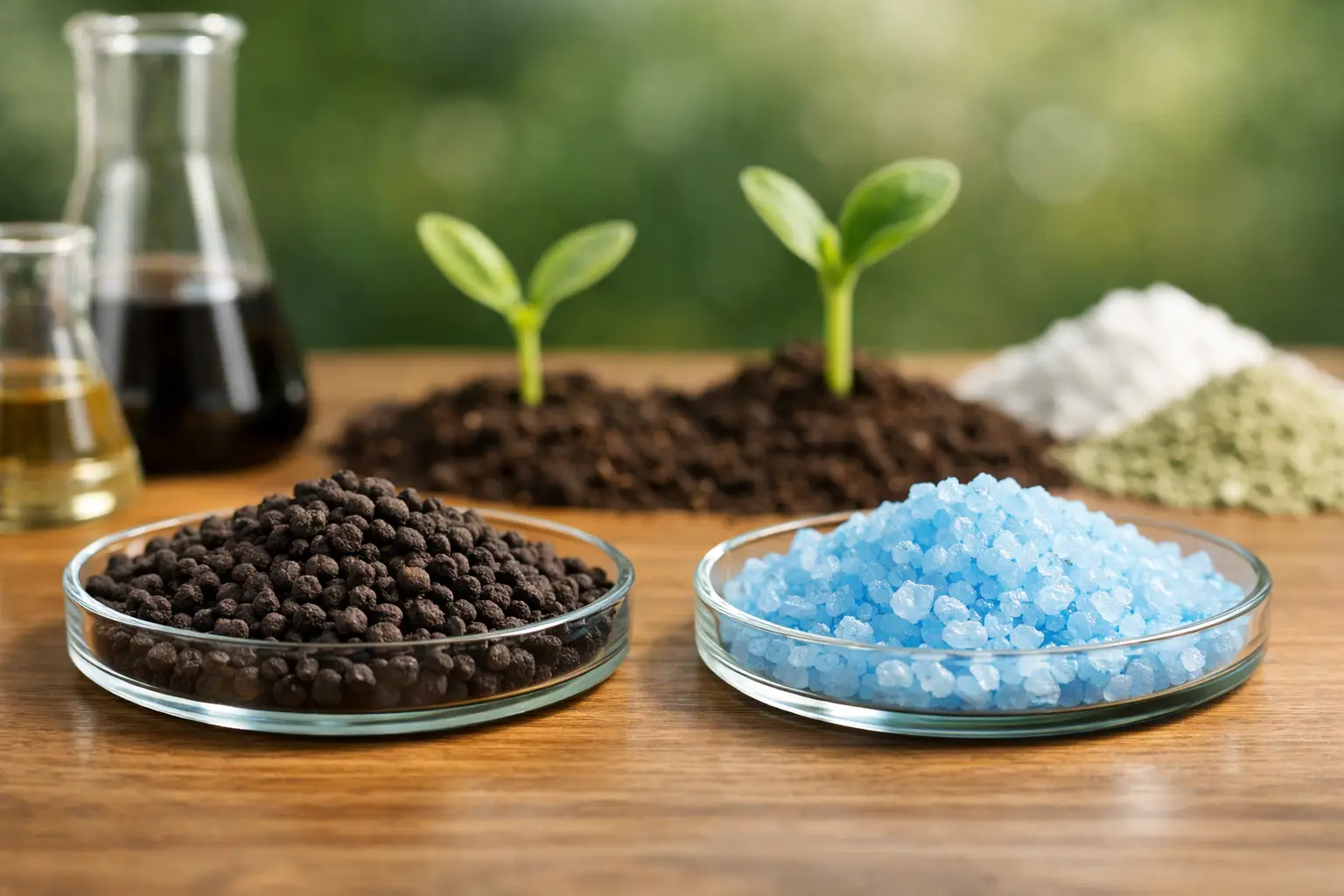
Chelated vs sulfate micronutrients: when each works
A zinc application that performs well in one field can fail in the next block for reasons that have little to do with the product label. pH, bicarbonates, placement, crop stage, and the speed of correction all shape the result. That is why the question of chelated versus sulfate micronutrients matters in commercial agriculture – not as a chemistry exercise, but as a field decision tied to response, efficiency, and cost.
For agronomists and farm managers, the real issue is not which form is universally better. It is which form fits the crop, the deficiency risk, the application method, and the operating conditions. Chelates and sulfates both have a place in serious fertility programs, but they do not behave the same way in the soil, in the tank, or on the leaf.
Chelated versus sulfate micronutrients in practice
Sulfate micronutrients are mineral salts. Common examples include zinc sulfate, manganese sulfate, copper sulfate, and ferrous sulfate. They are widely used because they are familiar, cost-effective per unit of nutrient, and often suitable for broad-acre and pre-plant programs. Once dissolved, they release the metal ion into solution, where it can be taken up by the crop or tied up by the soil chemistry.
Chelated micronutrients package the metal ion with an organic ligand that helps keep it soluble and protected from rapid precipitation or fixation. Common chelating agents include EDTA, DTPA, and EDDHA, each with different stability ranges. In practical terms, chelation can improve micronutrient availability in conditions where sulfate forms lose efficiency quickly, especially in alkaline soils or irrigation water with high bicarbonates.
That difference is the center of the comparison. Sulfates are usually less expensive upfront. Chelates often deliver more predictable availability under difficult conditions, but at a higher product cost. The right choice depends on how expensive a poor response would be.
Why nutrient percentage does not predict crop response
A fertilizer analysis tells you how much nutrient is in the bag or jug. It does not tell you how much of that nutrient remains available long enough to be absorbed. This is where many micronutrient programs underperform.
In acidic to neutral soils, sulfate forms can be very effective, particularly when the nutrient is incorporated and soil reactions are favorable. Zinc sulfate and manganese sulfate, for example, can fit well in corrective soil applications when pH is not excessively high and when enough moisture is present to support movement and uptake.
In calcareous or high-pH soils, the same sulfate source may react rapidly and become less available. Iron is the clearest example. Applying iron sulfate to a high-pH soil often produces disappointing results because iron quickly precipitates. In that setting, a stable iron chelate such as EDDHA is often far more reliable, even though the cost per pound of iron is much higher.
This is why source selection should start with field conditions, not habit. If the soil or water environment aggressively ties up free metal ions, the lower-cost sulfate product may not be the lower-cost decision after all.
Iron sources: practical pH suitability
| Source | Best practical pH range | High-pH suitability | Main comment |
|---|---|---|---|
| FeSO₄ Iron sulfate |
pH 5.0-6.5 | Poor above pH 7.0 | Often unreliable in calcareous or alkaline soils because iron precipitates quickly. |
| Fe-EDTA | pH 4.0-6.5 | Weak above pH 6.5-7.0 | Useful under acidic to mildly neutral conditions, but not reliable for alkaline soils. |
| Fe-DTPA | pH 4.0-7.5 | Moderate up to mildly alkaline soil | More stable than Fe-EDTA, but less reliable than Fe-EDDHA in calcareous soils. |
| Fe-EDDHA | pH 4.0-9.0 | Strong | Usually the most reliable iron source for high-pH and calcareous soils. |
Other micronutrient sources: practical pH suitability
| Source | Best practical pH range | High-pH suitability | Main comment |
|---|---|---|---|
| ZnSO₄ Zinc sulfate |
pH 5.0-7.0 | Fair to weak above pH 7.5 | Can work well in favorable soils, especially as a lower-cost corrective source. |
| Zn-EDTA | pH 4.0-7.5 | Moderate | Often useful for foliar spray and fertigation where cleaner availability is needed. |
| MnSO₄ Manganese sulfate |
pH 5.0-6.5 | Weak above pH 7.0-7.5 | Manganese availability declines quickly as pH rises. |
| Mn-EDTA | pH 4.0-7.5 | Moderate | Usually more reliable than sulfate when pH is less favorable or foliar consistency matters. |
| CuSO₄ Copper sulfate |
pH 5.0-7.0 | Fair to weak above pH 7.5 | Useful, but copper requires care because excess copper can become toxic. |
| Cu-EDTA | pH 4.0-7.5 | Moderate | Often selected where low-rate correction and compatibility are important. |
Practical note: Unlike iron, most chelated zinc, manganese, and copper products improve handling and availability, but they are not equivalent to Fe-EDDHA in high-pH soil correction.
Not all chelates behave the same
The chelating agent matters. Fe-EDTA, Fe-DTPA, and Fe-EDDHA should not be treated as interchangeable iron sources. Fe-EDTA is suitable mainly for acidic to mildly neutral conditions. Fe-DTPA extends usefulness into mildly alkaline conditions. Fe-EDDHA is usually the preferred soil-applied iron chelate for alkaline and calcareous soils.
pH and bicarbonates change the economics
High pH alone creates challenges, but bicarbonates often make the situation worse. In fertigated systems, irrigation water chemistry can reduce the effectiveness of sulfate micronutrients before they ever reach the root zone in a usable form. In foliar programs, hard water can also interfere with spray performance.
Chelates are not identical here. EDTA works well in mildly acidic to neutral conditions, but its stability drops as pH rises. DTPA performs better over a wider pH range. EDDHA is typically the strongest option for iron in alkaline soils. Treating all chelates as interchangeable is a mistake. The chelating agent matters as much as the metal.
When sulfate micronutrients are the better decision
It would be a mistake to frame chelates as the premium answer and sulfates as outdated. In many programs, sulfates remain the practical standard.
For soil-applied correction in suitable pH ranges, sulfate sources can provide efficient nutrition at scale. They often fit well in dry blends, pre-plant incorporation, or lower-cost maintenance strategies where the goal is to build or replenish availability rather than rescue a rapidly developing deficiency. They can also contribute sulfur, which may be agronomically useful depending on the crop and site.
Sulfates also make sense when tissue testing, soil testing, and field history show a moderate need rather than a severe or chronic deficiency problem. If the environment is favorable and timing is planned well, the return on investment can be strong.
The limitation is predictability under stress conditions. As pH rises, as carbonate levels increase, or as application is delayed into a period when a quick correction is needed, sulfates become less dependable.
When chelated micronutrients are worth the extra cost
Chelated micronutrients are most justified when the cost of poor availability is higher than the cost of the product. This is common in high-value crops, fertigated systems, high-pH soils, bicarbonate-affected irrigation water, and situations where the crop already shows deficiency symptoms.
They are also useful when the application window is narrow. A foliar correction during a sensitive growth stage, a fertigated treatment in alkaline water, or an iron correction in calcareous soil does not leave much room for an inconsistent response. In those cases, the chelate is not being used because it is “premium.” It is being used because the risk of failure is higher.
Foliar application changes the comparison
When micronutrients are applied foliarly, the soil fixation issue is reduced, but other factors become more important. Solubility, compatibility, burn risk, leaf penetration, and speed of correction all matter.
Sulfate products can work well as foliar sprays in some programs, especially for zinc and manganese, but they are generally more constrained by formulation quality, water condition, and crop sensitivity. Poorly managed sulfate foliar applications can increase the risk of leaf injury or leave inconsistent uptake.
Chelated foliar products are often chosen for cleaner tank mixing and more consistent delivery, particularly in high-value crops where the margin for error is small. That does not mean they always outperform sulfates. In some cases, a simple sulfate foliar spray is fully adequate and more economical. But if the application is being used to correct an active deficiency during a narrow growth window, chelation often improves reliability.
For farm managers, the question should be operational. Is this a routine support spray, or a time-sensitive correction where an inconsistent response has real yield or quality consequences?
Crop value and deficiency sensitivity should guide the decision
The same micronutrient strategy does not fit processing tomatoes, corn, almonds, potatoes, and citrus equally well. Crop value, root environment, fertigation infrastructure, and quality targets all shift the decision.
High-value irrigated crops often justify chelated products more easily because the cost of poor micronutrient availability is higher. Fruit set, finish, size uniformity, or visual quality can be affected by small nutritional failures. In these systems, the added cost of a chelate may be minor compared with the cost of uneven crop performance.
In broad-acre systems, sulfate sources may be more economically appropriate, particularly where deficiency risk is known, manageable, and responsive to soil application. The goal is not to overspend on form when timing, placement, and rate would solve most of the problem.
This is where professional agronomic planning matters. Source selection should connect to tissue testing, water analysis, soil chemistry, crop stage, and application logistics. Cropaia’s consulting and training approach is built around that kind of decision discipline rather than generic product preference.
How to choose between chelated and sulfate micronutrients
A useful way to evaluate chelated versus sulfate micronutrients is to ask four practical questions. First, how hostile is the soil or water chemistry to free metal ions? Second, how quickly does the crop need a response? Third, what is the economic consequence of an incomplete correction? Fourth, which application method is realistic on this farm?
If pH is high, bicarbonates are elevated, and the crop is already showing deficiency symptoms, chelates usually deserve serious consideration. If soil conditions are more favorable, the application is preventive, and budgets are tight across large acreage, sulfates may be the sounder choice.
The same logic applies to blends and staged programs. Some operations use sulfate forms for base fertility and reserve chelates for fertigation, foliar rescue, or the most sensitive growth stages. That hybrid strategy often reflects good agronomy because it aligns product cost with actual risk.
Common mistakes in source selection
One common mistake is comparing products only by nutrient concentration or cost per ton. A cheaper source that underperforms in a high-pH field is not cheaper in practice. Another is selecting a chelate without checking whether the chelating agent fits the field conditions. A third is using foliar micronutrients as a substitute for diagnosing the underlying cause of deficiency, which may be root restriction, irrigation management, or antagonism from other nutrients.
Micronutrient programs fail when product choice is separated from system management. The source matters, but so do placement, water quality, timing, and crop demand.
Chelates and sulfates are both useful tools. The better question is not which category wins, but where each one earns its place. When micronutrient decisions are tied to field chemistry and production goals, the program becomes more efficient and the crop response becomes easier to predict.












About Post Author
