

How to Improve Crop Performance at Scale
A field can test well, receive adequate fertilizer, and still miss its yield target by a wide margin. In most commercial operations, the gap is rarely caused by one major mistake. It is usually the result of small agronomic inefficiencies stacking up across irrigation timing, nutrient placement, pest response, field variability, and execution discipline. That is why understanding how to improve crop performance requires more than a higher input budget. It requires a tighter production system.
For agronomists, farm managers, and agribusiness teams, crop performance should be treated as a measurable outcome of decisions made before planting, during the season, and after harvest. Better results come from aligning crop requirements with soil conditions, water availability, climate pressure, labor capacity, and field-level variability. The challenge is not only choosing the right practices. It is choosing the right practices for each crop, in each field, under real operating constraints.
How to improve crop performance starts with diagnosis
The quickest way to waste money is to prescribe solutions before defining the problem. Poor crop performance may look similar from the road, but the causes can differ sharply. One field may be limited by root-zone oxygen stress from overirrigation. Another may be losing yield from potassium deficiency during peak demand. A third may be dealing with nematode pressure that has gone undetected for two seasons.
A proper diagnosis combines field observation with data that has decision value. Soil analysis, water quality testing, tissue or sap analysis, stand counts, pest scouting, compaction checks, and irrigation system evaluations all have a place. The key is to avoid collecting data with no action path behind it.
This is also where trade-offs matter. Tissue analysis can help confirm nutrient uptake status, but it often reflects what has already happened. Sap analysis can provide more immediate insight into current plant status, which can be useful for in-season adjustments, but sampling protocols and interpretation need to be disciplined. Neither method is universally better. The right choice depends on crop stage, mobility of the nutrient, and how quickly the operation can respond.
Build crop-specific programs, not generic plans
Commercial agriculture loses performance when recommendations are too broad. Corn, almonds, tomatoes, citrus, potatoes, and grapes do not respond to the same nutrient timing, irrigation strategy, or disease prevention approach. Even within the same crop, variety, rootstock, planting date, and target market can change the optimal program.
A crop-specific plan should define four things clearly: the yield target, the growth stages that drive risk, the likely limiting factors in the region, and the operational thresholds that trigger action. That means the fertilization program is tied to uptake curves, not calendar habit. The irrigation plan is tied to crop demand and soil-water dynamics, not fixed scheduling. The pest and disease program is tied to monitoring and pressure windows, not routine spraying without field justification.
Generic recommendations often survive because they are easy to communicate. They do not survive close economic analysis. When input costs, water constraints, and quality requirements are increasing, broad advice becomes expensive.
Improve irrigation performance before adding more water
In many operations, irrigation is the single biggest lever for improving crop performance. It is also one of the most commonly mismanaged. Underirrigation reduces growth, limits nutrient uptake, and lowers yield. Overirrigation can reduce oxygen in the root zone, increase disease pressure, leach nitrogen, and waste energy.
The right irrigation strategy depends on crop type, rooting depth, soil texture, system uniformity, and water quality. Drip irrigation offers tighter control over water placement and fertigation, which makes it highly effective in many high-value crops. Sprinkler systems may provide broader coverage and frost or cooling functions, but they typically offer less precision and can increase foliar disease risk in some situations. The question is not which system is best in general. The question is which system supports agronomic goals and operational reality in a specific production setting.
Scheduling also matters more than many teams admit. Soil sensors can improve visibility into root-zone conditions, but only if sensor placement is representative and thresholds are interpreted correctly. Weather-based irrigation scheduling can be useful at scale and may be easier to standardize across regions, but it can miss local soil variability and irrigation system issues. The strongest programs often combine both approaches with field verification.
Nutrition programs should match demand, source, and placement
A strong fertility program is not just about supplying enough nutrients. It is about synchronizing nutrient availability with crop demand while minimizing antagonism, losses, and unnecessary cost.
Nitrogen gets the most attention, but crop performance frequently suffers from imbalance rather than outright shortage. Potassium, calcium, magnesium, sulfur, and micronutrients can all become limiting depending on crop, soil conditions, irrigation water, and yield level. In some systems, chloride sensitivity also matters. That is one reason potassium sulfate and potassium chloride should not be treated as interchangeable. Potassium chloride may be a lower-cost source per unit of potassium, but chloride load can create problems in chloride-sensitive crops or saline conditions. Potassium sulfate can be the better fit where sulfur is also needed or where salt management is a concern.
Placement and timing are just as important as product choice. Broadcasting may suit some base applications. Fertigation allows more precise in-season delivery, but only where irrigation uniformity and management discipline are strong enough to support it. Foliar feeding can correct certain deficiencies quickly, but it cannot replace a fundamentally weak root-zone nutrition strategy.
Protect yield with proactive pest and disease programs
Waiting for visible damage is often waiting too long. Pest and disease pressure reduces crop performance not only through direct injury, but through stress accumulation, canopy loss, lower photosynthetic capacity, and quality defects that reduce marketable output.
The strongest programs are preventive in design but selective in action. That means understanding crop-specific risk periods, scouting consistently, and using thresholds where appropriate. Blanket applications may feel safer, yet they can drive resistance, inflate costs, and distract attention from the real problem.
Disease management is especially sensitive to timing. A fungicide applied after infection is established may still slow progression, but it rarely recovers lost potential. The same principle applies to insect management in crops where early feeding affects stand establishment or fruit set. Better performance comes from integrating field history, weather conditions, variety susceptibility, and scouting data into a practical response plan.
Use precision tools carefully
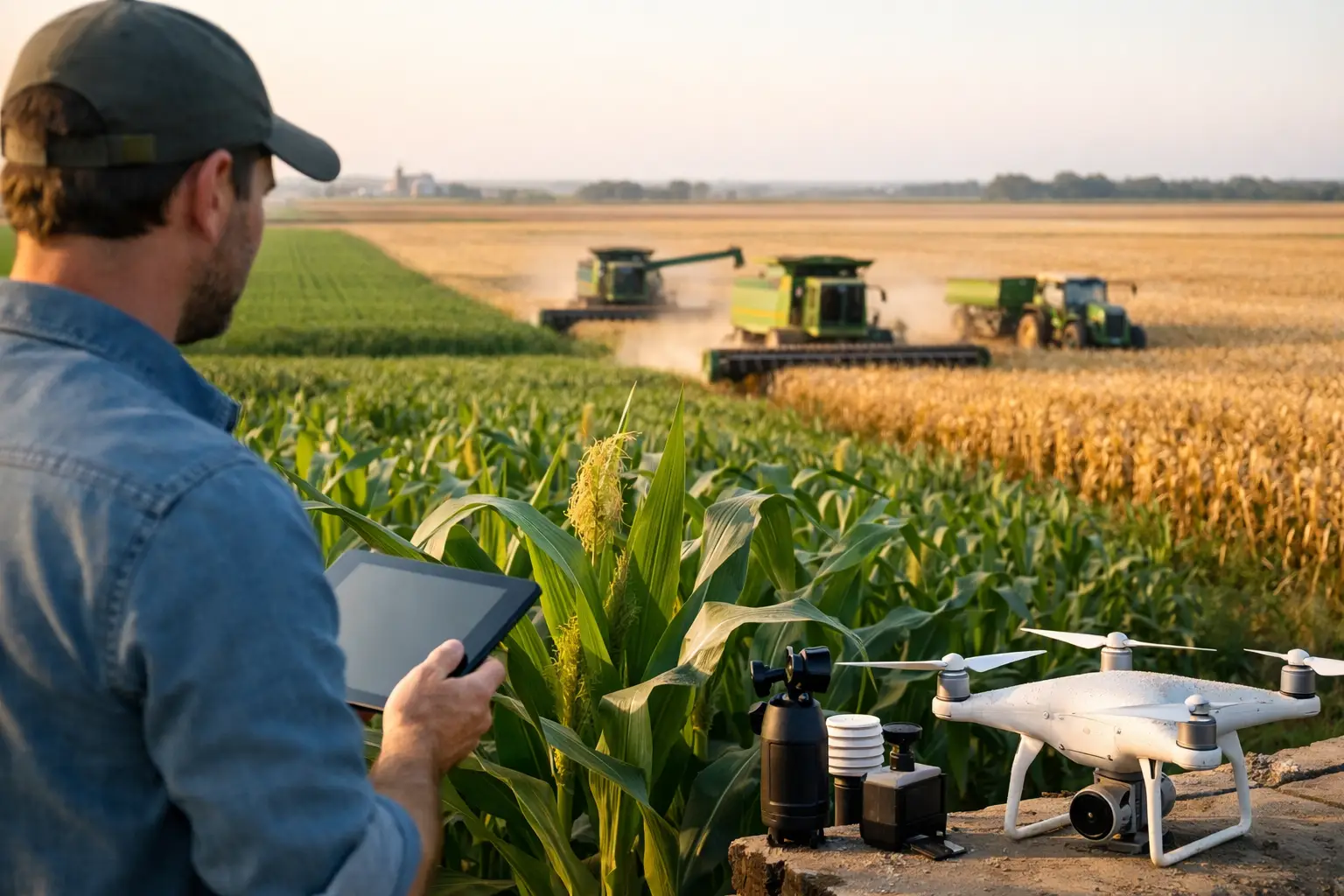
Digital agriculture can improve crop performance, but only when it improves decisions. Satellite imagery, drone mapping, soil nutrient maps, variable-rate application, and farm management software all have value. None of them fixes weak agronomy.
A common mistake is assuming more data means better management. In reality, poor interpretation can create false confidence. NDVI and EVI, for example, can both help monitor crop vigor, but they behave differently under dense canopy conditions. NDVI is widely used and useful for many applications, yet it can saturate in high biomass crops. EVI may provide better sensitivity in dense vegetation, but it also requires a more careful understanding of how the index is generated and used. The tool should match the agronomic question.
The same caution applies to remote sensing in general. Satellite imagery offers scale, consistency, and historical comparison. Drone imagery offers higher resolution and flexibility for targeted assessment. Satellite may be the better fit for broad monitoring across large acreage. Drone may be the better fit for diagnosing localized variability, drainage issues, or stand problems. Good systems use each where it adds value instead of forcing one tool into every job.
Execution discipline is where gains are won or lost
Most yield improvement plans sound strong in meetings. The difference in the field comes down to execution. Was fertilizer applied at the intended rate and timing? Did irrigation run with acceptable uniformity? Were pest thresholds checked on time? Was the recommendation adapted after weather changed? Did field teams document what actually happened?
This is where consulting, training, and management systems matter. Agronomy knowledge alone is not enough if recommendations do not translate into repeatable field action. Large operations especially benefit from clear protocols, accountable scouting systems, and staff training that builds consistency across locations and teams. Unbiased agronomic support helps here because it keeps the focus on measurable performance rather than product-driven decisions.
For organizations managing multiple farms, growers, or regions, standardization and local adaptation have to coexist. A central framework is essential for quality control, but field-level flexibility is equally important. The best programs define non-negotiable standards while leaving room for local agronomic judgment.
How to improve crop performance over multiple seasons
Short-term gains matter, but durable performance comes from managing the production system over time. Soil structure, salinity, residue handling, crop rotation, water quality, and disease carryover all shape next season before the next season begins.
That is why soil health and regenerative practices should be evaluated through agronomic function, not branding language. No-tillage can improve structure and reduce erosion in some systems, but it can also create establishment challenges or pest shifts in others. Cover crops can improve infiltration, nutrient cycling, and trafficability, but they also require management of water use, termination timing, and compatibility with the cash crop. These are not automatic wins. They are management choices with conditions for success.
For many enterprises, the next step is not another product trial. It is a stronger decision framework. That may mean tighter crop-specific protocols, better irrigation verification, more disciplined nutrient diagnostics, targeted training for field teams, or outside agronomic review to identify where performance is leaking away. Cropaia’s approach is built around that principle: measurable improvement comes from better decisions, executed well, at field level.
The most valuable question is rarely, what should we add? It is usually, what is currently limiting performance, and how precisely are we addressing it? Answer that honestly, and yield improvement becomes much more practical.











About Post Author
