

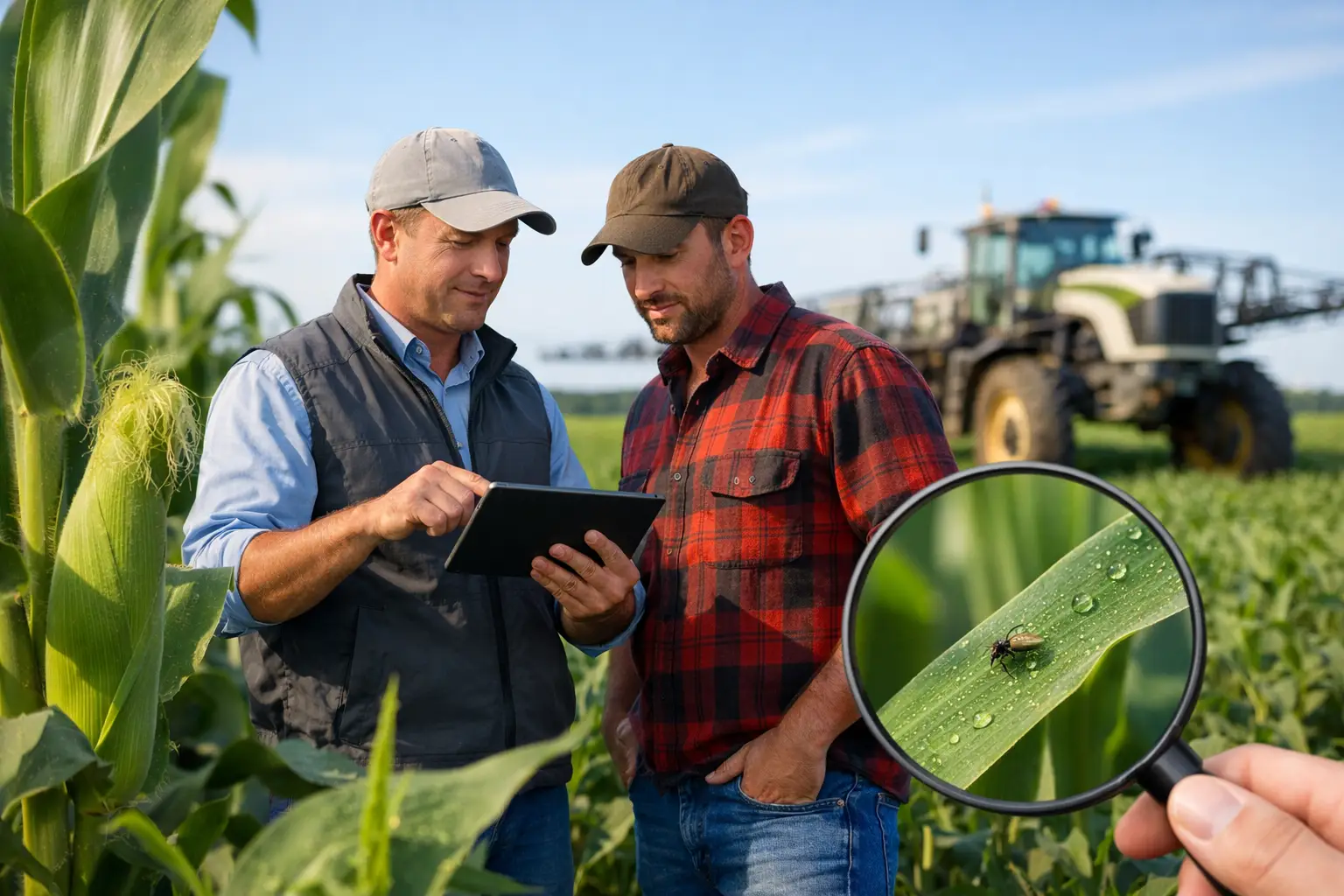
Crop Protection Consulting: Beyond Pesticides
Most crop protection failures do not come from a lack of pesticide options. They happen in the execution gap between field observation, pest identification, treatment timing, spray application, and follow-up evaluation.
A fungicide application may look justified on Monday morning and become unnecessary by Thursday afternoon if weather conditions shift. An insect threshold that worked last season may become unreliable under a different planting window, cultivar, irrigation schedule, canopy structure, or market residue requirement.
Commercial farms therefore need more than pesticide advice. Crop protection consulting should function as a decision system that connects pest and disease biology, crop stage, field variability, weather, irrigation, nutrition, spray execution, economics, and compliance.
When teams rely on static templates, copy-paste regional advice, calendar sprays, or reactive scouting, they do not truly manage risk. They absorb unnecessary cost, increase resistance pressure, and leave too much field performance to chance.
The mechanics of the execution gap
Crop protection recommendations often fail because the operation does not connect the recommendation to field execution:
- The team acts too late, or scouts collect incomplete field data.
- The agronomist identifies the pest correctly, but ignores the crop stage.
- The selected product fits the target, but the spray does not reach the lower canopy.
- The disease risk model gives useful guidance, but the farm lacks the labor or spray capacity to act within the narrow biological window.
In commercial agriculture, the recommendation is only one part of the result. The decision must pass through scouting, interpretation, approval, procurement, mixing, spraying, documentation, and follow-up evaluation. If one step fails, the biological recommendation may not translate into field performance.
Crop protection must therefore be managed as an execution system, not only as a pesticide recommendation. The key issue is not only product efficacy. The real question is whether the operation can detect the problem early, decide correctly, act on time, apply properly, document the action, and learn from the result.
Product advice vs. agronomic consulting
Product advice and crop protection consulting are not the same. In most cases, product recommendations focus on available products, standard regional programs, label rates, or broad seasonal calendars. That information can be useful, but it does not replace an independent field decision.
Crop protection consulting should be analytical, crop-specific, and accountable to field performance. A consultant should not only ask which pest or disease is present. A better question is why the problem is developing now, in this field, under these specific crop and management conditions.
The practical shift:
Instead of asking only, “What can I spray?” the better question is: “How do crop stage, cultivar susceptibility, canopy density, irrigation timing, nitrogen status, weather, scouting data, and spray coverage affect the risk and the treatment decision?”
This shift changes the recommendation completely. Sometimes the right decision is a pesticide application. In other cases, the better answer is a delayed spray, a different mode-of-action rotation, a nozzle or water-volume adjustment, improved sanitation, a change in irrigation timing, or a decision to skip a scheduled pass entirely.
For large-scale operations, this objectivity matters. It helps reduce unnecessary applications, protect pesticide efficacy, improve compliance, and prevent crop protection programs from becoming automatic input programs.
The crop protection decision chain
A professional crop protection decision should move through a clear chain: detection, diagnosis, risk assessment, treatment decision, application quality, and follow-up evaluation. If one link is weak, the final result becomes unreliable.
Detection → Diagnosis → Risk assessment → Treatment decision → Application quality → Evaluation
Detection and diagnosis
Good detection starts with disciplined scouting. When scouts miss early symptoms, pest hotspots, or lower-canopy infection, the decision begins with weak information.
Diagnosis determines whether the problem truly comes from a pest or disease. Nutrient deficiency, salinity, water stress, herbicide injury, poor drainage, or root problems can easily look like crop protection issues.
Risk assessment and life-cycle realities
Risk assessment connects the field observation to crop stage, weather, cultivar susceptibility, economic threshold, market tolerance, and expected damage. The treatment decision then evaluates whether intervention is justified and, if so, which product, rate logic, timing, rotation, and application method fit the situation.
A good treatment decision must also consider the pest life cycle. For some pests, one application against the visible stage is not enough.
The whitefly example:
Whitefly is a clear example. Treating only the visible adults may reduce the immediate flying population, but eggs and immature stages may continue the infestation. A stronger program considers the dominant life stages in the field, the residual activity of the product, the target stage of each active ingredient, and the need for a follow-up treatment at the right biological interval.
Many crop protection programs fail at this point. They treat what is visible today, but fail to plan against the next biological wave. The result is repeated spraying, weak control, higher cost, and stronger selection pressure for resistance.
Application quality and evaluation
Application quality determines whether the recommendation reaches the target. Water volume, droplet size, canopy penetration, sprayer calibration, agitation, coverage, and weather at spraying often decide whether a technically correct recommendation succeeds or fails.
Follow-up evaluation closes the loop. Without checking the field after treatment, the team cannot know whether the application worked, whether resistance is developing, whether coverage was adequate, or whether the same issue is likely to repeat.
One of the most valuable decisions is when not to spray
In crop protection, the most profitable recommendation is not always an application. Sometimes the correct decision is to wait, scout again, change the monitoring frequency, adjust irrigation timing, improve sanitation, remove an unnecessary tank-mix component, or avoid spraying under conditions that increase crop injury risk.
This is especially important in high-value crops and export-oriented production systems, where unnecessary applications increase cost, residue risk, resistance pressure, and operational complexity.
- A scheduled fungicide application may be difficult to justify if the weather has shifted away from disease-conducive conditions.
- An insecticide may be unnecessary if pest pressure remains below a meaningful threshold and natural enemies are active.
- A foliar spray may be physically possible but agronomically poor if heat stress, leaf sensitivity, or harvest timing increases the risk.
Effective consulting does not simply add treatments. It builds programs around the biology of the crop, the biology of the threat, and the operational reality of the farm. This means integrating residue restrictions, re-entry intervals, pre-harvest intervals, and application capacity directly into the action logic.
Why data alone does not improve crop protection
Digital tools can improve crop protection, but they do not replace agronomic judgment. Many digital crop protection programs do not fail because they lack data. They fail because the team does not convert data into disciplined field action.
Satellite imagery can identify unusual patterns in crop performance, but it cannot diagnose a disease by itself. A vegetation index anomaly may indicate stress, but the cause may be waterlogging, salinity, compaction, pest damage, nutrient deficiency, disease, or irrigation malfunction.
Weather models can estimate infection risk based on temperature, humidity, rainfall, and leaf wetness, but they cannot confirm actual disease severity in the field. Local interpretation still matters because canopy density, irrigation method, row orientation, and field topography create microclimates that differ from the nearest weather station.
Trap counts and sensors improve situational awareness, but they still require crop-stage context, threshold logic, and local validation. A trap count is not automatically a treatment decision. It is a signal that the agronomist must interpret.
Technology produces signals. Agronomy turns those signals into decisions. Field execution turns those decisions into results.
Training over dependence: managing the trade-offs
No crop protection program is perfect. Agronomists and farm managers always manage trade-offs between cost, risk tolerance, labor availability, residue restrictions, resistance management, market expectations, and biological uncertainty.
A preventive fungicide approach may reduce risk in high-value crops, but it can also increase costs and resistance pressure if the team cannot justify it agronomically. A stricter threshold for insect treatment may lower input use, but it may also expose the operation to yield or quality loss in fast-moving infestations. More intensive scouting improves detection, but it requires trained labor and disciplined reporting.
Consulting should not pretend to eliminate trade-offs. It should make them visible and manageable.
Many recurring crop protection failures are fundamentally execution and education failures. Scouts miss early symptoms because they do not fully understand disease development. Spray teams compromise coverage because they do not understand droplet dynamics, canopy penetration, and target location. Managers rely on calendar schedules because they apply thresholds inconsistently.
The best crop protection programs do not create permanent dependence on outside advice. They improve the farm’s internal decision capability. When the field team understands not just what to do, but the agronomic logic behind the action, the operation becomes more predictable, compliant, and defensible.
From better recommendations to better field decisions
Through Cropaia, we help commercial growers, agribusinesses, and agronomists bridge the gap between agronomic theory and field reality. The goal is not only to know which product can control a pest or disease, but to understand how to diagnose the problem, assess risk, time the intervention, protect pesticide efficacy, and evaluate the result.
Improve pest and disease decisions in the field
Cropaia’s practical Pest and Disease Management Course helps agronomists, farm managers, scouts, and technical teams strengthen pest identification, scouting logic, spray timing, resistance management, and control strategy.









About Post Author
