

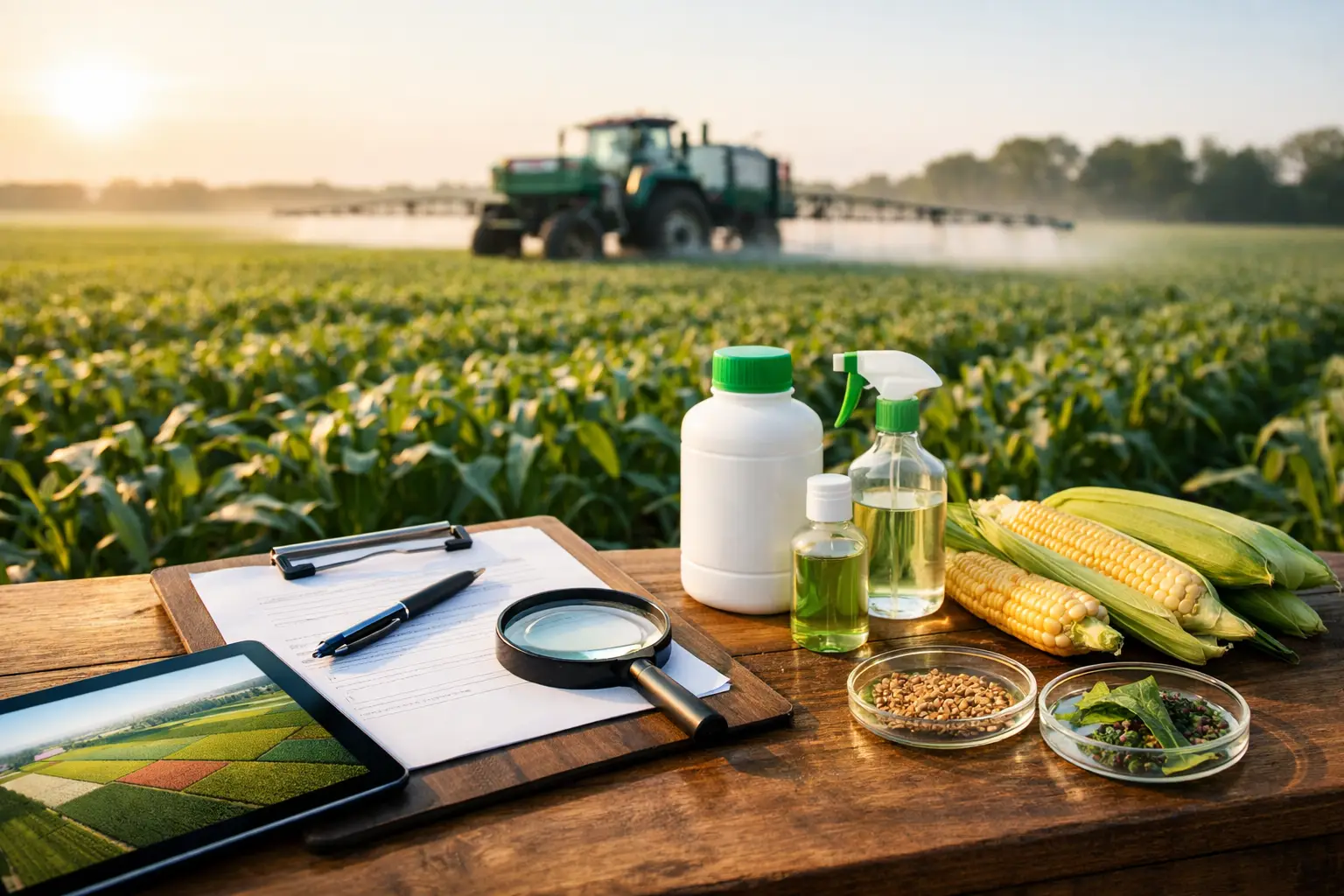
Crop Protection Program Guide for Farms
Designing a Crop Protection Program: From Spray Calendars to Execution Systems
A fungicide applied seven days too late, a herbicide selected without reviewing local resistance history, or an insecticide triggered by routine rather than economic thresholds can turn a profitable season into a loss-making one.
In commercial agriculture, crop protection is no longer a matter of choosing products. It is a continuous decision system that links agronomy, monitoring, timing, economics, and field execution under real operational constraints.
The core problem is simple: most crop protection failures do not come from wrong chemistry. They come from disconnected decisions across time, teams, and field realities.
The core imbalance in crop protection programs
Most crop protection systems are still built around a product-first mindset. A pest appears, and the immediate response is a chemical decision: what can we apply to eliminate it.
This approach ignores a more important fact: by the time a curative spray is triggered, yield potential has often already been reduced. Effective crop protection must therefore operate as a system, not a reaction.
In practice, every functioning program depends on three connected layers:
- Preventive agronomy – crop choice, planting date, irrigation design, nutrition balance, canopy development.
- Continuous surveillance – scouting, traps, field observation, and selective use of remote sensing.
- Targeted intervention – chemical, biological, or cultural actions applied at the correct biological and economic timing.
When one of these layers is weak, chemical inputs are used to compensate for structural gaps in the system rather than true field needs.
Crop protection failures often originate outside crop protection
Many recurring pest and disease problems are not purely entomological or pathological. They are often the result of irrigation, nutrition, or canopy management decisions.
Excess nitrogen, for example, can drive overly dense canopy growth that increases humidity and creates a favorable environment for fungal diseases. Uneven irrigation can generate both water stress and saturated zones within the same field, increasing susceptibility to mites in some areas and root diseases in others.
Weed escapes are also frequently misinterpreted. In many cases, the issue is not herbicide failure but weak crop competition due to stand variability, soil constraints, or early-season stress.
A functional crop protection program cannot treat these as separate disciplines. They are part of the same system.
Building programs around site-specific risk
Generic spray calendars fail because they assume uniform risk across crops, regions, and seasons. In reality, crop protection risk is site-specific and dynamic.
Even within a single crop, the correct program can vary significantly based on irrigation system, soil conditions, variety susceptibility, planting density, and market destination.
For example, high-density vegetable systems under drip irrigation require different disease timing logic than lower-density fields in open irrigation systems. In perennial crops, phenology and harvest logistics often determine spray windows more than pest pressure alone. In broadacre systems, weed resistance history can define the entire herbicide strategy before planting begins.
Effective program design therefore starts with a field-level risk profile rather than a product list. That profile includes agronomic history, pest pressure history, irrigation design, soil and water conditions, equipment capacity, and commercial constraints such as residue limits and market requirements.
Timing is the controlling variable in crop protection
The most expensive spray is often the one applied too late. The second most expensive is the one applied without necessity.
Crop protection success depends heavily on timing relative to crop stage, pest biology, and environmental conditions.
Weed control is most effective when weeds are small and the crop has not yet lost competitiveness. Disease control is often most effective when applied preventively or at the earliest infection stage. Insect control depends on understanding population dynamics rather than reacting to visible damage alone.
Thresholds are useful, but they are not fixed values. They shift based on crop value, market requirements, expected yield, input cost, and environmental conditions. A threshold in a high-value export crop is not equivalent to a threshold in a lower-margin production system.
The role of surveillance and decision quality
Scouting is often treated as a reporting task, but in reality it is a decision system input. Weak scouting leads to delayed or incorrect interventions, regardless of chemical quality.
Effective surveillance systems define not only what is observed, but also how often, where, and how data is translated into action.
Remote sensing and digital tools can support this process by identifying spatial variability and prioritizing field inspection. However, they do not replace field validation. Vegetation indices can highlight stress, but they cannot determine whether the cause is pests, disease, water stress, or nutrition.
Weather-based models can improve timing, but only when calibrated to local conditions and interpreted within field context. Without agronomic validation, they remain probabilistic signals rather than decision tools.
Chemistry is a managed constraint, not a standalone solution
Crop protection inputs must be evaluated beyond efficacy alone. Every application involves trade-offs between resistance risk, residue limits, re-entry intervals, pre-harvest constraints, environmental conditions, and operational feasibility.
Repeated use of the same mode of action increases resistance pressure. Poor coverage reduces efficacy even for highly effective products. Misaligned irrigation or rainfall timing can reduce residual performance in soil-active herbicides. Broad-spectrum insecticides can disrupt beneficial populations and create secondary pest outbreaks.
Resistance management must therefore be embedded in the seasonal strategy, not treated as a compliance requirement after the fact.
Execution determines outcome
A well-designed program can still fail in execution. Spray coverage, calibration, water quality, nozzle selection, timing discipline, and operator skill all directly influence results.
Equally important is organizational execution. If agronomists, scouts, and operators do not share a consistent decision logic, the program will drift over time regardless of initial design quality.
This drift is one of the most underestimated risks in commercial agriculture: programs degrade not because they were wrong, but because they are inconsistently applied across time and teams.
Closing the loop: program evaluation
A crop protection program should be evaluated as a system, not as a sequence of individual sprays.
Key questions include whether interventions were aligned with actual field risk, whether scouting data was sufficient and timely, whether delays affected outcomes, and whether repeated issues indicate structural agronomic constraints rather than isolated pest events.
Outcome metrics should include yield stability, quality consistency, input efficiency, resistance trends, and field-to-field variability—not only spray frequency or cost reduction.
Improvement comes from refinement of decisions over time, not from increasing input intensity.
From program design to operational discipline
Crop protection performance depends on aligning agronomic design with execution reality. This includes field capacity, team capability, irrigation infrastructure, and decision discipline across the season.
Through Cropaia, we help commercial growers, agribusinesses, and agronomists eliminate structural drift and build predictable, field-validated decision systems.
Optimize your field execution with Cropaia:
- For Enterprise Operations: We provide independent agronomic consulting to review your systems, align your cross-department decisions, and optimize the interplay between your plant nutrition, irrigation, and crop protection programs.
- For Technical & Field Teams: We deliver structured, practical education to build permanent internal capability. Cropaia’s Pest and Disease Management Course trains agronomists, farm managers, and scouts in disciplined scouting logic, thresholds, disease epidemiology, spray timing, and resistance management.











About Post Author
