

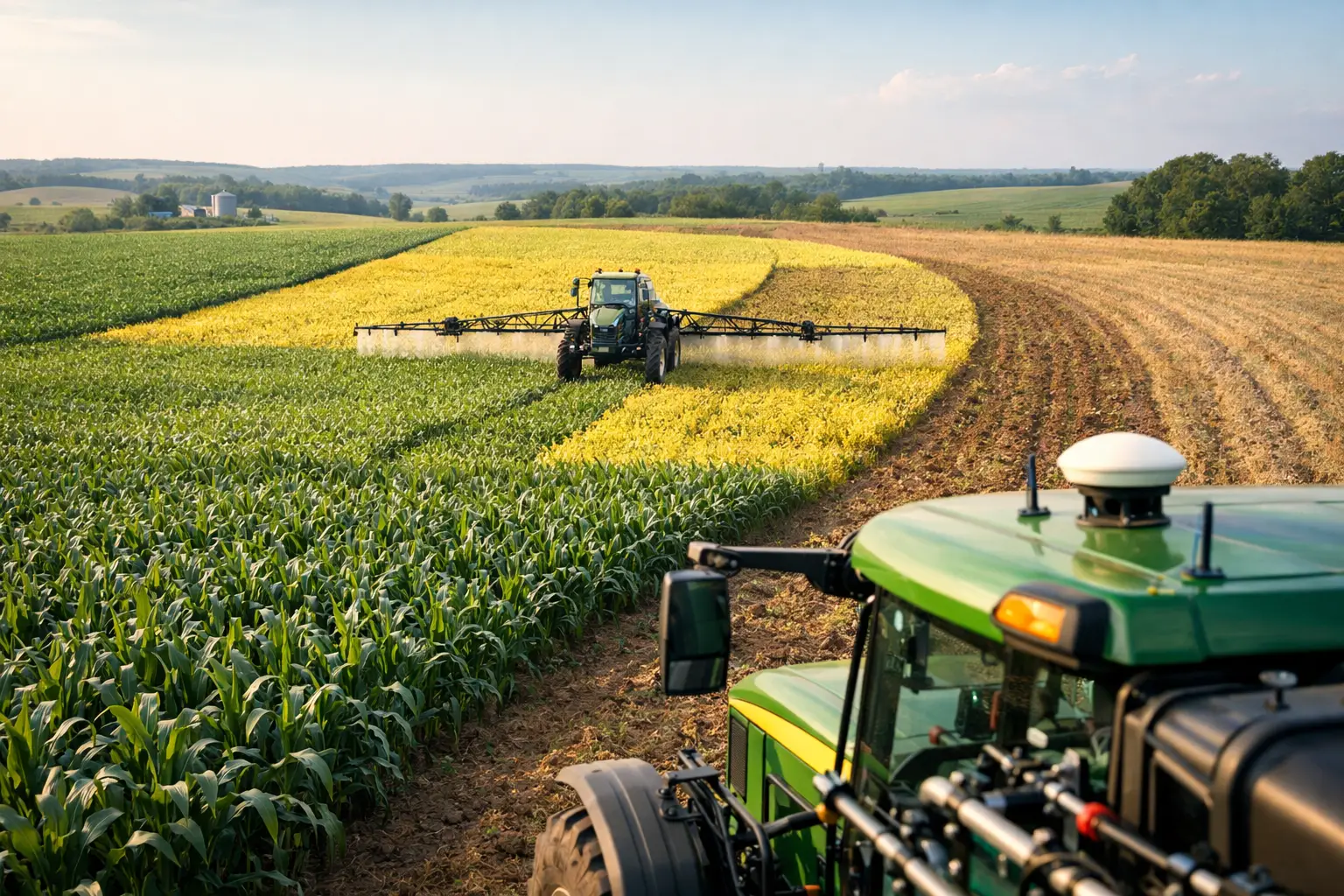
Variable-Rate Application Strategy for Field Zones
A field can show a uniform crop canopy from the road while carrying major differences in rooting depth, salinity, nutrient supply, water-holding capacity, and yield potential. Applying one fertilizer or irrigation rate across that field may be operationally simple, but it often means overapplying in some areas and failing to correct the limiting factor in others. A variable-rate application strategy is valuable only when it converts real agronomic variation into instructions that the field team can execute accurately.
For commercial farms and organizations managing grower networks, the objective is not to create more maps. It is to make better rate decisions, document why they were made, verify that they were applied, and measure whether the intervention improved crop performance and input efficiency.
Start with the agronomic decision, not the technology
Variable-rate application is often introduced as a hardware or software project. That is backward. The first question is which input should vary, and why. Nitrogen, phosphorus, potassium, lime, gypsum, irrigation water, and fertigated nutrients each respond to different sources of field variability. A prescription that is technically possible is not automatically economically justified.
In a high-value citrus block, for example, soil texture and irrigation uniformity may drive meaningful differences in nitrogen uptake and salt accumulation. In processing tomato, the more important issue may be uneven rooting conditions, irrigation capacity, or residual nitrate after the previous crop. In broad-acre grain production, stable yield zones may be useful for phosphorus or lime decisions, but a variable nitrogen rate may require more current-season evidence of crop demand and yield potential.
A sound strategy defines the production problem before selecting the data source. Is the goal to correct low soil-test potassium? Reduce nitrate leaching risk? Maintain a target soil-water depletion range? Avoid excessive vegetative growth in vigorous zones? The answer determines the sampling design, rate logic, equipment requirements, and validation method.
Build management zones that reflect stable causes
Management zones should represent areas likely to behave differently for a known agronomic reason. They are not simply colored sections on a yield map or satellite image. A zone is useful when it can support a different decision over time.
The strongest zone models typically combine several layers: soil survey information, elevation and drainage patterns, electrical conductivity where it has been properly interpreted, historic yield records, irrigation layout, field observations, and targeted soil or tissue analysis. Satellite imagery can add useful seasonal context, particularly for orchards, vineyards, vegetables, and distributed grower programs, but it cannot diagnose nutrient deficiency by itself. Low vigor may result from disease, compaction, poor drainage, damaged roots, poor irrigation distribution, salinity, or uneven stand establishment.
Sample by zone, not by field average
A field-average soil sample is rarely sufficient for variable-rate nutrient management. Each proposed zone needs representative sampling at the relevant depth, with enough points to distinguish a true pattern from random variation. For perennial crops, sampling should also respect the wetted zone, emitter position, root distribution, and the history of fertilizer placement.
Water quality belongs in the same analysis. High bicarbonate water can affect phosphorus availability and acidification requirements. Chloride, sodium, and boron may limit the acceptable fertilizer source or application rate. In drip-irrigated crops, water quality and irrigation frequency can influence nutrient distribution more than the nominal fertilizer rate.
Set rate rules before creating a prescription map
The map is the final output, not the decision framework. Before generating it, establish the agronomic rules for each zone: the target yield or crop load, expected nutrient removal, soil nutrient supply, contribution from irrigation water, organic amendments, residual nutrients, and the practical recovery efficiency of the planned application method.
For nitrogen, rate decisions should account for crop stage and loss pathways. A heavy early-season rate may be inappropriate in a sandy soil with frequent irrigation, even if the seasonal nitrogen budget is correct. Splitting applications through fertigation may improve control, but only if the irrigation system distributes water uniformly and the fertigation program is monitored. Variable-rate irrigation cannot compensate for poor pressure regulation, plugged emitters, or an incorrect estimate of crop evapotranspiration.
Rate caps and floors are equally important. A low-vigor zone should not automatically receive less fertilizer. If the cause is a correctable nutrient deficiency, a higher rate may be warranted. If the cause is shallow soil, root disease, persistent waterlogging, or severe salinity, additional fertilizer may increase cost and risk without improving yield. This is where field diagnosis must override a purely data-driven prescription.
Match the strategy to application capacity
A variable-rate plan fails when the application system cannot deliver it consistently. Granular spreaders require calibration across the product blend, operating width, speed range, and rate changes expected in the prescription. Blended fertilizers can separate during handling, producing a different nutrient analysis at the field edge than in the final passes. For liquid applications, flow-meter accuracy, pump response time, nozzle performance, and section control all affect the actual dose.
Fertigation introduces another level of control. The system must account for injection concentration, irrigation duration, flow by block or valve, pressure variation, and the time needed for nutrients to move through the wetting pattern. A prescription based on hectares is not enough when individual irrigation sectors have different actual flow rates or application efficiencies.
Operational constraints may justify fewer, larger zones. A five-zone recommendation may be agronomically elegant but impractical if the irrigation system can only manage two independently controlled sectors. In that case, simplify deliberately and quantify what is lost. A simpler prescription that is applied correctly is usually better than a highly detailed prescription that cannot be executed or audited.
Monitor execution as closely as the recommendation
Many organizations have a reasonable recommendation process but limited visibility after it leaves the agronomist’s desk. The result is a gap between prescribed, applied, and verified rates. Closing that gap requires field-level records that capture the zone, crop stage, product, dose, application date, operator, and actual application status.
This is particularly relevant for cooperatives, food companies, extension programs, and input suppliers managing hundreds or thousands of growers. Standardized protocols need room for field-specific adjustments, but those adjustments must be traceable. A regional agronomy director should be able to see which fields received the recommended intervention, which were delayed, where deviations occurred, and whether the crop response supports a change in the protocol.
A platform such as yieldsApp can organize this workflow across farms, field teams, and grower networks: distributing approved recommendations, recording execution, flagging exceptions, and connecting field observations with seasonal performance. The value is not the digitization of a rate map alone. It is the ability to coordinate agronomic decisions at scale without losing the local context that makes variable rates worthwhile.
Validate results with more than yield data
Yield is the final commercial measure, but it is not the only one. In orchards and vegetable crops, assess packout, fruit size distribution, quality parameters, crop uniformity, nutrient status, irrigation performance, and disease pressure where relevant. In row crops, compare yield, protein or quality, lodging, residual soil nitrate, and cost per unit of marketable production.
Validation should include untreated strips, comparison zones, or at least a documented baseline whenever practical. Without a comparison, a good season can make a weak prescription look successful, while difficult weather can hide a sound decision. The purpose is not academic perfection. It is to learn enough to improve the next season’s rate rules.
Where expert review adds the most value
The highest-value use of variable rates is often not across every input. It is at the point where a costly decision intersects with uncertain field conditions: salinity in drip-irrigated orchards, nitrogen management on light soils, potassium correction in high-yielding vegetables, or irrigation allocation when water supply is constrained.
Cropaia supports commercial farms and technical teams in reviewing these decisions through practical analysis of soil, water, tissue, irrigation, fertigation, and crop-performance data. For organizations, the same technical logic can be converted into training and operating protocols so agronomists apply consistent standards while retaining the ability to diagnose exceptions.
The strongest variable-rate application strategy is therefore not the one with the most zones. It is the one that identifies meaningful variation, applies a defensible response, and creates a record that helps the next decision become more precise.











About Post Author
