

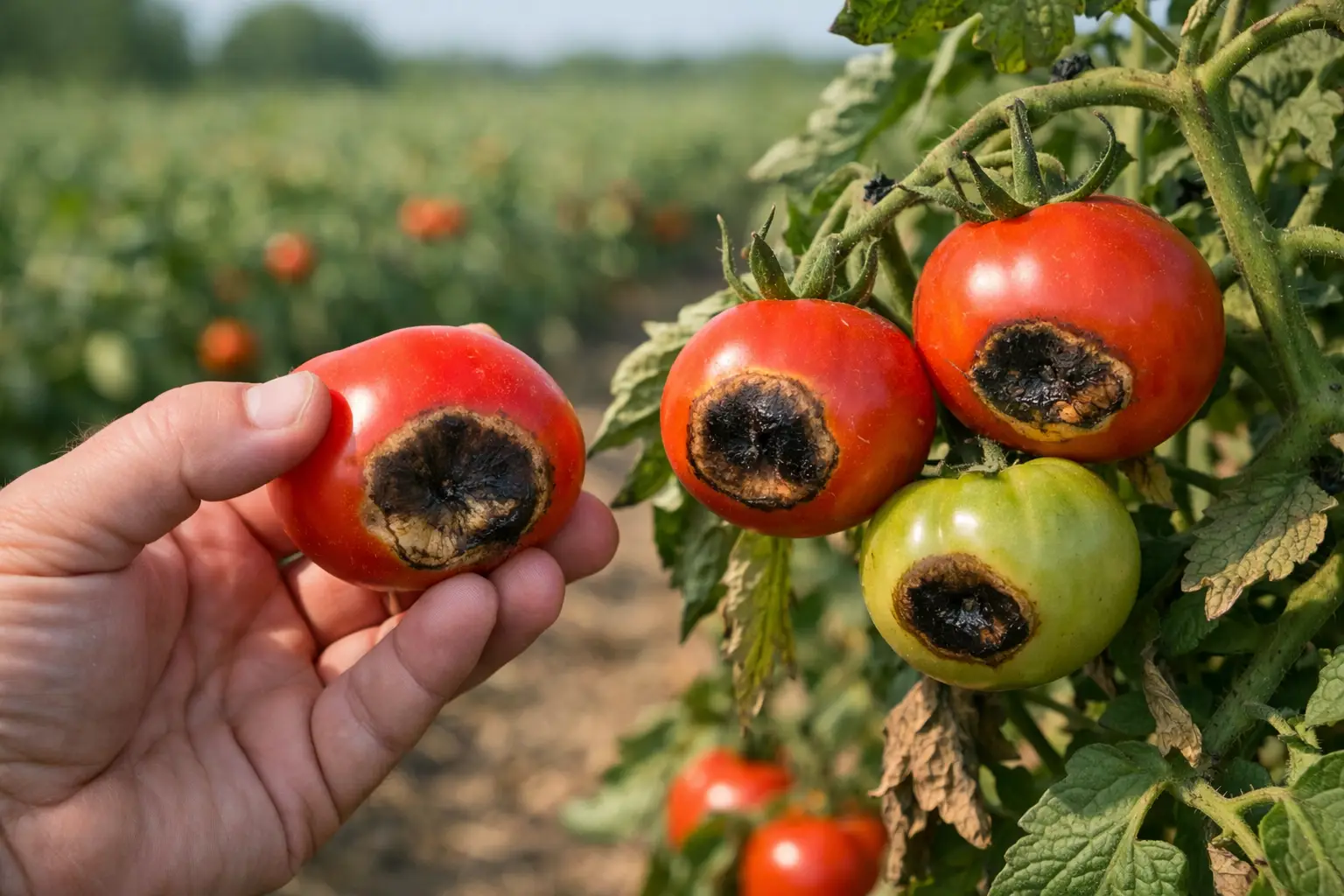
How to Diagnose Tomato Blossom Rot in Fields
A block can show 2% affected fruit one week and 18% the next, even when leaf and soil calcium tests look acceptable. That is why teams must diagnose tomato blossom rot as a fruit calcium-delivery failure, not automatically as a calcium-deficiency problem. The distinction determines whether the right response is irrigation correction, salinity management, nutrient-program adjustment, canopy management, or a more careful investigation of root function.
Blossom-end rot is costly in fresh-market and processing tomato because it reduces marketable yield, disrupts harvest planning, and can expose weak execution across a grower network. A fast visual diagnosis is useful, but a reliable commercial diagnosis requires crop history, irrigation records, water quality, nutrient balances, field variability, and fruit-stage observations.
How to Diagnose Tomato Blossom Rot Correctly
The characteristic symptom begins at the blossom end of immature fruit. It appears as a small, water-soaked or pale area, then enlarges into a dark brown to black, leathery, sunken lesion. The tissue is initially firm rather than soft. Secondary fungi or bacteria may colonize the damaged area later, but they are not the primary cause.
The key diagnostic point is timing. The physiological disruption usually occurs when fruit are young and rapidly expanding. By the time a dark lesion is visible, the calcium shortage in that specific fruit tissue has already occurred. Spraying calcium onto visibly affected fruit will not reverse the damage.
Inspect fruit across several positions in the canopy and across irrigation zones. Record the percentage of affected fruit by block, cultivar, planting date, fruit load, and fruit size class. A pattern concentrated in a few valves, lateral lines, soil textures, or topographic positions is more informative than the farm average.
Separate Blossom-End Rot From Look-Alikes
Several disorders can be mistaken for blossom-end rot. Sunscald usually develops on fruit exposed after canopy loss and tends to occur on the shoulder or side facing direct radiation, not consistently at the blossom end. Buckeye rot and other fruit rots are often associated with wet soil, splashing water, or pathogen activity; lesions may have concentric patterns, softer tissue, or rapid decay.
Herbicide injury, insect feeding, mechanical abrasion, and cracking may also create dark areas, but their location and timing differ. If lesions are irregular, occur well away from the blossom end, or spread rapidly through soft tissue, do not assume blossom-end rot. Send representative samples for pathology when symptoms are mixed or when a disease problem could be driving canopy loss, root stress, or fruit injury.
Why Calcium Tests Can Be Misleading
Blossom-end rot results from inadequate calcium concentration in the rapidly expanding cells at the fruit’s blossom end. Calcium moves mainly with the transpiration stream in the xylem. Leaves transpire strongly and compete effectively for calcium, while fruit have comparatively low transpiration. A plant can therefore have adequate calcium in the root zone, acceptable leaf calcium, and still produce affected fruit.
This is why a simple recommendation to “apply more calcium” often wastes time and money. Calcium availability matters, especially in low-calcium soils or systems relying on low-calcium water, but delivery to fruit depends on stable water uptake and root activity at the critical stage.
The most common drivers are uneven soil moisture, high salinity, root restriction or root disease, excessive ammonium, excessive potassium or magnesium relative to calcium, and rapid vegetative growth. High temperatures and low humidity can intensify competition between leaves and fruit. In protected systems, climate control and root-zone management may be more decisive than the fertilizer source selected.
There is also a trade-off. Aggressively reducing nitrogen to control vegetative growth can constrain canopy development and later yield. Increasing calcium through fertigation without checking electrical conductivity can raise salt stress. The correct intervention depends on the production system, water analysis, soil or substrate conditions, crop stage, and the source of variability.
Build a Field Diagnosis From Evidence
Start with the irrigation schedule, not the fertilizer invoice. Review the previous two to three weeks, particularly from flowering through early fruit enlargement. Compare planned irrigation with actual run times, flow rates, pressure, and application uniformity. In drip systems, clogged emitters, pressure variation, poor filtration, and blocked laterals can create localized moisture stress that is invisible from the headland.
Then examine soil or substrate moisture at the effective root depth. The question is not whether the surface appears wet. The question is whether water content fluctuated sharply where active roots were extracting water. Sandy sections may dry quickly between short irrigations, while heavier zones may experience poor aeration after long events. Both conditions can reduce calcium transport to fruit.
A practical investigation should review these factors together:
- Irrigation frequency, duration, uniformity, drainage, and root-zone moisture trends.
- Water electrical conductivity, bicarbonate, sodium, chloride, and calcium concentration.
- Fertigation rates and the balance among calcium, potassium, magnesium, ammonium, and nitrate.
- Root health, compaction, nematode pressure, soil-borne disease, and transplant establishment.
- Canopy density, excessive nitrogen-driven vigor, recent pruning practices, and heat events.
Do not interpret laboratory results in isolation. A soil test can show sufficient exchangeable calcium while high salinity limits uptake. A leaf analysis can indicate adequate total calcium because mature leaves accumulate it, even as young fruit remain vulnerable. Tissue sampling remains valuable, but it should be used to test a field hypothesis, not replace field observation.
Use Distribution Patterns to Find the Cause
The spatial pattern often narrows the diagnosis. Uniform incidence across a greenhouse or field may point to a broad climate, nutrition, or irrigation scheduling issue. Incidence limited to particular rows or zones often points to hydraulic performance, soil texture, salinity accumulation, root damage, or inconsistent transplant establishment.
Compare affected and unaffected locations with the same cultivar and planting date whenever possible. Check emitter discharge, soil moisture, root color and density, EC, pH, and fruit-load differences. This paired comparison is usually more useful than collecting a single composite sample across a variable field.
Correct the System, Not Just the Symptom
Once blossom-end rot is confirmed, stabilize root-zone moisture first. In many commercial tomato systems, this means adjusting irrigation frequency and duration to reduce sharp wet-dry cycles while maintaining adequate aeration. The exact strategy differs by soil texture, rooting depth, weather demand, and irrigation system capacity. More frequent pulses can help in coarse soils or substrates, but they can worsen oxygen stress in poorly drained conditions.
Review the fertigation program against measured water quality and soil or substrate EC. Ensure calcium is supplied in a soluble, compatible form and delivered during the period of active fruit set and enlargement. At the same time, avoid disproportionate potassium, magnesium, or ammonium applications that can interfere with calcium uptake. This is a balance exercise, not a single-product decision.
Correct root constraints where possible. Repair irrigation nonuniformity, manage drainage, investigate root pathogens, and avoid practices that damage the root system during peak fruit demand. In high-value protected production, substrate EC, drainage percentage, and drainage EC should be reviewed daily during a problem episode. In open fields, soil moisture monitoring at multiple depths and zones provides a stronger basis for decisions than a calendar schedule.
Foliar calcium can have a limited supporting role under certain conditions, particularly where young tissues require supplemental calcium. It should not be presented as the primary cure for blossom-end rot. Coverage, formulation, environmental conditions, and the plant’s limited capacity to move calcium from leaves into fruit all restrict its effect. Use it only within a broader program that addresses water relations and root-zone conditions.
Standardize the Response Across Farms and Growers
For organizations managing multiple farms or contracted growers, blossom-end rot is also an operational issue. Different scouts may label symptoms differently, irrigation records may be incomplete, and corrective actions may not be verified. That creates recurring losses even when technical recommendations are sound.
A standardized protocol should require symptom photos, incidence by block and fruit stage, irrigation and fertigation records, water and root-zone measurements, diagnosis confidence, recommended action, and a follow-up inspection date. This creates traceability from field observation to corrective action and allows technical managers to compare incidence with weather, irrigation performance, cultivar, and management practices across locations.
Cropaia can support complex tomato cases through independent irrigation, fertigation, salinity, and nutrition review, while advanced technical training can help agronomy teams diagnose disorders consistently. For organizations coordinating distributed field teams, yieldsApp can convert the diagnosis protocol into assigned field tasks, monitored recommendations, evidence collection, and exception alerts across grower networks.
A reliable blossom-end rot program does not promise zero incidence under every heat event or root-zone constraint. It gives the production team a disciplined way to identify the real limiting factor early, act on the zones that need correction, and verify whether the next fruit set is improving.












About Post Author
