

What Causes Uneven Crop Growth Across Fields?
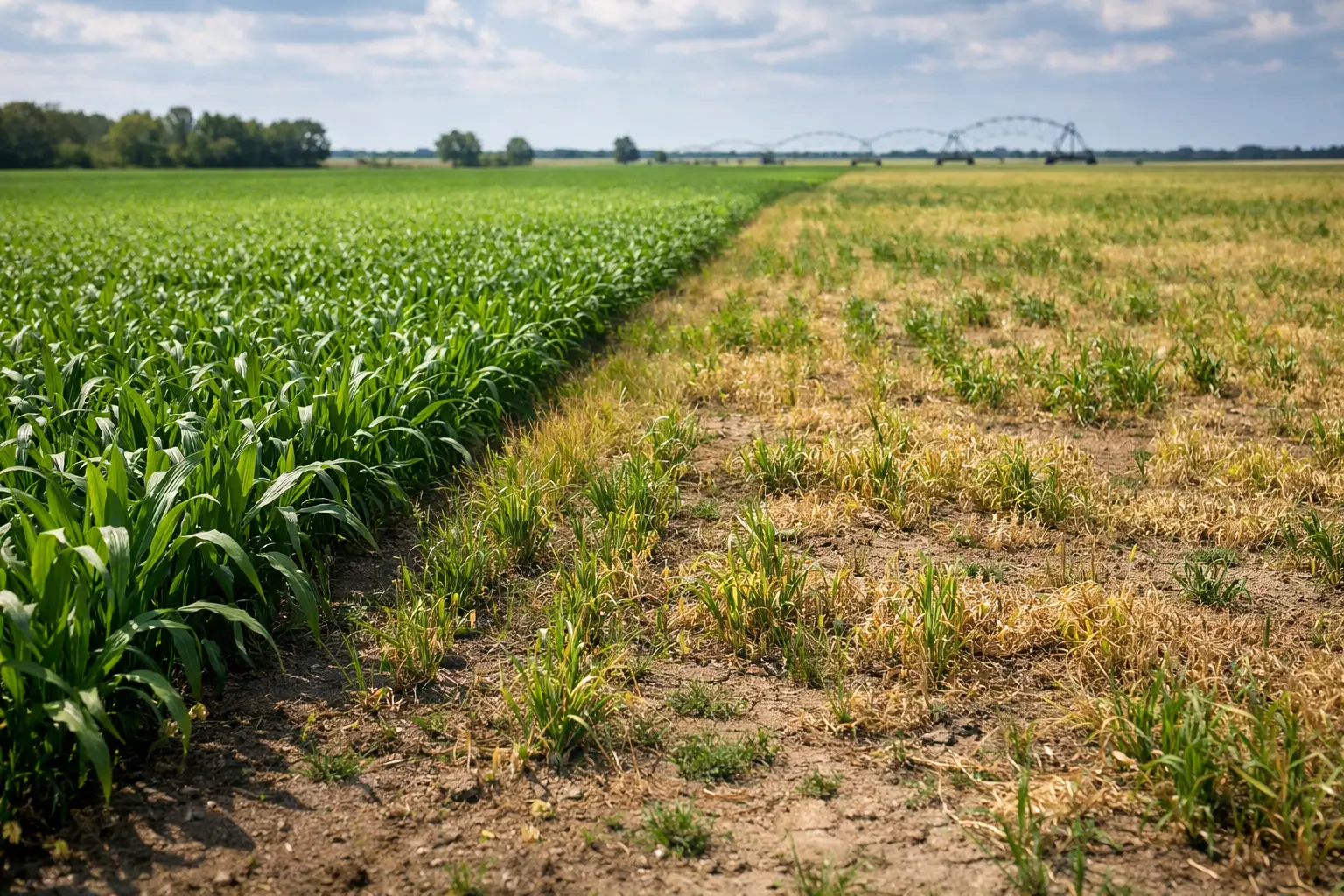
A field can look uniform from the road and still contain zones that are two phenological stages apart. In commercial production, what causes uneven crop growth is rarely one isolated problem. It is usually an interaction between field variability, irrigation performance, root-zone conditions, nutrient availability, and the consistency of management execution.
The visible symptom – uneven height, canopy density, color, flowering, fruit set, or maturity – is not the diagnosis. Treating every weak area with more fertilizer is one of the fastest ways to increase cost while making salinity, imbalance, or excessive vegetative growth worse. The correct response begins by separating patterns, measuring the root-zone environment, and tracing the problem back to its operational cause.
What Causes Uneven Crop Growth? Start With the Pattern
Before collecting samples, map where variation occurs. The geometry of the weak area often narrows the diagnosis substantially.
A problem that follows irrigation lines, sprinkler overlap, pressure zones, or the far end of a drip block points first to water distribution, emitter performance, filtration, pressure regulation, or clogging. A pattern that matches soil boundaries, low spots, slopes, old field roads, or filled areas is more likely related to texture, compaction, drainage, salinity, or restricted rooting. Random individual plants can indicate planting quality, localized pests and diseases, seedling vigor, or root injury.
Timing matters as much as spatial pattern. If variation appears shortly after planting, investigate stand establishment, soil temperature, planting depth, soil crusting, root pathogens, and early irrigation management. If it develops after canopy closure or during rapid fruit fill, the likely drivers shift toward irrigation capacity, nutrient demand, oxygen stress, salinity accumulation, or competition between vegetative and reproductive growth.
In orchards and vineyards, compare weak and strong zones using trees or vines of similar age, rootstock, crop load, and exposure. In annual crops, compare plants at the same planting date and population. A valid comparison is the foundation of useful tissue, soil, and water analysis.
Water Supply Is Often the First Constraint
Uneven water availability is among the most common causes of uneven crop growth because it affects expansion, nutrient uptake, transpiration, root development, and reproductive performance at the same time. Yet the question is not simply whether the field received enough water. It is whether each management zone received the intended volume at the intended time, with an acceptable distribution uniformity.
Under-irrigated zones often show smaller plants, reduced leaf area, short internodes, lighter fruit, and earlier stress during hot periods. However, over-irrigated zones may also grow poorly. Saturated soil limits oxygen diffusion, weakens roots, increases susceptibility to root disease, and reduces the plant’s capacity to absorb nutrients. A wet-looking area is not necessarily a well-irrigated area.
Check actual pressure and flow at representative points, including the beginning and end of irrigation laterals and submains. Measure application, not just run time. Review filter cleaning, flushing records, injector performance, repairs, and changes in water source. In drip-irrigated fields, excavate the wetted zone in both weak and strong areas. Surface moisture alone can be misleading, especially in layered soils or where emitters are partially clogged.
Irrigation scheduling must also account for different soil water-holding capacities. A single schedule can be operationally convenient but agronomically wrong when a field contains sandier ridges, heavier depressions, shallow soil over hardpan, or variable rooting depth. Splitting irrigation zones may require capital and management effort, but it can prevent chronic yield gaps that no fertilizer adjustment will solve.
Root-Zone Limitations Create Persistent Variability
When a weak zone remains weak despite apparently adequate irrigation and nutrition, inspect the roots. Healthy roots should occupy the expected soil volume, with active fine roots distributed through the wetted profile. Sparse, darkened, stubby, or shallow roots point to a constraint belowground.
Compaction can be caused by repeated traffic, field preparation, previous land use, or a naturally dense soil layer. It limits rooting depth and makes the crop more sensitive to short dry periods, high temperatures, and nutrient shortages. In poorly drained areas, compaction and excess water often occur together. The result can be a patch that alternates between oxygen stress after irrigation and water stress a few days later because roots never develop deeply enough.
Soil texture and profile changes are equally relevant. A coarse layer may drain quickly and require smaller, more frequent applications. A fine-textured layer may hold water but drain slowly. Stony ground can reduce the effective rooting volume even where laboratory texture results appear favorable. Digging pits in contrasting zones is slower than reviewing a spreadsheet, but it frequently provides the evidence that remote imagery and surface scouting cannot.
Root diseases, nematodes, and chemical injury should be considered when poor growth has irregular boundaries or follows a history of susceptible crops. Confirmation requires appropriate root, soil, and laboratory sampling. Visual symptoms alone cannot reliably distinguish biological root damage from salinity or waterlogging.
Nutrient Deficiency Is Not Always a Fertilizer Deficit
Uneven nutrient status may result from insufficient nutrient supply, but it can also be caused by poor uptake. Water stress, low oxygen, high salinity, unsuitable pH, root restriction, antagonism between nutrients, and poor fertilizer distribution can all produce deficiency symptoms in a field that has received adequate fertilizer on paper.
Nitrogen variation commonly appears as differences in canopy color and vigor, but nitrogen is mobile in soil and easily affected by irrigation distribution, leaching, denitrification, and uneven fertigation injection. Potassium deficiencies may concentrate in sandy or heavily cropped zones, while calcium-related disorders can be more severe where transpiration, root health, or irrigation uniformity differs. Micronutrient availability often responds strongly to pH, bicarbonate levels, phosphorus management, and soil moisture.
Use paired sampling. Take soil and tissue samples separately from clearly defined weak and strong zones, at the same crop stage and using the same plant part. Pair these results with irrigation water analysis and a review of the fertilizer program, including source, timing, concentration, injection duration, and final flushing. A single composite sample across a variable field can average away the very problem being investigated.
High electrical conductivity deserves particular attention. Salinity reduces the plant’s ability to extract water even when the soil is moist, and sodium can damage soil structure and infiltration. In fertigation systems, salinity risk depends on irrigation water quality, fertilizer choice, dose, rainfall, leaching fraction, drainage, and seasonal salt accumulation. Correcting salinity may require changes in water management and drainage, not merely a different fertilizer grade.
Field Execution Can Be the Hidden Cause
Many uneven fields are not failing because the agronomic recommendation was poor. They are failing because the recommendation was not executed consistently.
A fertilizer program may be technically sound, yet one farm applies it late, another uses an incorrect stock concentration, and a third misses applications after a pump or filter failure. An irrigation schedule may specify short pulses during peak demand, but field teams may combine them into one long event for convenience. Planting dates, transplant quality, pruning intensity, thinning, crop load, and crop-protection timing can also create variation that is later misread as a nutrition problem.
This is especially relevant for companies, cooperatives, and sourcing programs managing many growers. The operational question is not only whether agronomists issued recommendations. It is whether each recommendation was localized, assigned, completed, verified, and linked to field observations and outcomes.
Cropaia supports commercial farms and technical teams that need a rigorous second opinion on irrigation, fertigation, salinity, nutrient interpretation, and yield-limiting field variability. For distributed operations, yieldsApp can convert field protocols, observations, sampling records, and corrective actions into a coordinated workflow across farms and agronomists. Digital records do not replace field diagnosis, but they make recurring execution gaps visible and auditable.
A Practical Diagnostic Sequence
Avoid changing several inputs at once. If irrigation, fertilization, and crop protection are all altered without a diagnosis, the result may look better temporarily while the original constraint remains unknown.
Start by delineating weak and strong zones using field observations, yield records, irrigation layout, elevation, soil maps, and imagery where available. Then inspect plants and roots in both zones. Measure irrigation pressure, flow, and application consistency. Sample soil, tissue, and irrigation water based on the suspected mechanism, not as a routine exercise. Finally, compare planned versus actual operations: what was applied, when, where, and at what rate.
The best corrective action is usually targeted. A sandier zone may need a different irrigation pulse. A saline zone may require a managed leaching and drainage plan. A compacted section may need remediation before the next crop cycle. A weak fertigation zone may need hydraulic correction rather than more total fertilizer. Treating the entire field uniformly is sometimes necessary for operational reasons, but it should be recognized as a compromise, not assumed to be agronomically optimal.
Uneven crop growth becomes manageable when the farm moves from visual symptoms to evidence: pattern, timing, roots, water, chemistry, and execution. That discipline turns a frustrating field complaint into a defined production problem with a measurable corrective path.











About Post Author
