

Trends in Irrigation Automation for Farms
A pivot or drip block can apply precisely the programmed volume and still miss the crop’s real demand. A rain event may not wet the active root zone. A stressed tomato crop may require a different strategy from a vigorously vegetative one, even when soil moisture appears adequate. That distinction is driving the most valuable trends in irrigation automation: systems are moving beyond remote switching toward agronomic decision support.
For commercial growers and agribusinesses, automation is not simply a labor-saving investment. It is an operating model for making water, nutrient, energy, and labor decisions more consistently across fields, seasons, and production teams. The strongest programs connect measurement, interpretation, execution, and verification.
Trends in Irrigation Automation Are Becoming Agronomic
Early automation focused on timing. A manager programmed valves to open at a set hour for a set duration, often based on a weekly schedule. This can reduce labor and prevent obvious missed irrigations, but it does not account well for changing evapotranspiration, soil texture, crop stage, rainfall distribution, salinity, or irrigation system performance.
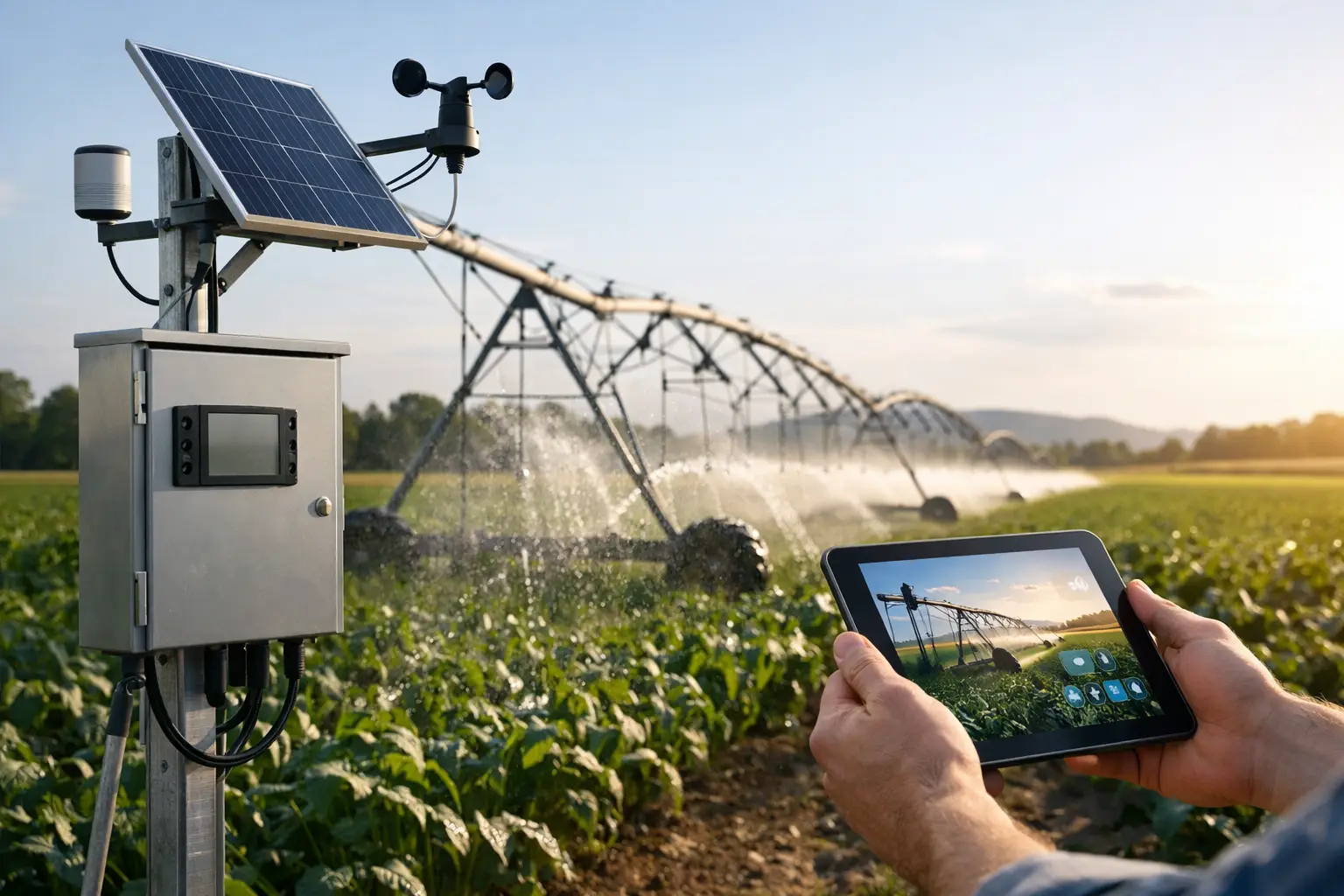
Current systems increasingly combine automated control with field data. Soil moisture sensors, weather stations, flow meters, pressure sensors, satellite imagery, and pump controls can feed a common dashboard or farm management system. The goal is not to collect more information for its own sake. It is to improve the irrigation decision: when to start, how much to apply, which zone to prioritize, and whether the intended water actually reached the crop root zone.
This shift matters most where irrigation is both a yield driver and a production risk. In processing tomato, for example, excess water late in the cycle can reduce soluble solids and create uneven maturity. In avocado, poor moisture management can weaken roots and compound disease pressure. In corn or soybeans, water deficits during sensitive reproductive stages can have a disproportionate effect on yield. Automation must therefore be designed around crop physiology and production targets, not around valve schedules alone.
Sensor Networks Are Being Judged by Decision Value
More farms are installing sensor networks, but sensor density is not the same as field intelligence. A single probe in an unrepresentative location can create false confidence. A high-density deployment with no calibration, maintenance plan, or decision protocol can produce noise rather than better irrigation.
The practical trend is toward purposeful placement. Soil moisture sensors should represent meaningful management zones defined by soil texture, rooting depth, topography, irrigation design, and crop history. In drip-irrigated fields, placement must account for wetting patterns and distance from emitters. In orchards, sensors should reflect the active root zone rather than simply the deepest measurable profile.
Sensors also need to be interpreted in layers. Shallow readings help identify whether a recent irrigation reached the upper root zone. Deeper readings indicate whether water is being stored for future use or moving below the active rooting depth. A falling soil moisture trend may justify irrigation, but the decision still depends on forecast evapotranspiration, crop stage, canopy development, and the capacity of the irrigation system to recover.
Flow and pressure data are gaining equal importance. Soil moisture can suggest that a block is not receiving enough water; flow and pressure monitoring can help identify why. A clogged filter, broken mainline, pressure-regulator problem, or leaking valve may turn a sound irrigation recommendation into poor field execution. Automated alerts are useful when they distinguish meaningful exceptions from normal system variation.
From Calendar Schedules to Dynamic Irrigation Plans
Weather-based scheduling has become more accessible, particularly where reference evapotranspiration data can be paired with crop coefficients and rainfall records. This is an improvement over calendar scheduling, but it should not be treated as a complete irrigation plan. Crop coefficients are generalized estimates. They can diverge from actual field conditions when crop development, plant density, canopy cover, residue, or stress differs from the assumed model.
The more advanced approach uses an evapotranspiration water balance as a planning framework, then checks it against field measurements. Weather data estimates atmospheric demand. Soil moisture confirms how the root zone is responding. Plant observations and, where appropriate, canopy-temperature or sap-flow measurements help identify whether the crop is experiencing stress despite apparently acceptable soil water conditions.
This combination is especially useful in high-value crops and variable fields. A citrus block on sandy soil may need shorter, more frequent pulses than an adjacent block with greater water-holding capacity. A uniform program may be simpler to manage, but it can waste water in one area while imposing stress in another. Automation enables different schedules by management zone, provided the irrigation infrastructure has sufficient hydraulic control.
Fertigation Control Is Joining Irrigation Automation
For drip-irrigated production, irrigation automation is increasingly tied to fertigation management. The timing and duration of water applications affect nutrient placement, nutrient uptake, and leaching risk. An automated system that doses fertilizer accurately but applies excess irrigation can still move nitrate below the effective root zone.
Modern fertigation control can manage injection timing, stock solution rates, pH adjustment, electrical conductivity targets, and flushing sequences. Yet a controller cannot replace an agronomic nutrient program. The correct nitrogen, potassium, calcium, or micronutrient strategy depends on crop demand, irrigation water quality, soil chemistry, yield target, and tissue or sap analysis. Automation improves repeatability; it does not decide whether the prescription itself is appropriate.
This is a critical distinction for agribusiness operations seeking measurable sustainability gains. Reduced fertilizer loss requires more than a dosing pump. It requires aligned irrigation volumes, water-quality monitoring, nutrient accounting, and verification through field measurements.
Remote Control Is Useful, but Exception Management Is Better
Remote valve operation remains a valuable feature, especially for geographically dispersed farms or operations with limited field labor. Managers can respond to a pump shutdown, delay an irrigation after rainfall, or adjust a set without traveling to the site. However, remote control alone often transfers the same manual decision process from the field to a phone.
The stronger trend is exception-based management. Instead of asking a manager to inspect every block each day, the system flags deviations that require attention: unexpected high flow, low pressure, a missed irrigation cycle, a soil moisture profile that is not recovering, or water use that exceeds the planned budget. This allows irrigation teams to focus on the blocks where performance has departed from expectation.
Alert design matters. Too many generic notifications lead to alert fatigue, and critical issues get ignored. Thresholds should be set according to field conditions and adjusted during the season. A pressure change that is irrelevant in one zone may signal a serious distribution problem in another.
The Limits of Fully Autonomous Irrigation
Autonomous irrigation can be appropriate in stable, well-characterized zones with reliable equipment and strong historical data. It is less reliable when fields are highly variable, sensors are poorly maintained, or unexpected factors are common. Power interruptions, communication failures, rainfall variability, disease-management requirements, and water-allocation constraints can all require human judgment.
There is also a financial trade-off. A fully integrated platform with sensors, telemetry, automated valves, flow monitoring, and variable-rate control can deliver substantial value in high-value crops or water-constrained regions. On broad-acre operations with lower margins, a phased approach may generate better returns: begin with flow measurement, weather data, and a few representative soil moisture locations, then add control capability where the operational benefit is clear.
Technology selection should follow an irrigation assessment, not a product catalog. Evaluate water source reliability, filtration, pump capacity, distribution uniformity, field zoning, communication coverage, labor constraints, and the farm’s ability to act on the data. If the system has poor uniformity, automating its schedule will not correct the underlying hydraulic problem.
Building an Automation Program That Performs
Effective implementation begins by defining the decisions the farm needs to improve. These may include reducing water use per marketable ton, preventing crop stress during key growth stages, improving fertigation precision, lowering labor exposure, or documenting water performance for a processor, lender, or sustainability program.
Then establish a baseline. Measure current application volumes, distribution uniformity, energy use, labor time, crop performance, and known problem areas. This creates a standard against which the automation investment can be evaluated. Without a baseline, it is easy to celebrate new dashboards while overlooking unchanged field results.
Finally, build team capability. Farm managers, irrigation supervisors, agronomists, and maintenance personnel need clear responsibilities for reviewing data, responding to alarms, validating sensor readings, and documenting changes. The best system is one that field teams trust and use consistently. Training should include irrigation agronomy, not only controller operation.
The future of irrigation automation will be defined less by how many devices a farm installs and more by the quality of its decisions. With unbiased agronomic guidance, practical training, and disciplined field verification, companies such as Cropaia can help turn automated irrigation from a connected infrastructure project into measurable crop performance.











About Post Author
