

Can Poor Water Reduce Yield? Yes, and Here’s How
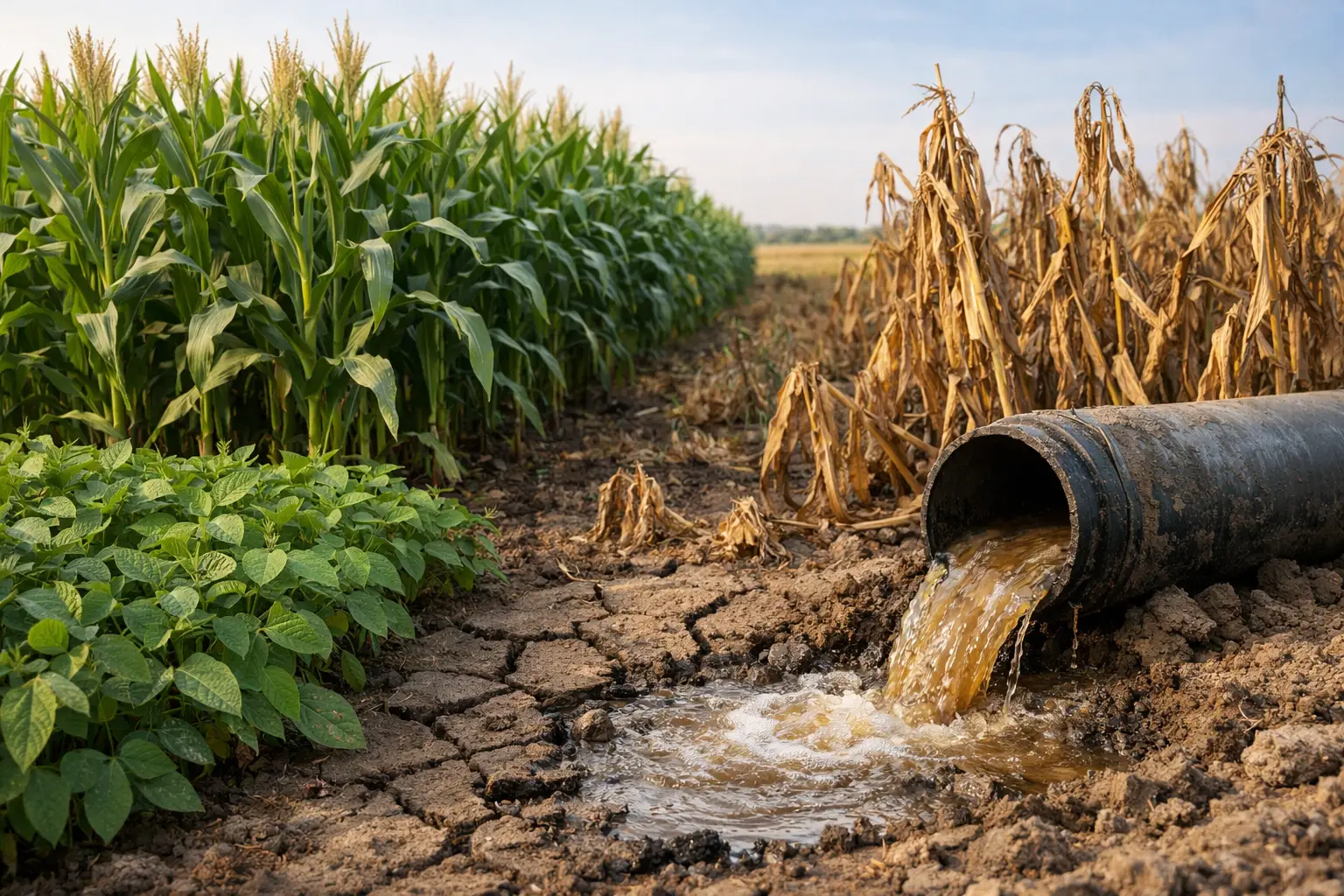
A field can receive the correct irrigation volume, meet its fertilizer program, and still lose production because the water itself is working against the crop. The answer to can poor water reduce yield is unequivocally yes. Water quality can limit emergence, root development, nutrient uptake, canopy function, fruit quality, and the productive life of irrigation infrastructure.
For commercial operations, the risk is rarely a single bad irrigation event. More often, it is a gradual process: salts accumulate in the active root zone, bicarbonates alter soil structure, emitters lose uniformity, or a nutrient program becomes less available at the point where roots need it. By the time visual symptoms are obvious, yield potential may already be reduced.
Can Poor Water Reduce Yield Across Crop Systems?
Poor-quality water does not affect every crop, soil, or irrigation system in the same way. A water source that is workable for a salt-tolerant field crop on deep, well-drained soil may create serious constraints for a chloride-sensitive fruit crop under drip irrigation on a heavy soil. The relevant question is not whether water is “good” or “bad” in isolation. It is whether its chemistry, biological load, and physical condition are compatible with the crop, soil, climate, fertilizer program, and irrigation method.
Water quality affects yield through three connected pathways. First, dissolved salts can make it harder for plants to extract water, even when the soil appears adequately moist. Second, certain ions can accumulate to toxic levels or disrupt nutrient balance. Third, water chemistry can damage the soil and irrigation system that deliver water to the crop.
A sound assessment therefore connects laboratory results to field conditions. Electrical conductivity, sodium adsorption ratio, bicarbonate concentration, chloride, boron, pH, hardness, iron, manganese, and microbial indicators each mean something different operationally. Treating a water test as a pass-fail document misses the agronomic decision.
The Main Water-Quality Mechanisms That Depress Yield
Salinity reduces the crop’s effective water supply
Salinity is commonly expressed as electrical conductivity, or EC. Higher EC indicates a greater concentration of dissolved salts. As salinity in the root zone increases, plants must use more energy to take up water. This osmotic stress can slow growth, reduce leaf expansion, impair flowering, and limit grain fill or fruit sizing.
The severity depends on crop sensitivity and growth stage. Establishment and early root development are often particularly vulnerable. In high-value crops, moderate salinity may also reduce marketable yield through smaller fruit, uneven maturity, lower pack-out, or quality defects before it causes clear crop loss.
Irrigation water EC alone is not the final risk measure. Rainfall, evapotranspiration, drainage, irrigation frequency, and leaching fraction determine how much salt remains in the root zone. Under arid conditions or protected production, salts can build rapidly when leaching is insufficient. Under poorly drained conditions, adding more water to leach salts may create its own oxygen stress and disease risk. The management decision must balance both constraints.
Sodicity weakens soil structure and infiltration
Sodium is different from total salinity. Excess sodium relative to calcium and magnesium can disperse clay particles, causing surface sealing, reduced infiltration, crusting, and loss of soil pore continuity. This condition is generally evaluated using sodium adsorption ratio, or SAR, alongside EC and bicarbonate levels.
A sodicity problem can look like an irrigation scheduling problem: water ponds at the surface, wetting patterns become uneven, and sections of the field show water stress shortly after irrigation. Yet the root cause may be deteriorating soil structure rather than insufficient applied volume.
This distinction matters because the corrective action differs. Increasing irrigation duration may worsen runoff, nutrient movement, and waterlogging without restoring infiltration. Where appropriate, calcium amendments, acidification strategies, organic matter management, drainage improvement, and revised irrigation practices may be needed. The correct program depends on soil texture, carbonate content, water chemistry, and the economics of the crop.
Specific ions can cause toxicity and nutrient imbalance
Chloride, boron, sodium, and bicarbonates can directly or indirectly reduce crop performance. Chloride can accumulate in sensitive crops, particularly where leaching is limited. Boron has a narrow range between deficiency and toxicity, making repeated low-level inputs relevant over time. Sodium may compete with potassium uptake, while high bicarbonate concentrations can raise pH in the wetted zone and reduce the availability of phosphorus, iron, zinc, and manganese.
The fertilizer program may then be blamed for symptoms that originate in the irrigation water. For example, a crop may receive the planned rate of potassium or micronutrients but still show deficiencies because root activity, soil chemistry, or antagonistic ions limit uptake. This is why water analysis should be interpreted together with soil testing, tissue or sap analysis, irrigation records, and field observations.
Physical and biological water issues affect distribution and crop health
Water quality is also an infrastructure issue. High levels of suspended solids, iron, manganese, calcium carbonate, or biological growth can clog filters, mains, valves, and drip emitters. Even minor reductions in distribution uniformity can create meaningful yield variation across large fields.
In systems using surface water, microbial load and organic matter may increase filtration and sanitation requirements. Reclaimed water can be a valuable resource, but it requires disciplined monitoring of salts, nutrients, pathogens, and operational reliability. Water source classification alone is not enough. Seasonal change, blending practices, and treatment performance must be verified.
Diagnose Water-Related Yield Risk Before Symptoms Spread
A useful water-quality program starts with representative sampling. Test each source separately, including wells, reservoirs, canals, blended supplies, and treated water. Sample at the point where water enters the irrigation system, and repeat testing when source conditions change. One historical report cannot represent a season of variable water supply.
The laboratory panel should be selected for the production risk. At minimum, commercial irrigation decisions commonly require EC, pH, major cations and anions, SAR, bicarbonate, chloride, boron, hardness, and relevant physical indicators. Where filtration, fertigation, or reclaimed water is involved, additional parameters may be essential.
Results should then be mapped against four field questions: What is the crop’s sensitivity? What is the rooting depth and soil texture? How much seasonal leaching is realistically available? Is irrigation being applied uniformly? This converts a water report into a field-level risk assessment.
Remote sensing and farm management platforms can help identify patterns, but they do not replace water and soil measurements. A low-vigor zone on an imagery map may reflect salinity, compaction, emitter clogging, disease, shallow soil, or nutrient limitation. Ground-truthing with EC mapping, soil sampling, flow and pressure checks, and targeted plant analysis is what turns a pattern into a defensible diagnosis.
Manage the Water, Not Just the Irrigation Schedule
The strongest response is usually a coordinated program rather than a single correction. Irrigation scheduling may need to include a calculated leaching requirement. Fertigation may require acidification or a different nutrient source to account for bicarbonates and antagonistic ions. Filtration and maintenance schedules may need adjustment to protect distribution uniformity. In some cases, blending sources, improving drainage, or changing the crop mix in the most constrained blocks is more economical than trying to force a uniform solution across the entire operation.
Crop choice and rootstock selection can also be practical risk-management tools, particularly in long-term water-constrained regions. Tolerance should not be treated as immunity, however. A tolerant crop can still lose yield when salts accumulate beyond its threshold or when sodicity restricts infiltration and root function.
For agribusinesses and extension programs, water quality should be included in grower protocols, procurement risk assessments, and agronomy training. The commercial impact extends beyond tonnage. Variable water quality can affect consistency, grade, shelf life, input efficiency, and the reliability of production forecasts.
Poor water is not always a reason to abandon a source. It is a reason to make a more precise agronomic decision. When water chemistry, soil behavior, irrigation performance, and crop response are evaluated together, managers can protect yield potential before a hidden constraint becomes a visible field problem.











About Post Author
