

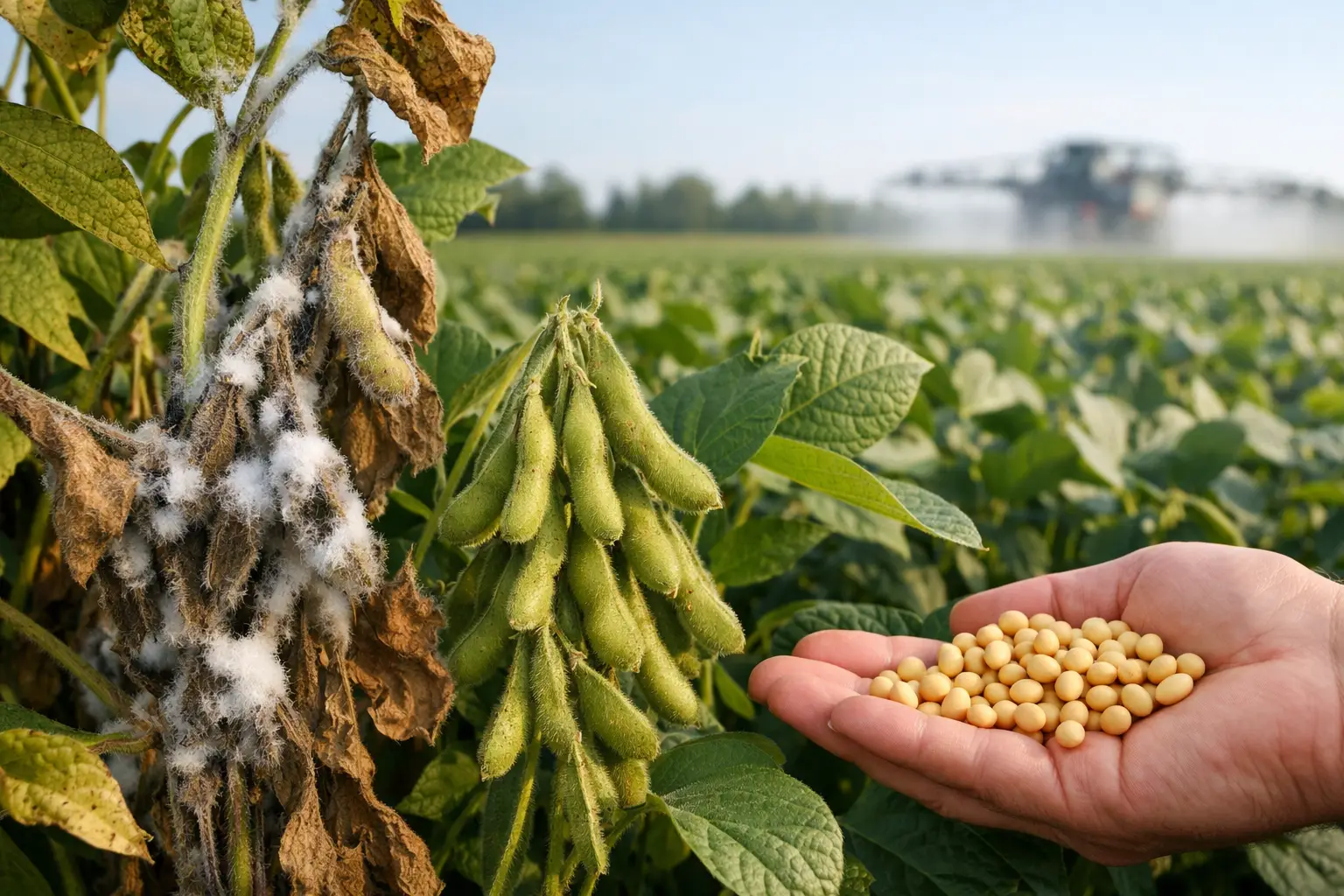
Soybean White Mold Control That Protects Yield
White mold losses are rarely the result of one missed spray. They are usually the outcome of a favorable microclimate, a susceptible variety, dense canopy growth, infested field history, and fungicide decisions made without a clear disease-risk assessment. Effective soybean white mold control requires managing that system before flowering, then executing precisely during the period when infection is most likely.
White mold, caused by Sclerotinia sclerotiorum, is a high-consequence disease in many soybean-producing regions. It can reduce standability, interfere with harvest, and cause substantial yield loss in localized areas that expand over seasons. For commercial operations, the objective is not simply to react to visible symptoms. It is to identify high-risk fields, reduce the conditions that favor infection, and document outcomes well enough to improve the program each year.
Understand How White Mold Develops
The pathogen survives as sclerotia, hard black survival structures, in soil and crop residue. Under favorable soil moisture and temperature conditions, sclerotia produce small mushroom-like structures called apothecia. These release spores that are carried into the soybean canopy.
Spores do not typically infect healthy stems directly. They often colonize senescing flowers and then grow into nearby plant tissue when the canopy remains cool, humid, and wet. This is why flowering stage, canopy closure, and extended wetness are more relevant to fungicide timing than the appearance of obvious stem symptoms.
Quantitative disease modeling establishes specific microclimate thresholds for infection risk:
- Temperature Range: Optimum temperatures range between 15°C and 25°C, with absolute threshold bounds set from 7°C to 25°C.
- Relative Humidity: Humidity levels consistently between 85% and 100%.
- Conditions Duration: High-risk infection windows require these temperature and humidity conditions to persist for a duration of 4 consecutive days.
The classic field symptom is a bleached or tan lesion on the stem, often with white cottony fungal growth and black sclerotia inside or on the outside of stems. By the time these symptoms are widespread, preventive treatment opportunities have largely passed. Field teams should use symptoms to confirm disease distribution and refine future risk maps, not as the primary trigger for first applications.
Build a Field-Level Risk Assessment Before Bloom
A sound program starts with field segmentation. White mold pressure is seldom uniform across a farm. Low-lying zones, historically high-yielding areas with dense canopies, irrigated fields, and fields with previous white mold commonly deserve different management than lower-risk acres.
Field history is among the strongest predictors. Because sclerotia can persist for several years, a field with known white mold deserves attention even when the previous crop showed limited symptoms. Rotation can reduce inoculum pressure, particularly when non-host crops are used, but it is not a complete solution. S. sclerotiorum has a broad host range, and some rotation crops or broadleaf weeds can maintain the pathogen.
Risk assessment should combine several factors: field history, variety susceptibility, planting population, row spacing, fertility program, irrigation method and scheduling, crop growth stage, weather outlook, and expected canopy density. No single factor gives a reliable answer. A susceptible variety in narrow rows may still be low risk in a dry, open canopy, while a moderately tolerant variety can face high pressure in a dense, irrigated field with a history of disease.
For large operations, assign each field or management zone a practical risk category before R1. This allows managers to prioritize scouting labor, fungicide inventory, applicator capacity, and irrigation adjustments where they are most likely to produce a return.
Canopy Management Is Part of Soybean White Mold Control
White mold is a canopy disease as much as it is a pathogen problem. Practices that create an overly dense, humid canopy can increase risk, especially where weather supports prolonged leaf wetness during flowering.
Seeding rate and row width should be evaluated together with local yield potential. High populations and narrow rows may support yield in some environments, but they can also accelerate canopy closure and restrict air movement. The right population is not a universal number. It depends on soil productivity, planting date, variety architecture, expected moisture, and historical white mold pressure. In fields with recurring disease, reducing an excessive population can be a more durable intervention than adding another reactive input.
Fertility decisions also require discipline. Excessive nitrogen availability can encourage vegetative growth and create a denser canopy, particularly where manure or previous crop credits are not properly accounted for. This does not mean underfeeding the crop. It means basing nutrient decisions on realistic yield targets, soil test results, organic nutrient sources, and field-specific crop demand.
Irrigation management deserves equal attention. Water stress during reproductive growth can reduce yield, but frequent irrigation that keeps the canopy and soil surface wet through flowering may favor apothecia development and infection. Where irrigation flexibility exists, schedule applications around crop water demand, rainfall, soil moisture, and disease risk. Avoid treating irrigation solely as a fixed calendar operation during the most sensitive flowering period.
Time Fungicides for Prevention, Not Symptoms
Fungicides can be an effective component of soybean white mold control, but they are preventive tools. Their value depends on product selection, timing, coverage, disease pressure, and the rest of the production system.
Applications are commonly targeted around early flowering through full bloom, often beginning near R1 and extending toward R3 depending on risk, product label, weather, and canopy development. The goal is to protect flowers and susceptible tissue before or during the infection window. An application made after stem lesions are visible will not reverse established disease.
When selecting active ingredients, product decisions should align with FRAC classifications, modes of action, and chemical mobility. Example active ingredients include:
- Boscalid (e.g., Agroboss 50 WDG): FRAC Group 7 (Succinate-dehydrogenase inhibitors / SDHI). Mode of action C2 (Respiration inhibition) with systemic mobility.
- Propiconazole (e.g., Eradicate): FRAC Group 3 (DMI-fungicides / DeMethylation Inhibitors). Mode of action G1 (Sterol biosynthesis in membranes) with systemic mobility. Often co-formulated with Azoxystrobin (EC).
- Flutriafol (e.g., Topguard): FRAC Group 3 (DMI-fungicides / DeMethylation Inhibitors). Mode of action G1 (Sterol biosynthesis in membranes) with systemic mobility (SC formulation).
- Coniothyrium minitans: A biological mycoparasite targeting Sclerotinia sclerotiorum. It offers systemic mobility, an Environmental Impact Quotient (EIQ) of 8.97 per kg/ha, and functions as a biological control to reduce sclerotia load prior to bloom.
A single application may be sufficient in lower-risk situations. In fields with a strong disease history, a dense canopy, prolonged favorable weather, and an extended flowering period, a second application may be justified. The decision should be based on incremental risk and expected return, not on a routine two-pass program across every acre.
Coverage is a frequent operational limitation. White mold infection occurs within the canopy, so nozzle choice, carrier volume, droplet spectrum, boom height, travel speed, and canopy penetration matter. A product with strong efficacy can underperform if insufficient spray reaches the flowering zone. Ground and aerial applications each have trade-offs. Ground equipment can provide greater carrier volume and coverage potential, while aerial application may preserve timeliness when fields are wet or crop height limits ground access. The best option is the one that delivers labeled application quality during the real infection window.
Fungicide stewardship also matters. Follow labeled rates, preharvest intervals, and resistance-management guidance. Avoid cutting rates to stretch inventory. Partial rates may compromise control and create poor-quality performance data for future decisions.
Use Varieties and Rotation as Long-Term Risk Controls
Variety selection is one of the few decisions made before planting that can materially influence white mold risk. Ratings differ among seed suppliers and environments, so use local performance data where available rather than assuming a general tolerance claim will translate across every field.
Partial resistance does not eliminate the need for canopy and fungicide management in a high-risk setting. Its practical value is that it can reduce disease severity, provide more decision flexibility, and improve the economics of a broader integrated program. For operations managing many fields, placing the most tolerant varieties in historically infested acres is often more strategic than treating all acres as equivalent.
Rotation should be viewed as inoculum management, not eradication. Cereals and grasses can help interrupt the disease cycle, while crops that are susceptible hosts may preserve risk. Weed control also belongs in the discussion because broadleaf weeds can support the pathogen and complicate canopy airflow. The rotation plan should be assessed across the full farm, especially where land is leased, fields are exchanged, or crops move between production units.
Make Scouting and Data Collection Operational
Scouting should begin before flowering and continue through reproductive development. Before bloom, confirm stand density, row closure, crop vigor, wet areas, and previous disease zones. During bloom, inspect the lower and middle canopy for flower retention, humidity, and early symptoms in known hotspots. After symptoms develop, map their location and severity rather than relying on a general field impression.
Digital field records can turn this information into better recommendations. Record planting date, variety, seeding rate, row spacing, fertility sources, irrigation events, fungicide products and timings, application conditions, weather patterns, disease incidence, and yield. Yield maps are particularly useful when interpreted alongside disease maps, because white mold losses may be obscured by other yield-limiting factors.
Remote sensing can help identify unusual vigor patterns, wet zones, and areas for targeted inspection, but it cannot diagnose white mold reliably on its own. Satellite or drone imagery should guide ground truthing. The decision value comes from combining imagery with field observations, crop-stage records, and agronomic context.
Evaluate the Program After Harvest
Postharvest review is where experienced teams separate activity from improvement. Compare disease maps, yield results, application records, and field conditions across varieties and management zones. Ask whether fungicide timing matched flowering and weather risk, whether coverage was adequate, and whether dense-canopy areas repeatedly produced losses.
Do not judge a program only by whether white mold was present. In a high-pressure year, reduced severity and protected yield may represent a successful outcome. In a low-pressure year, a costly treatment may show little visible benefit. Multi-year field records provide the perspective needed to distinguish those situations.
The most effective white mold programs are built before the first flower opens, then refined through disciplined field evidence. When growers, agronomists, and application teams work from the same risk-based plan, each decision becomes more defensible and each season produces better information for the next one.












About Post Author
