

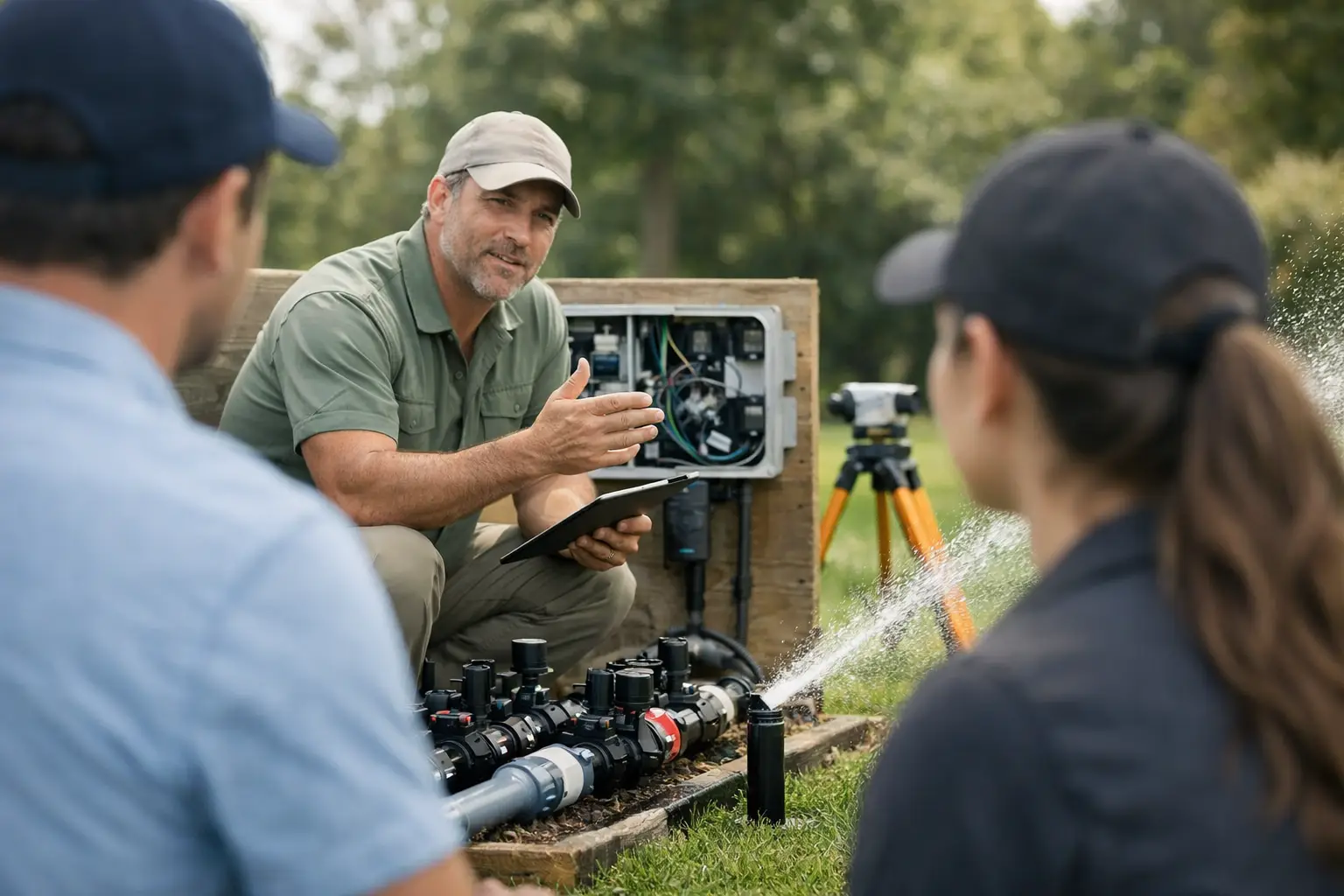
Professional Irrigation Certification Course
When irrigation errors show up in a commercial field, they rarely stay small. A weak scheduling decision can reduce yield, lower packout quality, increase disease pressure, waste pumping costs, and create nutrient losses that are hard to recover later in the season. That is why a professional irrigation certification course matters – not as a credential for its own sake, but as a structured way to improve field decisions where water, crop response, and economics intersect.
For agronomists, farm managers, irrigation specialists, and agribusiness teams, the right course should build practical competence. It should help professionals move beyond general advice such as “irrigate by evapotranspiration” or “install sensors” and into stronger judgment about when each method works, where it fails, and how to interpret field signals under real operating constraints. In commercial agriculture, that difference has direct financial value.
What a professional irrigation certification course should actually teach
A useful program starts with crop-water relations, but it cannot stop there. Participants need a working understanding of evapotranspiration, root-zone dynamics, infiltration, water-holding capacity, salinity risk, distribution uniformity, pressure variation, and the relationship between irrigation timing and nutrient movement. If the course treats these as separate topics, it misses the point. In the field, they interact every day.
For example, a farm manager may know that soil moisture sensors indicate depletion at one depth, while weather-based scheduling suggests a different irrigation trigger. A strong course explains why those differences happen. Rooting depth may be shallower than expected because of compaction. Sensor placement may be unrepresentative. A weather-based model may not reflect canopy development accurately. The value of certification training is not memorizing formulas. It is learning how to diagnose conflicting information before making a costly decision.
A serious curriculum should also address irrigation system performance. Drip, sprinkler, center pivot, microsprinkler, and surface systems each create different management requirements. Drip irrigation can offer high application precision, but only if filtration, pressure regulation, emitter maintenance, and pulse strategy are managed carefully. Sprinkler systems may support broader field coverage and frost or cooling functions in some crops, but wind drift, evaporation losses, and non-uniformity can reduce effective application. A professional audience needs this level of comparison because system choice and system management are not the same problem.
Core skills covered in a professional irrigation certification course
The strongest programs usually combine theory with applied measurement. That means participants should learn how to estimate crop water demand, audit irrigation systems, read pressure and flow data, evaluate soil moisture trends, and identify hydraulic or management issues that affect water delivery. Without those applied components, certification can become too academic for commercial use.
Scheduling is typically the center of the course, and it should be. But scheduling should be taught as a decision framework rather than a calendar exercise. In practice, irrigation timing depends on crop stage, soil texture, rooting depth, weather conditions, irrigation system capacity, labor availability, water quality, and the operational limits of the farm. During peak demand periods, the best schedule on paper may not be feasible. Professionals need to know how to prioritize blocks, protect the most sensitive growth stages, and reduce damage when water supply or pumping capacity becomes a constraint.
Water quality deserves more attention than many training programs give it. Poor-quality irrigation water can influence infiltration, soil structure, emitter clogging, and nutrient availability. Sodium hazard, bicarbonates, salinity load, and suspended solids are not side issues for large-scale production. They shape the performance of both the irrigation system and the crop. A professional course should connect water analysis results to field management choices rather than treating lab values as isolated numbers.
Why certification matters for agronomists and farm managers
For independent agronomists and consultants, certification can improve credibility, but the larger benefit is technical consistency. Irrigation recommendations often affect fertilizer efficiency, crop stress, and disease exposure. If irrigation advice is weak, the rest of the agronomic program can underperform. Formal training helps advisors speak with more confidence across disciplines, especially when working with fertigation, sensor interpretation, and crop-specific water management.
For farm managers, the value is often operational. Irrigation decisions sit at the intersection of labor, infrastructure, energy cost, and crop timing. A manager with stronger irrigation training is better positioned to question assumptions, identify weak system performance, and align field practice with production goals. That may mean reducing overirrigation in one block while increasing irrigation frequency in another, based on soil and crop response rather than habit.
For agribusinesses, food companies, and public-sector teams, certification can support more standardized field support across regions. That is especially relevant where teams advise growers across different climates, crops, and irrigation systems. A common technical framework helps improve recommendation quality, training consistency, and performance benchmarking.
How to evaluate a professional irrigation certification course
Not all courses are built for commercial agriculture. Some are too general, while others focus narrowly on design principles without enough field management application. The best way to evaluate a course is to look at the level of decisions it prepares people to make.
A strong program should be crop-relevant and commercially grounded. If the content never gets into rooting patterns, crop stages, deficit irrigation strategy, salinity management, or fertigation interactions, it may not meet the needs of professional users. The same is true if the course avoids field diagnostics. Irrigation management requires interpretation, not just technical terms.
Instruction quality matters as much as syllabus design. Trainers should have practical field experience, not just classroom knowledge. Commercial irrigation problems are often messy. Pressure loss may interact with terrain, block design, maintenance gaps, and pumping constraints. A course led by experienced practitioners is more likely to cover those real-world complications and the trade-offs behind good decisions.
Assessment style also matters. If certification only tests recall, it may say little about field readiness. Better programs evaluate practical interpretation: Can the participant review moisture data, weather demand, and system capacity, then recommend a workable irrigation plan? Can they identify causes of non-uniformity or explain why a crop is under stress despite recent irrigation? That level of assessment has much more professional value.
Professional irrigation certification course vs informal training
Informal training has its place. Many irrigation professionals learn from equipment suppliers, peer networks, local extension resources, and years of field troubleshooting. That experience is valuable, and no certification replaces it. But informal learning can leave gaps, especially when recommendations need to be consistent across teams or justified in a formal consulting or enterprise setting.
A professional irrigation certification course offers structure. It forces participants to connect hydraulic performance, plant response, soil behavior, and water management into one system. It also creates a shared language for discussing issues across agronomy, operations, and management.
That said, certification is not a guarantee of good judgment. Some professionals hold credentials but still rely too heavily on one tool or one scheduling philosophy. Others with no formal certification may have excellent field instincts. The best outcome is a combination of both: structured training supported by field observation, data interpretation, and ongoing review of results.
Where irrigation certification fits in a broader agronomy skill set
Irrigation should not be treated as a standalone specialty unless roles are highly segmented. In most commercial operations, irrigation decisions influence nutrition, disease pressure, root development, and final quality. Overirrigation can reduce oxygen in the root zone, leach nitrogen, and increase certain disease risks. Underirrigation can limit uptake, reduce fruit sizing, restrict canopy development, and lower marketable yield. A certification course is most valuable when participants understand those agronomic connections.
That is why many organizations benefit from pairing irrigation training with broader agronomy education. Teams responsible for crop programs need to understand how water management interacts with fertilization plans, pest pressure, and field variability. In practice, the best irrigation decisions are rarely made in isolation.
For organizations looking to build internal capability, a course should support measurable improvement. That may include better irrigation uniformity, fewer stress events, improved water productivity, lower runoff or drainage losses, stronger fertigation timing, or better use of sensors and weather data. Training should lead to performance changes, not just completion certificates.
A professional irrigation certification course is worth pursuing when it sharpens decisions under real field conditions. For serious agricultural professionals, that is the standard that matters. The right training does not just teach how irrigation works. It strengthens the judgment needed to use water more precisely, protect crop performance, and make better agronomic decisions when conditions are less than ideal.











About Post Author
