

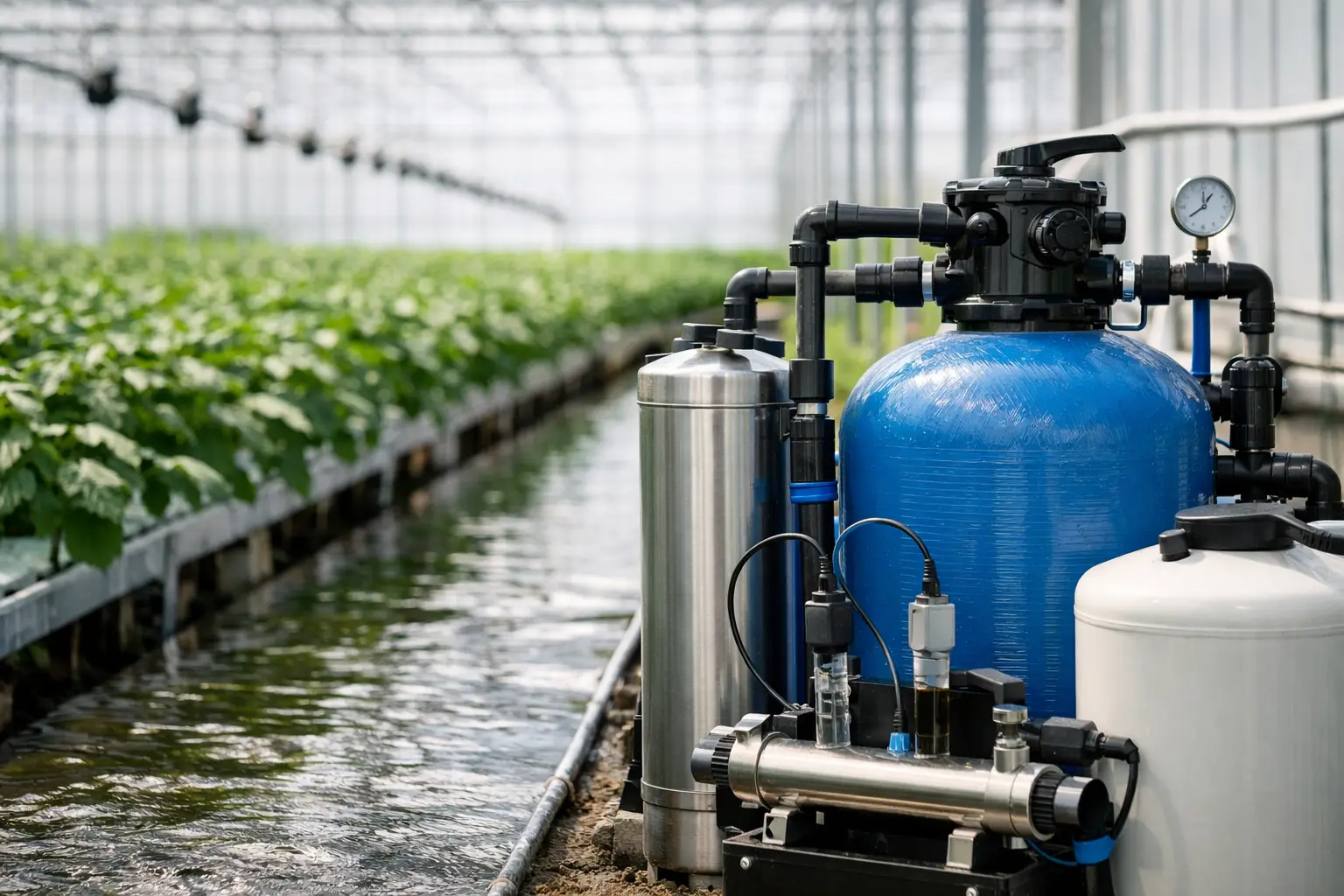
Greenhouse Water Treatment Guide for Growers
A fertigation tank that tests perfectly on Monday can still create nutrient lockout, emitter plugging, or root disease pressure by Friday if the source water is not under control. A practical greenhouse water treatment guide starts with that reality: irrigation water is not just a carrier. It is a production input that directly affects chemistry, biology, equipment performance, and crop uniformity.
For commercial greenhouse operations, water treatment should be managed with the same discipline applied to fertilizer programs, climate control, and crop protection. The right treatment strategy depends on source variability, crop sensitivity, irrigation method, and operational scale. There is no single treatment train that fits every facility, and that is exactly why many water problems persist longer than they should.
What a greenhouse water treatment guide should actually solve
In professional greenhouse production, water treatment is not only about making water “clean.” The real objective is to make water fit for purpose. That may mean reducing bicarbonates to stabilize pH, removing suspended solids to protect drippers, disinfecting recirculated water to reduce pathogen spread, or adjusting sodium and chloride risk where source quality is marginal.
The first mistake is treating all water issues as filtration problems. Many are chemical compatibility problems. Others are biological. A greenhouse using deep well water may face iron, manganese, and alkalinity challenges with low pathogen risk. Another operation using captured surface water may have acceptable chemistry but significant microbial pressure and seasonal turbidity spikes. The treatment design should reflect the dominant risk, not a generic equipment package.
Start with water analysis, not equipment
Before selecting any treatment method, build a complete water profile. At minimum, commercial growers should review pH, electrical conductivity, alkalinity, hardness, sodium, chloride, sulfate, bicarbonate, calcium, magnesium, iron, manganese, boron, and suspended solids. If the operation recirculates irrigation water, microbial testing and pathogen monitoring also become central.
One lab report is rarely enough. Greenhouse water quality often shifts by season, blending ratio, pumping depth, rainfall pattern, or storage conditions. If you are using multiple sources, test each source separately and test the blended water that actually reaches the crop. That distinction matters because treatment decisions are made at the point of use, not at the wellhead in isolation.
H3: Why source type changes treatment priorities
Groundwater tends to be more chemically stable, but it may carry elevated alkalinity, iron, manganese, or salts. Surface water usually shows greater seasonal fluctuation, more suspended solids, and higher biological risk. Reclaimed or recycled water can improve water security, but it requires tighter monitoring for salts, pathogens, and disinfection byproducts.
This is where agronomic context matters. A water profile that is manageable in a substrate-grown ornamental crop may be unacceptable for sensitive vegetable transplants or hydroponic leafy greens. Treatment targets should be crop- and system-specific.
The main treatment categories and where each fits
A strong greenhouse water treatment guide needs to separate treatment goals clearly because different technologies solve different problems.
Filtration protects the irrigation system first
Filtration removes physical particles such as sand, silt, organic debris, and precipitated material. Screen, disc, media, and sand separators each have a place depending on particle load and water source. For relatively clean groundwater, simple filtration may be enough upstream of drip systems. For surface water or recirculated water, a multi-stage approach is often more appropriate.
Filtration is essential, but it does not correct dissolved salts, alkalinity, or most microbial problems. Many operations overestimate what filters can do and then struggle with chemistry-driven clogging downstream.
Acidification manages alkalinity, not just pH
High alkalinity water continuously pushes the root zone and stock solution toward higher pH. That can reduce micronutrient availability, destabilize fertilizer programs, and create crop-specific deficiency symptoms even when nutrient concentrations look adequate on paper.
Acid injection is commonly used to neutralize bicarbonates. The goal is not simply to lower measured water pH for a moment. The goal is to reduce buffering capacity so the fertigation program can hold a workable root-zone pH over time. Nitric, phosphoric, and sulfuric acid can all be used, but each changes the nutrient balance differently. The choice should align with the fertilization program, crop demand, and safety protocols.
Disinfection reduces pathogen movement through water
Where irrigation water is recycled or sourced from ponds and canals, disinfection becomes a crop health tool. Common options include ultraviolet treatment, ozone, chlorine-based systems, peracetic acid, and slow sand filtration in some programs.
There is no perfect disinfection method. UV can be effective and leaves no residual, but water clarity must be high and shielding from suspended matter can reduce performance. Chlorine-based treatment provides residual protection in distribution lines, but dosage control, contact time, organic load, and phytotoxicity risk all need close management. Ozone is powerful, yet system complexity and capital cost are higher. The right choice depends on infrastructure, labor capacity, recirculation design, and biosecurity goals.
Reverse osmosis solves salinity problems, but at a cost
If sodium, chloride, or total dissolved solids are high, reverse osmosis may be the only reliable way to produce water suitable for high-value greenhouse crops. It is especially relevant where source water quality limits crop choice or causes chronic nutritional imbalance.
That said, reverse osmosis is not a casual upgrade. It increases capital cost, energy demand, maintenance requirements, and concentrate disposal needs. It also strips beneficial minerals, which means the fertigation program must be rebuilt around a very low-mineral water source. For some operations, blending treated and untreated water is the more economical solution.
Matching treatment to the actual greenhouse risk
The best treatment strategy is usually a treatment train, not a single device. A greenhouse with moderate alkalinity and clean well water may only need acidification and basic filtration. A hydroponic greenhouse recirculating drain water may need fine filtration, disinfection, oxidation control, and ongoing microbial verification. A nursery producing salt-sensitive crops in a coastal region may need partial desalination and tighter sodium management.
This is where decision-making should move from water quality numbers to production consequences. Ask which issue is currently costing the operation the most. Is it emitter plugging, pH drift, inconsistent nutrient uptake, disease transfer, or limited source suitability? Treatment should be prioritized against the most expensive constraint first.
Monitoring after installation is where most programs succeed or fail
Installing a treatment system does not mean the water problem is solved. It means the operation now has a process that must be verified. Commercial greenhouse managers should monitor not only source water but also post-treatment water, stock tanks, irrigation lines, and in many cases the delivered solution at the emitter.
A treatment system can underperform quietly. Filters can bypass solids. UV intensity can decline. Acid injection can drift out of calibration. Chlorine residual can disappear before water reaches the far end of the zone. Reverse osmosis membranes can foul gradually and still appear functional until crop symptoms become obvious.
H3: What to monitor routinely
At a minimum, routine monitoring should include pH, EC, alkalinity where relevant, pressure differentials across filters, and verification that treatment setpoints are actually being achieved. In recirculating systems, microbial testing and sanitation performance checks should be scheduled, not done only after a disease event.
Good greenhouse teams also connect water treatment data with crop response. If root-zone pH rises despite acidification, the issue may be injection accuracy, source variation, substrate buffering, or fertilizer composition. Water management should be integrated with agronomy, not separated as a maintenance task.
Common mistakes in greenhouse water treatment
The most common mistake is buying technology before defining the problem clearly. The second is relying on a single annual water test. The third is treating irrigation water as an engineering issue only, without considering crop sensitivity and fertigation compatibility.
Another frequent problem is focusing on average values instead of operational peaks. A greenhouse may tolerate average turbidity or acceptable average sodium, yet short periods of poor water quality can trigger plugging, crop stress, or nutrient antagonism. For that reason, trend data is often more useful than isolated test results.
Large operations should also consider training as part of the treatment plan. Even well-designed systems fail when staff are not trained to interpret readings, calibrate dosing equipment, or recognize early warning signs. That is one reason companies such as Cropaia emphasize practical agronomic training alongside technical advisory work.
Greenhouse water treatment guide for long-term decisions
Water treatment should support business resilience, not just daily irrigation. If your greenhouse is expanding, shifting crops, increasing recirculation, or operating under tighter sustainability targets, the treatment system should be evaluated against future demand as well as current use.
A treatment setup that is adequate for today’s crop mix may become a limiting factor when moving into more sensitive varieties or more intensive fertigation programs. The strongest operations review water treatment as part of broader production strategy, including irrigation uniformity, fertilizer efficiency, disease prevention, and compliance requirements.
The useful question is not whether water can be treated. It is whether the treatment approach improves crop consistency enough to justify its cost, complexity, and management load. When that question is answered with field data instead of assumptions, water treatment becomes a measurable production advantage rather than a recurring source of uncertainty.
The growers who gain the most from water treatment are not always the ones with the most equipment. They are the ones who understand their water, match treatment to agronomic risk, and keep verifying performance after the system is installed.










About Post Author
