

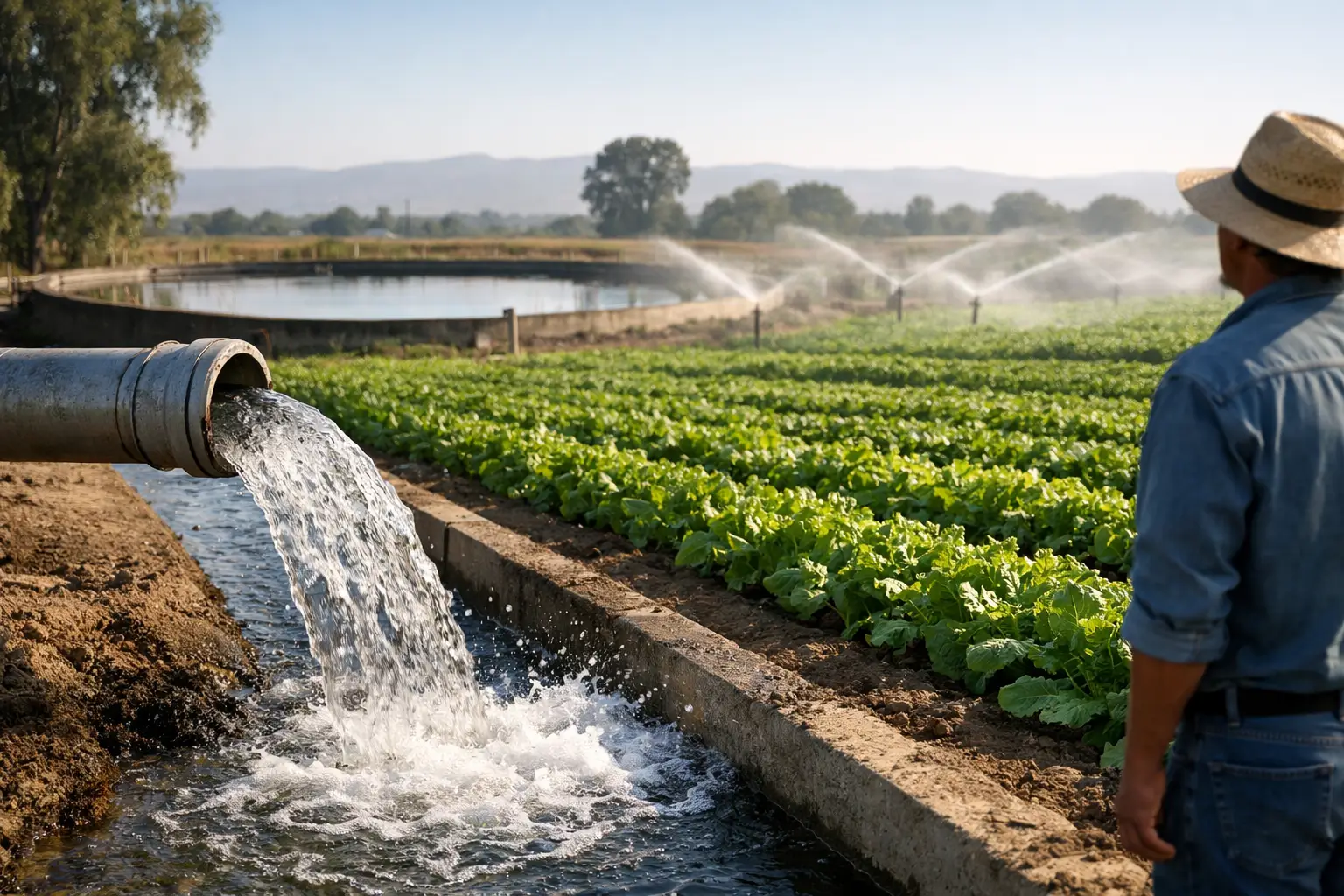
Water Reuse in Agriculture: What Works
A farm can have enough water on paper and still face a real irrigation problem in the field. That is often the starting point for water reuse in agriculture. The issue is not only access to more water. It is whether the reused source fits the crop, the soil, the irrigation system, and the market requirements without creating new agronomic or compliance risks.
For commercial operations, reused water is no longer a niche option reserved for arid regions or emergency planning. It is becoming part of mainstream water strategy for permanent crops, row crops, forage systems, and food supply chains under pressure from drought, regulation, and competing urban demand. The opportunity is significant, but so is the margin for error. Water reuse works best when it is treated as an agronomic input that must be characterized, monitored, and managed with the same discipline applied to fertility and crop protection.
Why water reuse in agriculture is gaining ground
The business case has strengthened. In many production regions, freshwater allocations are less predictable, pumping costs are rising, and growers are being asked to document resource efficiency more rigorously. Reclaimed municipal water, food processing wastewater, drainage recovery, and other nontraditional sources can provide volume and reliability where conventional supplies are no longer sufficient.
That said, reliability of supply does not automatically mean suitability of use. A reused source may help stabilize irrigation scheduling, but if salinity climbs, sodium accumulates, or suspended solids plug emitters, the operational gain can turn into a yield penalty. This is why serious water reuse programs are built around source characterization, treatment fit, and field-level management, not just access agreements.
Not all reused water is agronomically equal
The term reused water covers very different water streams. Municipal reclaimed water is the most widely discussed, but even within that category, quality can vary by treatment process, industrial inputs into the sewer system, and seasonal plant performance. Food and beverage processing water may have value in local reuse systems, but nutrient load, organic matter, and variability need careful handling. Agricultural drainage recovery can extend water supplies, yet it often concentrates salts and specific ions that matter greatly in sensitive crops.
For agronomic decision-making, the first question is not whether the water is legally classified as reusable. The first question is whether its chemistry and biological profile fit the production system. That means looking beyond a basic lab report. Electrical conductivity, sodium adsorption ratio, chloride, boron, bicarbonates, pH, total suspended solids, and pathogen indicators all influence whether the water can be used safely and efficiently. In many cases, nutrient content also deserves attention because reused water can contribute meaningful nitrogen, phosphorus, potassium, or sulfur. That can reduce fertilizer demand, but only if the nutrient load is consistent enough to count in the program.
Water quality decisions should start with crop sensitivity
Crop tolerance is the practical center of the decision. A reused water source that performs acceptably in forage or cotton may be a poor fit for berries, leafy vegetables, or young orchard plantings. Permanent crops deserve particular caution because water quality problems can create long-term root zone issues that are costly to correct. High chloride or boron, for example, may not trigger immediate failure, but repeated use can reduce vigor, compromise fruit quality, and shorten productive lifespan.
Growth stage also matters. Some crops can tolerate lower-quality water during vegetative periods but not during germination, establishment, or specific quality-sensitive windows. This opens the door to blended or staged strategies, where better water is reserved for the most sensitive periods and reused water is applied when tolerance is higher. The right answer depends on the crop, market destination, and irrigation method.
Irrigation system choice can make or break performance
Water reuse in agriculture is not only a water quality issue. It is a system design issue. The same source can behave very differently under drip, sprinkler, or surface irrigation.
Drip irrigation offers precision and can reduce foliar contact, which is useful where microbial risk or food safety exposure is a concern. But drip is also less forgiving when suspended solids, biofilm, iron, manganese, or organic matter are present. Filtration, flushing capacity, and chemical treatment become central management points. If these are underbuilt, plugging risk rises quickly and distribution uniformity falls before the problem is fully visible.
Sprinkler systems can sometimes tolerate certain physical water quality issues better than drip, but they introduce other concerns. Foliar deposition of salts can damage sensitive crops, and direct contact with harvested plant parts may not fit food safety protocols in some operations. Surface systems may handle solids differently again, yet they can worsen infiltration issues where sodium is high and soil structure is vulnerable.
This is where technical comparison matters. A water source should not be judged in isolation. It should be evaluated against the delivery system, filtration package, maintenance protocol, and labor capacity needed to keep performance stable over time.
The main agronomic risks are manageable, but not optional
Salinity is usually the headline risk, and for good reason. It affects water uptake, root function, nutrient balance, and ultimately yield. But sodium deserves equal attention because infiltration decline can become the hidden limiter in reused water programs. A field may receive enough water by volume while the soil accepts it less effectively over time.
Specific ion toxicity is another major concern. Chloride and boron are common examples, especially in sensitive horticultural crops. Nutrient imbalance can also develop where reused water contains high nitrogen or bicarbonate. What looks beneficial on a water report can distort the fertility plan if not integrated correctly. Excess ammonium, nitrate, or phosphorus may push vegetative growth, affect fruit quality, or raise leaching concerns depending on the crop and soil.
Pathogens are often discussed from a regulatory perspective, but the field reality is more nuanced. Risk depends on crop type, irrigation method, treatment level, and time between irrigation and harvest. The answer is rarely a simple yes or no. It is a matter of matching source, treatment, and application practice to the crop use case.
How to evaluate water reuse in agriculture before scaling
The best programs start small and measure aggressively. Before expanding across large acreage, run a pilot with representative blocks, soils, and irrigation equipment. One season of structured monitoring is more valuable than broad assumptions based on general water standards.
A sound evaluation includes baseline and in-season water analysis, soil salinity and infiltration tracking, emitter performance checks, and tissue monitoring where ion accumulation is a concern. Compare not only yield, but also packout, quality traits, maintenance burden, and fertilizer adjustment needs. In processing crops and contract production, quality specifications may matter as much as tonnage.
Blending is often an effective strategy, especially where the reused source is marginal rather than clearly suitable. A partial blend with better-quality water can lower salinity, reduce sodium hazard, and improve operational flexibility. The economics depend on infrastructure and water pricing, but agronomically it can shift a risky source into a workable one.
For enterprise operations and public-sector programs, decision frameworks should include more than agronomy. Monitoring costs, treatment reliability, labor requirements, reporting obligations, and market acceptance all affect long-term viability. This is where unbiased technical review is essential. A water reuse project that looks efficient in a planning document can fail in execution if field constraints were underestimated.
Monitoring is where most water reuse programs succeed or fail
Too many projects rely on initial water testing and then move into routine use with limited follow-up. That is a mistake. Reused water quality can shift with season, upstream discharges, rainfall events, treatment plant performance, and storage conditions. A static management plan for a variable water source is not a management plan.
At minimum, commercial users should monitor the parameters most likely to affect crop performance and system integrity, then link those results to field action. Rising electrical conductivity may trigger extra leaching where feasible. Higher sodium hazard may justify gypsum or other infiltration-support strategies depending on the soil. Increased suspended solids may require filtration changes or more frequent flushing. The key is not collecting more data for its own sake. It is creating operational thresholds that prompt timely action.
Digital tools can improve this process, especially when water quality data, irrigation records, soil measurements, and crop observations are reviewed together. Water reuse is a classic example of why data alone does not improve farming decisions. The value comes from interpretation, agronomic context, and disciplined field execution.
In practice, the strongest water reuse programs are rarely the ones with the most advanced treatment claims. They are the ones that match water source to crop sensitivity, invest in the right delivery system, and monitor performance closely enough to correct problems early. For organizations managing large acreages or supply chain commitments, that discipline turns reused water from a contingency plan into a credible production asset. If the goal is resilient agriculture, reused water deserves serious consideration, but only with agronomy at the center of the decision.











About Post Author
