


Fertilizer Compatibility: How to Avoid Mixing Problems
Fertilizer compatibility describes whether two or more fertilizer materials can be mixed without causing precipitation, sediment formation, separation, excessive pH shift, or loss of nutrient availability. A fertilizer compatibility chart is used to screen these combinations before preparing a tank mix, fertigation solution, or foliar application.
However, compatibility is not determined by the fertilizer names alone. Water quality, concentration, temperature, formulation type, mixing order, and application method can all change the behavior of the final solution. For this reason, a chart should be used as a first screening tool, followed by a jar test when the combination, water source, or application conditions are uncertain.
For commercial operations, fertilizer compatibility is not a minor handling detail. It affects application efficiency, nutrient availability, equipment uptime, and crop response. In high-value systems and large-acre programs alike, a bad mix can turn a routine application into a costly correction.
What a fertilizer compatibility chart actually tells you
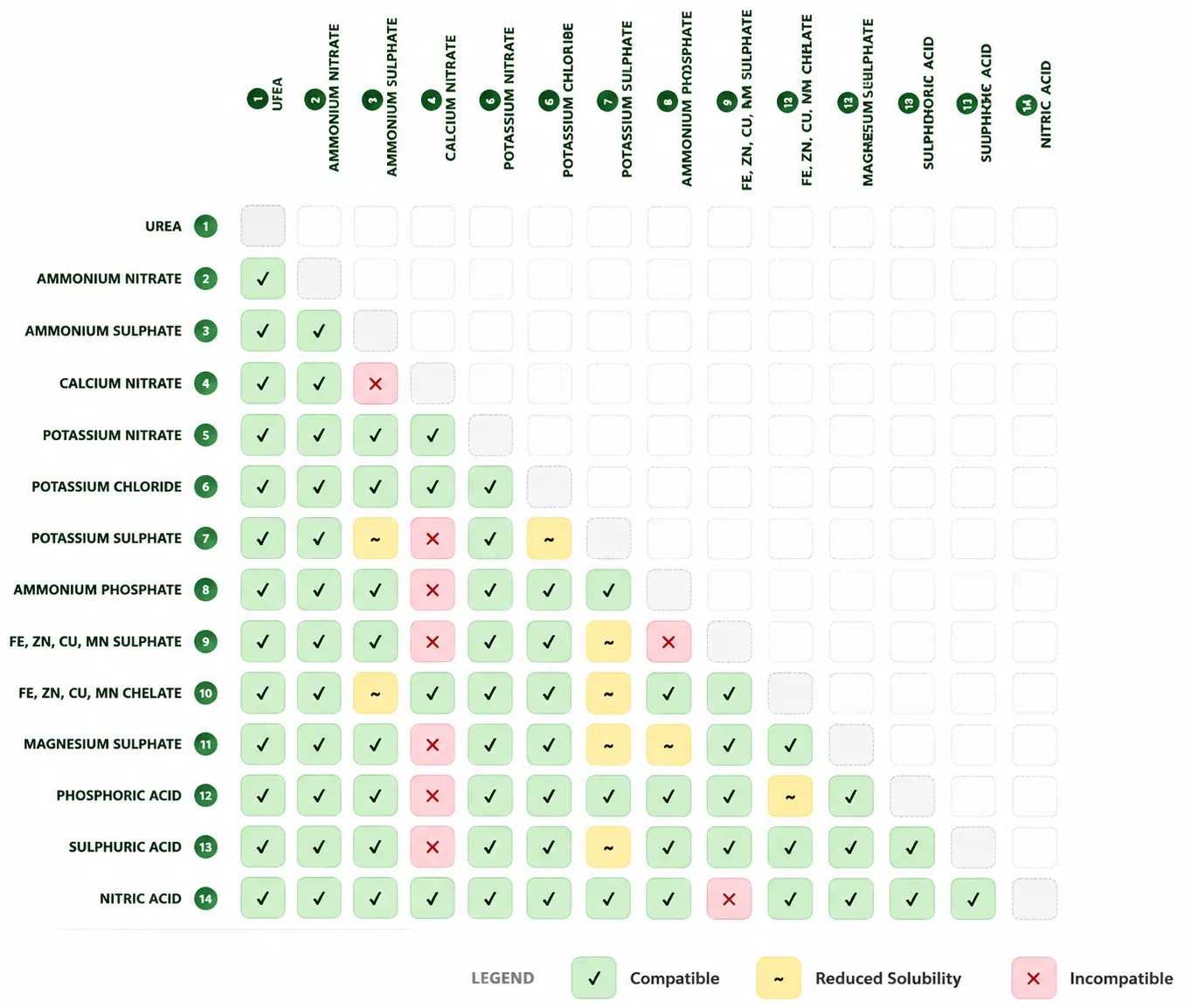
A compatibility chart is a starting point for predicting whether fertilizer materials can be mixed without creating physical or chemical problems. Most charts classify combinations as generally compatible, conditionally compatible, or incompatible. The interpretation is more nuanced than a simple yes-or-no classification.
Physical compatibility describes how long materials remain in solution or suspension to ensure uniform application. Chemical compatibility refers to reactions that may reduce nutrient availability, shift pH, or increase burn risk, even when the mixture remains physically stable.
This is why compatibility charts do not work in isolation. They require evaluation alongside water quality, formulation type, dilution rate, temperature, order of addition, crop stage, and application method.
Why compatibility fails in real field conditions
In practice, incompatibility typically results from three mechanisms. Precipitation occurs when dissolved ions form insoluble compounds, commonly involving calcium with phosphates or sulfates. Crystallization or “salting out” occurs when high concentration, low temperature, or insufficient dilution drive dissolved materials out of solution. Suspension instability appears when a mixture settles or separates during handling or application.
Water chemistry is often a stronger driver than product formulation. Hardness, bicarbonates, pH, and total dissolved salts can significantly change compatibility behavior. A mix that is stable in one water source may fail in another.
Formulation differences further increase variability. Products with similar nutrient content can behave differently depending on whether they are clear solutions, suspensions, chelated micronutrients, or complexed formulations.
Reading compatibility by chemistry, not only by N-P-K
Compatibility should not be evaluated only at the nutrient category level. Chemical form determines reaction behavior.
UAN is generally compatible with many liquid fertilizers, but sensitivity increases when combined with high phosphate loads, sulfur products, or micronutrients, especially at low temperatures. Ammonium polyphosphate is widely used but can still react with calcium-containing materials. Calcium nitrate remains one of the most frequent sources of precipitation when mixed with phosphates or sulfates.
Potassium thiosulfate is effective but condition-dependent, particularly in the presence of calcium or acidic environments. Micronutrient formulations may also destabilize mixtures depending on whether they are sulfate-based, chelated, or complexed.
The key question is therefore not nutrient pairing, but chemical compatibility under defined conditions.
Common combinations that require extra caution
Calcium with phosphate remains a high-risk combination due to insoluble calcium phosphate formation. Calcium with sulfates carries similar risk. High-analysis phosphate solutions mixed with metallic micronutrients may generate sediment depending on pH and concentration.
Thiosulfate-containing products can alter local chemical conditions and destabilize otherwise acceptable blends. Temperature can determine whether a mix remains stable or crystallizes during application.
Foliar applications require additional caution. Even physically stable mixtures can cause leaf injury due to high salt load, low pH, free ammonia, or aggressive adjuvant systems. Physical compatibility does not guarantee crop safety.
How to use a fertilizer compatibility chart correctly
A compatibility chart serves as a screening tool before testing, not as a final decision system. Product-specific formulation data is essential, as stabilizers, impurities, and pH adjustments can significantly alter behavior.
Application context must also be considered. Fertigation systems typically allow higher dilution and shorter residence time constraints compared to foliar applications, where sensitivity to concentration and mixing order is higher.
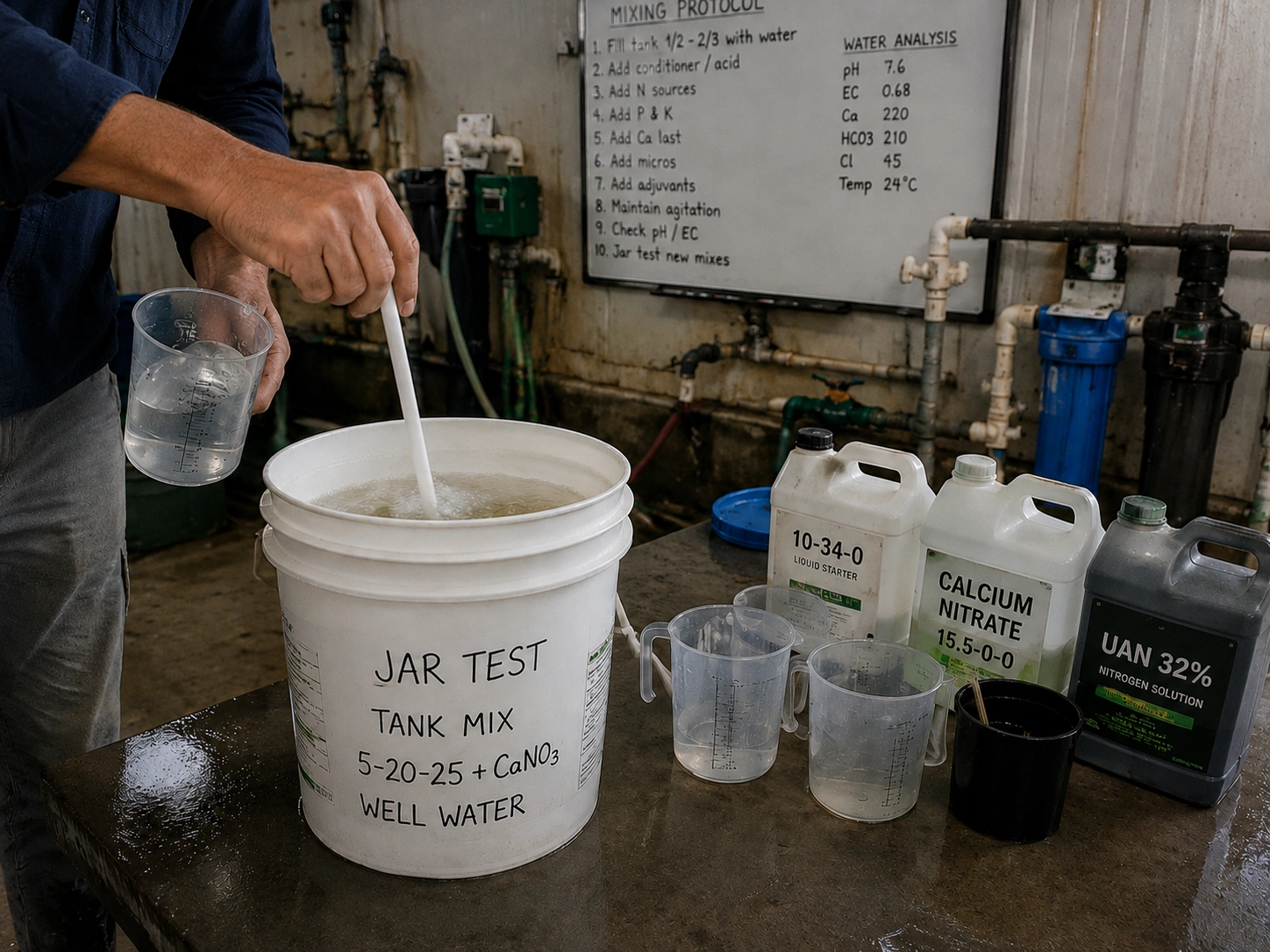
Field validation remains essential. A jar test using the actual water source, ratios, and mixing sequence is the most reliable method to detect precipitation, crystallization, or instability that is not visible in compatibility tables.
Practical limitations of compatibility charts
Compatibility charts do not fully capture variability between products that appear similar. Manufacturing differences, stabilizers, and formulation chemistry can significantly affect real behavior, particularly when switching brands.
Water quality introduces additional uncertainty. Hardness, bicarbonates, pH, and temperature can shift compatibility outcomes even when combinations are generally considered safe.
For this reason, compatibility charts must always be validated under real conditions through jar testing before field application. Even known compatible combinations should be re-tested when water source, product formulation, concentration, or temperature changes.
Field decision logic
Compatibility decisions should not start with “Can I mix this?”, but with whether the mix will remain stable and agronomically valid under actual field conditions.
This requires evaluating the system rather than the label:
1. Water constraints: hardness, bicarbonates, pH, salinity, temperature
2. Chemical interactions: calcium-phosphate risk, sulfate stability, micronutrient behavior, thiosulfate sensitivity
3. Formulation behavior: solution, suspension, chelate, complex, additive load
4. Concentration effects: salt load and dilution dynamics in the tank
5. Application mode: fertigation vs foliar vs soil (different tolerance thresholds)
6. Crop sensitivity: stage, stress level, canopy development, uptake capacity
7. Operational constraints: time-to-application, storage duration, agitation and transport
The output is not a binary classification but a practical risk judgment:
– Low risk: proceed under standard protocol
– Conditional: proceed only under defined constraints (pH, dilution, order, timing)
– High risk: redesign mix or separate applications
Mixing order is not a minor detail
Compatibility failures are often procedural. The same products can behave differently depending on mixing sequence and agitation.
In general, start by partially filling the tank with water, then add conditioners if required, followed by base fertilizers, micronutrients, and finally adjuvants, as this sequence reduces the risk of instability compared with mixing concentrated materials directly.
Agitation must be balanced. Insufficient mixing leads to settling, while excessive agitation may destabilize certain formulations or mask incompatibility until later in the system.
Compatibility is not the same as agronomic fit
A tank mix can be chemically compatible but agronomically inappropriate. Nutrient timing, placement strategy, and crop demand must be considered independently of tank stability.
Combining multiple nutrients into a single application may improve operational efficiency but can reduce agronomic precision. Similarly, a stable foliar mix may still perform poorly if environmental conditions limit uptake, or if nutrient ratios are misaligned with crop stage requirements.
Compatibility supports execution, but it does not replace agronomic decision-making.











About Post Author
