

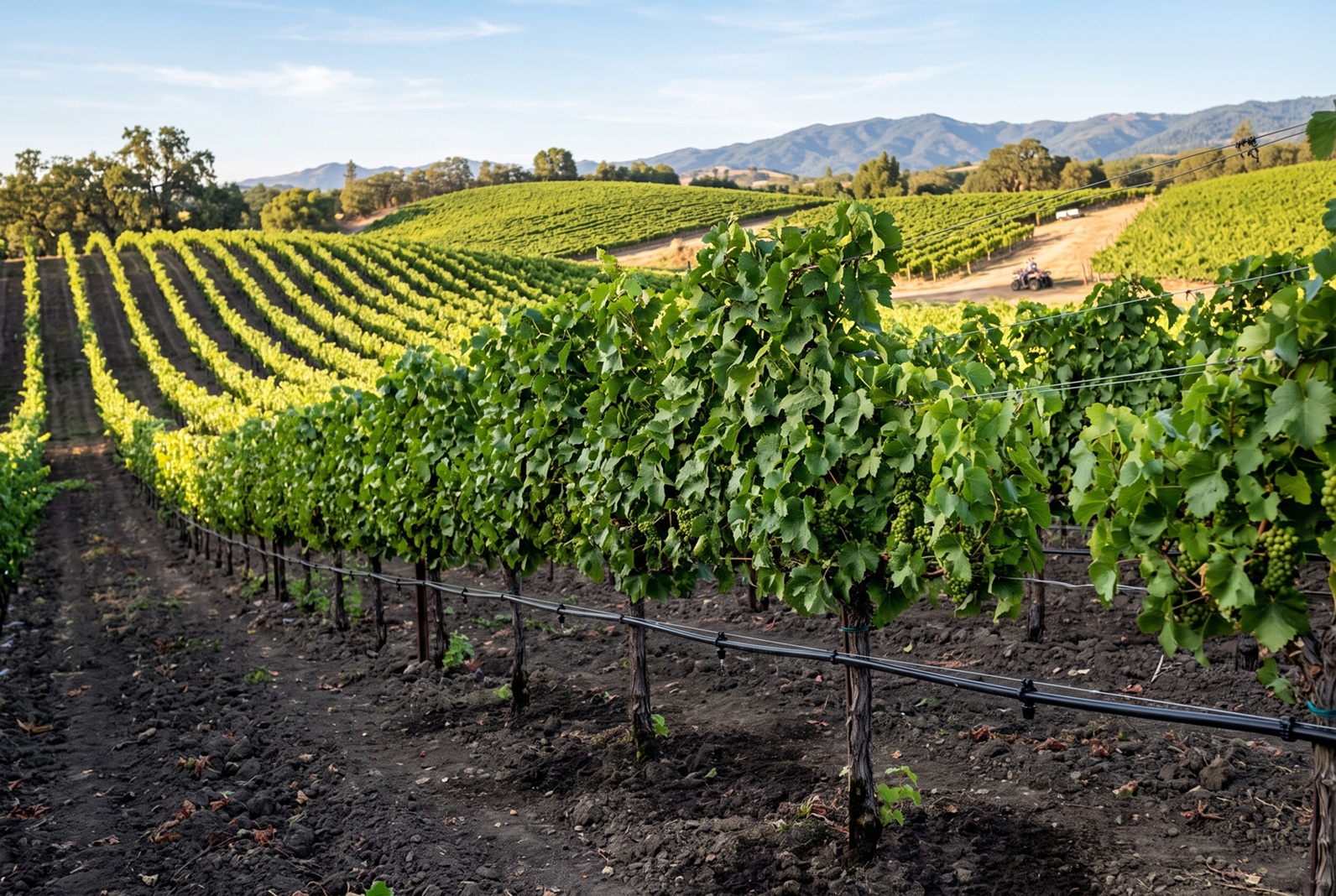
Vineyard Irrigation Planning for Yield and Quality
A vineyard can receive the correct seasonal volume of water and still be irrigated poorly. The usual problem is timing: water applied before the root zone needs it, stress imposed during a sensitive growth stage, or a uniform schedule applied to blocks that are not uniform. Effective vineyard irrigation planning converts a water allocation into field-specific decisions that support the intended balance of yield, canopy, berry composition, and vine longevity.
For commercial vineyards, irrigation is not simply a response to weather. It is a production input that interacts with soil depth, root distribution, cultivar, rootstock, crop load, trellis system, salinity, fertigation, and the market destination of the fruit. A plan built only around a weekly irrigation calendar cannot manage these interactions reliably.
Start Vineyard Irrigation Planning With Production Targets
The irrigation target should be defined before calculating run time. A vineyard producing high-yielding table grapes has a different water strategy from a block managed for concentrated red wine, and both differ from young vines being established in shallow or variable soils. The objective is not to minimize water use at all costs. It is to apply water deficits, when appropriate, without creating irreversible restrictions in canopy function, berry development, or bud fruitfulness for the following season.
Define the target by block, not by farm average. Record the cultivar, rootstock, vine age, spacing, training system, expected yield, soil limitations, irrigation method, and known variability. A vigorous block on deep loam may need a more controlled irrigation approach than a weak block on gravel, even when both are planted with the same variety.
Production targets also need to be realistic about water supply. When water is limited, the decision is often not whether to irrigate less, but where reduced irrigation will have the lowest commercial cost. That may mean protecting younger vineyards, higher-value varieties, or blocks with greater crop potential while accepting a controlled reduction elsewhere. This is a management decision that should be made before peak demand, not after vines show severe stress.
Build a Daily Water Balance, Then Verify It in the Field
A practical plan starts with crop evapotranspiration. Reference evapotranspiration, or ETo, estimates atmospheric demand from weather data. Crop evapotranspiration is calculated by adjusting ETo with a crop coefficient that reflects canopy size, ground cover, phenology, and the wetting pattern of drip irrigation.
The basic relationship is straightforward: ETc equals ETo multiplied by Kc. The difficult part is selecting a Kc that represents the actual vineyard rather than a generic vineyard value. A sparse young canopy, a fully developed vigorous canopy, and a hedged deficit-irrigated canopy do not intercept or transpire the same amount of water. Local weather stations, phenology records, and periodic canopy observations provide a much better starting point than a fixed seasonal coefficient.
Rainfall must also be treated carefully. A rain gauge may show 0.4 inches of rain, but only a portion may enter the active root zone. Intense rainfall can generate runoff, while light rain may only wet the soil surface. Effective rainfall depends on soil texture, slope, residue or cover, infiltration rate, and the depth of the wetted root zone.
The calculated water balance is a decision framework, not proof that the vine is adequately supplied. Verify it using soil moisture measurements, plant observations, irrigation-system flow data, and, where available, stem water potential or other validated plant-based indicators. Each method has limitations. Soil sensors can miss roots or represent only one soil layer. Plant measurements require disciplined timing and trained interpretation. Weather-based models can drift when canopy conditions differ from assumptions. Together, they are substantially more useful than any single measurement.
Match Irrigation to Phenology and Intended Stress
Water requirements are not constant through the season. Early shoot growth requires enough soil moisture to establish canopy area and support future fruit development. Excess irrigation at this stage, however, can encourage excessive vigor, shading, and disease-prone canopies in fertile soils.
From bloom through fruit set, severe stress can reduce berry set and final crop potential. The level of acceptable deficit depends on cultivar, fruit destination, canopy condition, and prior-season vine reserves. In blocks with weak growth or low carbohydrate reserves, aggressive early deficits can create problems that persist beyond one harvest.
The period after fruit set and before veraison is often where regulated deficit irrigation is considered. Moderate, carefully managed water restriction may control excessive vegetative growth and improve the balance between canopy and fruit in some wine grape systems. It is not a universal quality tool. If the root zone dries too quickly, high temperatures coincide with restriction, or crop load is excessive, the result can be reduced berry size, poor color development, sunburn exposure, and loss of yield.
After veraison, irrigation decisions must protect fruit function and harvest objectives. Excess water close to harvest can dilute soluble solids, increase berry splitting in susceptible varieties, or complicate disease management. Conversely, allowing extreme stress can stop ripening, reduce leaf area, and impair the vine’s ability to replenish reserves. The correct strategy depends on whether the block is destined for fresh market, juice, raisin, or a specific wine program.
Know the Root Zone Before Setting Run Times
Irrigation scheduling fails when it assumes that all soils store and release water similarly. A deep, well-structured soil may provide a large buffer between irrigations. A shallow, stony soil may require short, frequent events because the available water reservoir is limited. In layered soils, roots may be concentrated above a restrictive horizon even though the total soil profile appears deep.
Field assessment should establish effective rooting depth, texture by layer, bulk density or compaction risk, salinity, drainage constraints, and the location of the drip wetting front. These factors determine the readily available water that can be depleted before irrigation is needed. They also determine whether a long irrigation event moves water into the active root zone or below it.
Emitter spacing, discharge rate, and soil texture need to be considered together. Widely spaced emitters in coarse soil can create isolated wet bulbs and uneven vine access. High discharge rates on slow-infiltrating soil can cause surface runoff or ponding. System design limitations cannot be repaired through scheduling alone, but they should be visible in the plan so managers can adjust event length, pulse irrigations, or future infrastructure investments.
Include Water Quality, Salinity, and Fertigation
Water quantity is only one part of irrigation management. High electrical conductivity, sodium hazard, bicarbonates, chloride, and boron can change how irrigation should be scheduled and how fertilizer programs should be designed. Under saline conditions, a deficit strategy that looks acceptable on paper may increase salt concentration around active roots and reduce water uptake.
Leaching fractions should not be applied as a generic percentage. They must be justified by water quality, soil drainage, salinity monitoring, and the position of salts in the wetted profile. Extra water applied without adequate drainage can raise the water table or worsen root-zone oxygen stress. A soil and water analysis, followed by monitoring of saturation extract EC or a consistent field method, is essential where salinity is a material risk.
Fertigation should be synchronized with root activity, crop uptake, and irrigation frequency. Small, well-timed nutrient applications can improve distribution and reduce losses, but only if the irrigation event wets the intended root volume without pushing nutrients below it. Nitrogen applied late or excessively may sustain unwanted vigor and delay maturation. Potassium decisions need equal care because soil fixation, water quality, and crop demand can make simple concentration targets misleading.
Turn the Plan Into a Repeatable Operating System
A technically sound schedule has little value if irrigation crews cannot execute it consistently. Every block should have a current irrigation record that includes valve or zone identification, emitter flow, measured system pressure, application rate, planned run time, actual run time, rainfall, soil moisture observations, and exceptions such as repairs or water interruptions.
At scale, this becomes an operational coordination issue. A grower network, winery sourcing program, or cooperative may need consistent protocols while still allowing block-level adjustments. The central team needs visibility into whether recommendations were issued, whether irrigation was completed, what evidence supported a change, and which blocks require follow-up. Standardization should organize decisions, not erase agronomic judgment.
This is where Cropaia can support growers and technical teams with irrigation, fertigation, water-quality, and salinity reviews that connect field measurements to commercially defensible programs. For organizations managing many growers or farms, yieldsApp can structure irrigation protocols, field observations, task completion, exceptions, and traceable agronomic recommendations across the operation.
The strongest irrigation plans are revised throughout the season. Compare actual vine response, yield, berry quality, water use, and salinity results against the original assumptions. Each block then becomes a better-calibrated system for the next season, rather than another vineyard managed by a calendar that was never designed for its conditions.











About Post Author
