

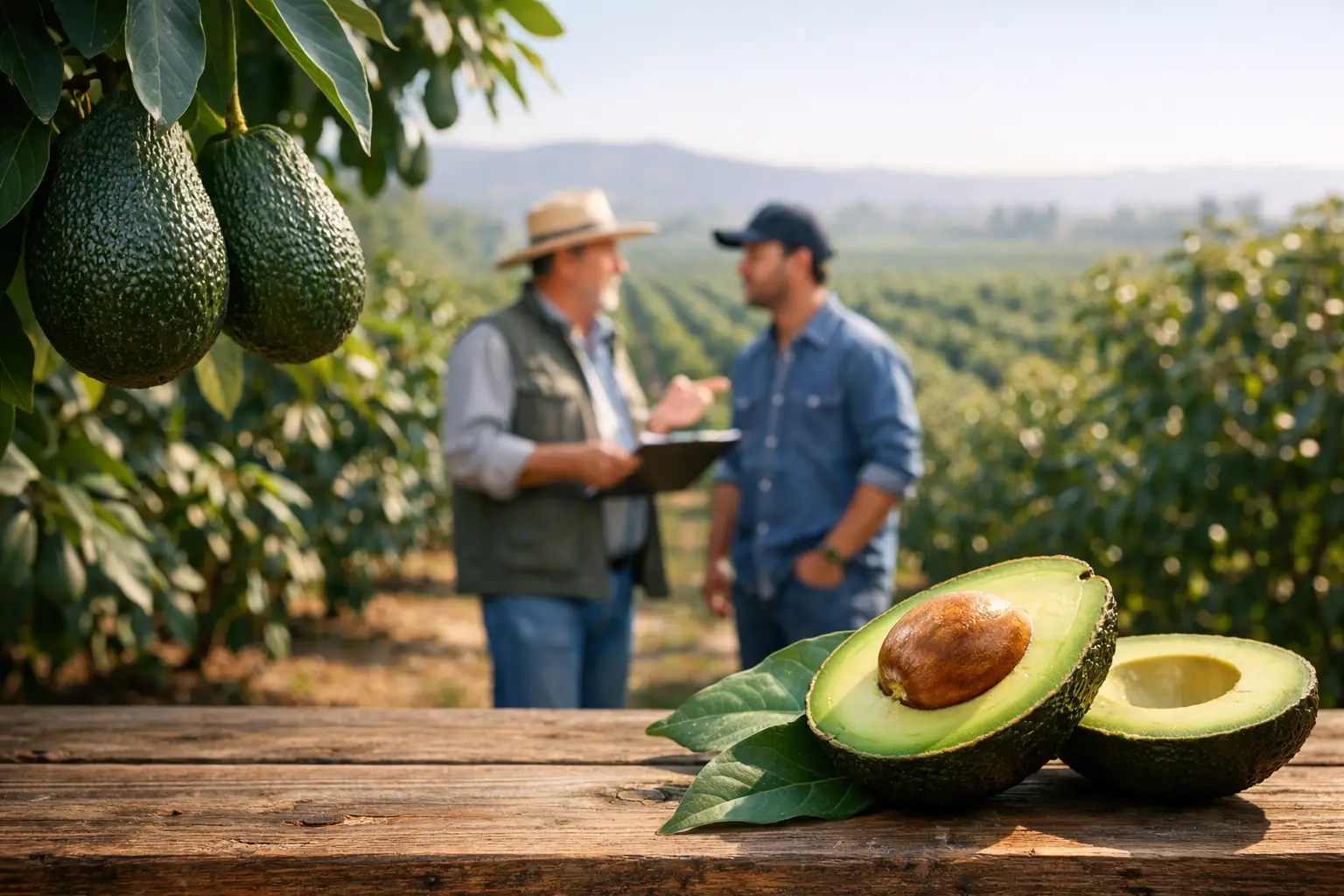
Best Avocado Nutrition Strategies for Commercial Farms
Avocado nutrition failures rarely begin with a missing fertilizer product. They usually begin when a sound-looking program ignores root activity, irrigation uniformity, salinity, cultivar, crop load, or the phenological stage of the orchard. The best avocado nutrition strategies treat fertilizer, water, soil conditions, and field monitoring as one management system rather than separate decisions.
For commercial orchards, the goal is not simply to produce greener canopies. It is to maintain productive roots, support consistent flowering and fruit set, carry the crop without excessive vegetative growth, and protect fruit size and quality. That requires field-specific decisions, particularly where water quality, soil texture, rootstock, and yield potential vary across blocks.
Start With Root-Zone Conditions, Not a Fertilizer Recipe
Avocado has a shallow, oxygen-sensitive root system. This makes nutrient availability highly dependent on irrigation management. A block can receive an adequate annual nitrogen, potassium, or calcium supply and still show deficiency symptoms if roots are stressed by saturation, poor drainage, high salinity, or poorly distributed irrigation.
Before changing a fertilizer program, assess water quality, soil texture, infiltration, emitter performance, drainage, and root-zone salinity. Chloride and sodium deserve close attention where groundwater or blended water is used. High bicarbonate water can also complicate phosphorus and micronutrient availability, especially in calcareous soils.
The practical implication is straightforward: fertigating more nutrients into a stressed root zone is not a correction. It can increase electrical conductivity around active roots and further restrict uptake. In heavy soils, shorter irrigations may be needed to avoid prolonged saturation. In sandy soils, frequent small applications may be necessary to keep nutrients in the active root zone without excessive leaching. The correct approach depends on the soil profile, irrigation system, water chemistry, and the distribution of active roots.
Build Nitrogen Around Crop Demand and Canopy Control
Nitrogen is necessary for leaf area, shoot growth, flowering support, and fruit development. It is also the nutrient most likely to be overapplied in avocado orchards. Excess nitrogen can encourage vigorous vegetative growth, shade the interior canopy, weaken flowering balance, and create a demand for additional pruning. It may also increase leaching losses in coarse soils or after heavy irrigation events.
A useful nitrogen strategy starts with realistic yield targets and the orchard’s current condition. Young, expanding orchards require a different approach than mature blocks carrying a heavy crop. An orchard with weak leaf color and low shoot extension may need more available nitrogen, but the cause may also be poor root health, waterlogging, low soil temperature, or a localized irrigation failure.
Split applications through the irrigation season rather than relying on a few large doses. This improves synchronization with root uptake and reduces losses. The timing should reflect local phenology: spring vegetative growth, bloom, fruit set, summer fruit development, and postharvest recovery do not carry the same nutritional priorities. However, phenology is not a calendar. It must be verified in the orchard, because elevation, cultivar, rootstock, and weather can shift crop stages materially between regions and even between blocks.
Leaf analysis remains essential, but it should not be read in isolation. A leaf nitrogen value can be within a published sufficiency range while the orchard is still receiving too much nitrogen for its crop load and canopy density. Yield records, pruning intensity, shoot growth, fruit size distribution, and irrigation data provide the operating context.
Manage Potassium Without Creating Salinity Pressure
Potassium is central to fruit growth, carbohydrate movement, water regulation, and marketable fruit size. Demand often rises as the fruit develops, especially in productive orchards. Yet potassium management has a real trade-off: heavy applications of potassium salts can increase root-zone salinity, particularly when irrigation water already contains elevated chloride or sodium.
The potassium source should be chosen with water quality and soil conditions in mind. Where chloride is a constraint, potassium chloride may be a poor fit even when it is the least-cost source per unit of nutrient. Potassium sulfate, potassium nitrate, or other fertigation-compatible sources may be more appropriate, but their cost, nitrogen contribution, compatibility, and application timing must be considered.
Do not assume that a high potassium rate will correct small fruit. Fruit size can be limited by poor pollination, excessive crop load, inadequate irrigation during key growth periods, restricted roots, canopy imbalance, or insufficient carbohydrate reserves. Potassium analysis and fruit sizing should guide the response, not a single visual observation.
Treat Calcium as a Water-Flow and Root-Health Question
Calcium is frequently discussed as a fertilizer input, but its movement in the plant depends largely on transpiration and functioning roots. Foliar calcium can have a place in a targeted program, yet it cannot replace root-zone calcium supply, balanced irrigation, and healthy feeder roots.
Calcium availability is often challenged by acidic soils with low base saturation, sodic conditions, salinity, or uneven soil moisture. In acidic soils, lime or gypsum decisions should follow soil analysis, depth-specific sampling, and an understanding of whether the objective is pH correction, calcium supply, sodium displacement, or improved soil structure. These are different problems and require different materials and application methods.
Overreliance on calcium foliar sprays is a common operational error. Spray programs can be difficult to execute consistently across large grower networks, and response is variable when coverage, timing, water volume, and tissue condition are not controlled. The first question should be whether the orchard’s irrigation and root environment allow calcium to move where it is needed.
Use Micronutrients With Evidence, Not Habit
Boron, zinc, iron, manganese, and other micronutrients can limit avocado performance, particularly in high-pH soils, calcareous conditions, or blocks with long-standing root restrictions. Boron deserves careful management around flowering and fruit set, but the margin between deficient and excessive supply is narrow. Applying it routinely without tissue and soil evidence creates unnecessary risk.
Zinc and iron responses are similarly dependent on soil pH, bicarbonate levels, root activity, source selection, and placement. A foliar application can provide a rapid, tactical response in some situations. It will not solve persistent iron chlorosis caused by high bicarbonate water, calcareous soil, and poor drainage. In those cases, the nutrition plan needs to be integrated with water and soil management.
A sound diagnostic process combines correctly timed leaf samples, soil samples from relevant depths, water analysis, field observations, irrigation records, and yield history. Sampling must also be consistent. Mixing leaves from different cultivars, age classes, soil types, or crop conditions can produce an average value that represents no actual management zone.
Convert Analysis Into Block-Level Decisions
The strongest avocado nutrition programs operate by management zone, not orchard average. Divide blocks when soil texture, water source, tree vigor, yield history, salinity risk, or irrigation design differs materially. This allows nitrogen and potassium timing, acidification, leaching management, and micronutrient interventions to be adjusted where they are economically justified.
For multi-farm operations, the technical recommendation is only half the work. Teams need a clear protocol for sampling, laboratory interpretation, fertilizer approval, irrigation verification, field observations, and follow-up. Without this operating discipline, the same problem is often diagnosed differently by each agronomist, and implementation becomes impossible to audit.
This is where Cropaia consulting can help commercial avocado operations review irrigation, fertilization, water quality, and analysis results as one production system. For organizations coordinating multiple orchards or independent growers, yieldsApp can turn approved nutrition protocols into assigned field actions, monitored compliance records, block-level observations, and comparable execution data across regions.
Monitor the Results That Matter
A nutrition program should be reviewed against more than fertilizer volume and laboratory values. Track applied nutrient units by block, irrigation volume and frequency, water electrical conductivity, soil salinity trends, leaf analysis, canopy condition, yield, packout, and fruit size distribution. When possible, compare results across similar management zones rather than across fundamentally different orchards.
The most useful review point is before the next season’s program is locked. Ask whether the orchard achieved the expected yield and size distribution, whether nutrient applications were actually delivered as planned, and whether water management limited uptake. If the answer is uncertain, the next action is better measurement and field diagnosis, not automatically a higher fertilizer rate.
Avocado nutrition rewards disciplined adjustment. Build the program from the roots upward, verify every major assumption with field data, and make the operational system strong enough that recommendations are carried out consistently.











About Post Author
