

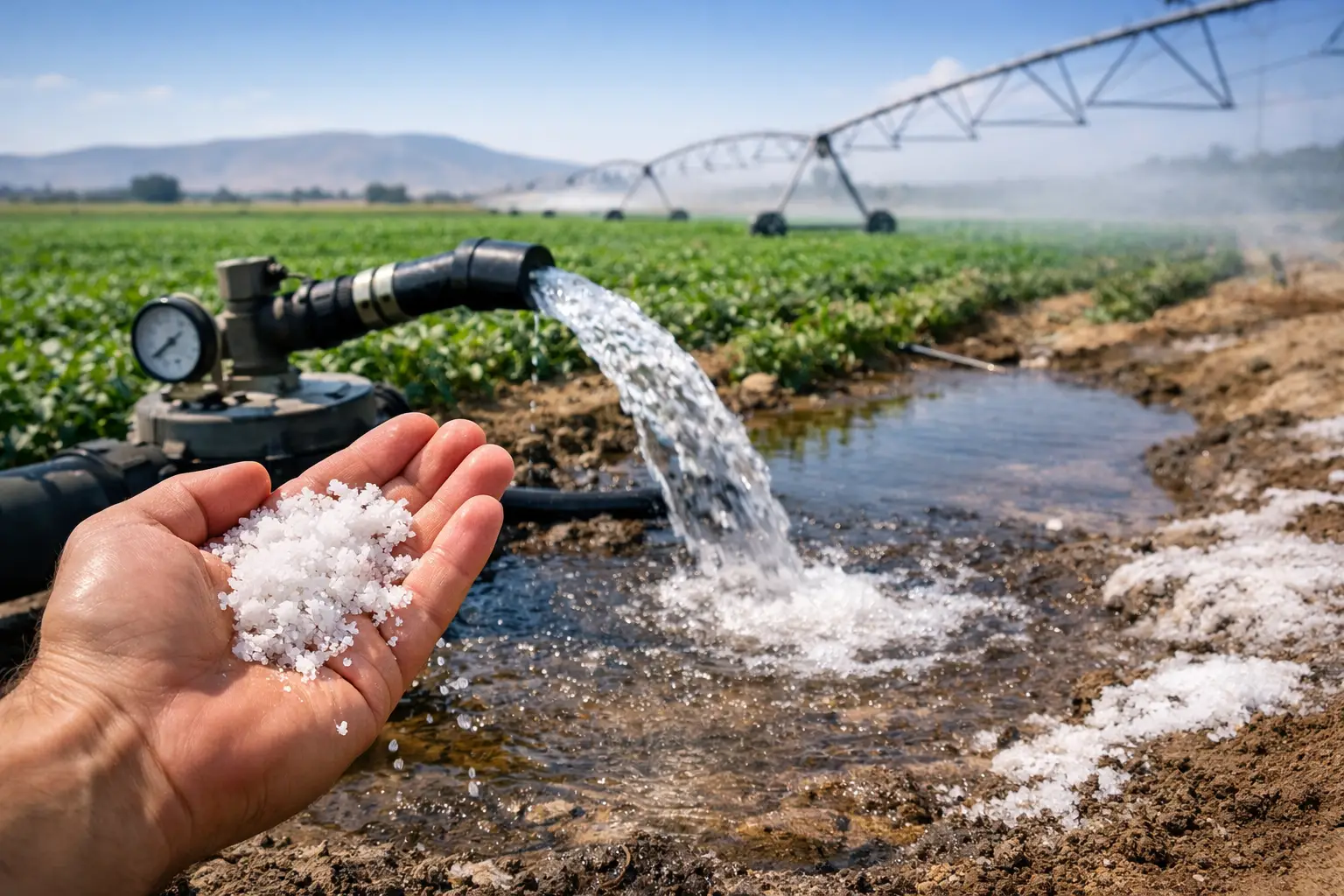
Salinity Management in Irrigation Water
A field can look well irrigated and still be under water stress. When irrigation water carries too much dissolved salt, the crop may struggle to take up water, specific ions can reach toxic levels, and the root zone can become progressively less productive. That is why salinity management in irrigation water is not a side issue. It is a core part of irrigation design, fertigation strategy, and long-term soil performance.
For growers, agronomists, and irrigation managers, the challenge is rarely just high salinity or low salinity. The real challenge is matching water quality to crop tolerance, soil conditions, climate, and irrigation method. Good decisions start with measurement, but they only deliver results when they are translated into field practices that fit the system.
What salinity in irrigation water actually does
Salinity is mainly the concentration of dissolved salts in water. In practical terms, irrigation water salinity is commonly evaluated through electrical conductivity, or EC. As EC rises, the osmotic potential of the soil solution becomes more negative, and plants need to expend more energy to absorb water.
This matters even when the soil appears moist. A crop can be surrounded by water and still behave as if it were drought-stressed because the salts in the root zone reduce water availability. The first visible effect is often slower growth rather than immediate leaf burn. In many crops, yield loss starts before obvious symptoms appear.
The second layer of risk comes from specific ions. Sodium, chloride, and boron can become problematic depending on crop sensitivity and concentration. Sodium also affects soil structure, especially when combined with low calcium levels and poor drainage. In that case, the issue is not only plant stress but also reduced infiltration, crusting, and poor aeration.
Salinity management in irrigation water starts with the right analysis
Many irrigation decisions are made from a single lab report, but one number is not enough. Effective salinity management in irrigation water requires a broader reading of water chemistry and how that chemistry interacts with soil.
EC is the starting point because it gives a quick picture of total salt load. But it should be reviewed together with sodium adsorption ratio, bicarbonate, chloride, boron, calcium, magnesium, and pH. In some cases, total dissolved solids are also reported, although EC is generally more useful for irrigation decisions.
Water source matters as well. Groundwater can be stable but consistently saline. Surface water may fluctuate by season. Reclaimed water can be agronomically useful, yet it often requires closer control of sodium, chloride, and pathogen-related management. Even within the same farm, different wells may produce materially different water quality.
Testing frequency should reflect variability and risk. A single annual test may be enough for a stable source with a long history. Where quality shifts during the season, more frequent sampling is justified. The cost of testing is small compared with the cost of managing yield loss after salts accumulate in the profile.
Crop tolerance is useful, but only within context
Crop salt tolerance tables are helpful, but they are often used too rigidly. A listed threshold does not mean a crop is safe below that point and damaged above it in the same way under all conditions. Tolerance depends on growth stage, rootstock, climate, soil texture, irrigation frequency, and whether salts are concentrated between irrigations.
For example, a moderately tolerant crop under drip irrigation in a well-drained sandy soil may perform better than the same crop under furrow irrigation in a heavier soil with shallow drainage. Likewise, a crop in a hot, dry climate may experience stronger salinity effects because evaporative demand is higher and salts concentrate faster around the roots.
Sensitive crops require tighter management margins. High-value horticultural crops often justify more aggressive monitoring, blending strategies, and leaching programs because even moderate salinity can reduce quality, not just tonnage.
The soil and irrigation system decide how severe the problem becomes
Water quality does not act alone. The same irrigation water can create very different outcomes depending on the soil and delivery method.
In coarse-textured soils, salts can be leached more easily, but the root zone may also respond quickly to irrigation gaps, especially in hot weather. In fine-textured soils, salts may accumulate more slowly at first yet become harder to remove once infiltration declines or drainage is limited. If sodium hazard is high, clay dispersion can reduce infiltration and make reclamation much more difficult.
Irrigation method changes where salts accumulate. With drip irrigation, salts are often pushed toward the edge of the wetting front, which can protect the active root zone when scheduling is precise. However, if irrigation volume is cut too far or emitter uniformity is poor, salts can move back into the main root area. Sprinkler irrigation raises additional concerns for foliar injury from chloride and sodium in sensitive crops. Surface irrigation can support leaching, but distribution uniformity is often less controlled.
Practical strategies for salinity management in irrigation water
The first step is usually not a major investment. It is operational discipline. Salinity can often be managed more effectively by improving irrigation scheduling, monitoring the root zone, and adjusting fertility practices than by reacting late with corrective measures.
Leaching is one of the main tools, but it needs to be applied with precision. Extra water is required to move salts below the active root zone, yet excessive leaching wastes water, moves nutrients beyond the roots, and can create groundwater concerns. The right leaching fraction depends on irrigation water salinity, crop tolerance, soil properties, and rainfall contribution.
Blending water sources can reduce salinity risk where infrastructure allows it. This is common when a farm has access to both lower-salinity surface water and more saline groundwater. The economics are site-specific. Blending can be highly effective, but it depends on reliable source availability and good mixing control.
Calcium-based amendments may be needed where sodium hazard threatens infiltration or soil structure. In those situations, gypsum is often considered, but its value depends on the actual chemistry. Applying gypsum without confirming sodium-related structural risk is not a management plan. It is an expense.
Fertigation also deserves close attention. Poor-quality irrigation water narrows the margin for fertilizer mistakes. Overapplication of nitrogen or potassium salts can increase osmotic stress in the root zone. Nutrient programs should be built with the water analysis in mind, especially in intensive production systems.
Drainage is the part many operations underestimate. If salts cannot move below the root zone and out of the system, they are only being redistributed. This is why farms with marginal water quality often succeed or fail based on drainage capacity, not only on irrigation volume.
Monitoring should focus on the root zone, not only the water source
A clean water report does not guarantee a clean root zone later in the season. Salts accumulate as plants take up water and leave much of the dissolved load behind. That is why soil and substrate monitoring are essential.
In open-field production, soil EC should be tracked by depth and position relative to the emitter or wetted area. In protected cultivation, substrate EC can change quickly and directly affect plant performance. Tension between vegetative growth and osmotic stress is especially relevant in fertigated systems where EC is intentionally manipulated.
Leaf tissue analysis can support diagnosis, particularly when chloride, sodium, or boron toxicity is suspected. Still, tissue results are most useful when interpreted alongside water and soil data. A single dataset rarely explains the full problem.
When higher salinity water can still be used successfully
Marginal water is not automatically unusable. In many regions, it is the only available source, and productive agriculture still depends on it. The key is to stop asking whether the water is good or bad in absolute terms and start asking under what conditions it can be used with acceptable risk.
That may involve shifting to more tolerant crops, using rootstocks with better ion exclusion, increasing irrigation frequency, improving uniformity, strengthening drainage, or changing the seasonal production window. Sometimes the correct decision is not to force a sensitive crop through poor water conditions, even if the infrastructure can technically deliver the water.
This is where unbiased agronomic assessment matters. The best answer is rarely a single product or a single threshold. It is a system decision that weighs crop value, water availability, soil limitations, and the cost of mitigation.
Salinity management rewards consistency more than occasional correction. Farms that measure regularly, interpret data correctly, and make timely adjustments usually protect both yield and soil function far better than farms that wait for visible damage. In irrigation, salts are easier to manage early than to remove later, and that is a useful principle to keep close at every stage of the season.











About Post Author
