



Fertilizer Uptake Efficiency in Commercial Crops
A crop can receive the correct fertilizer rate on paper and still leave a large share of that investment unavailable to roots. Fertilizer uptake efficiency is determined not only by the nutrient source and application rate, but by the timing, placement, root activity, irrigation management, soil chemistry, and operational consistency behind every application. For commercial farms, the question is not simply how much nutrient was applied. It is how much reached the active root zone, entered the plant at the required growth stage, and contributed to marketable yield and quality.
What Fertilizer Uptake Efficiency Really Measures
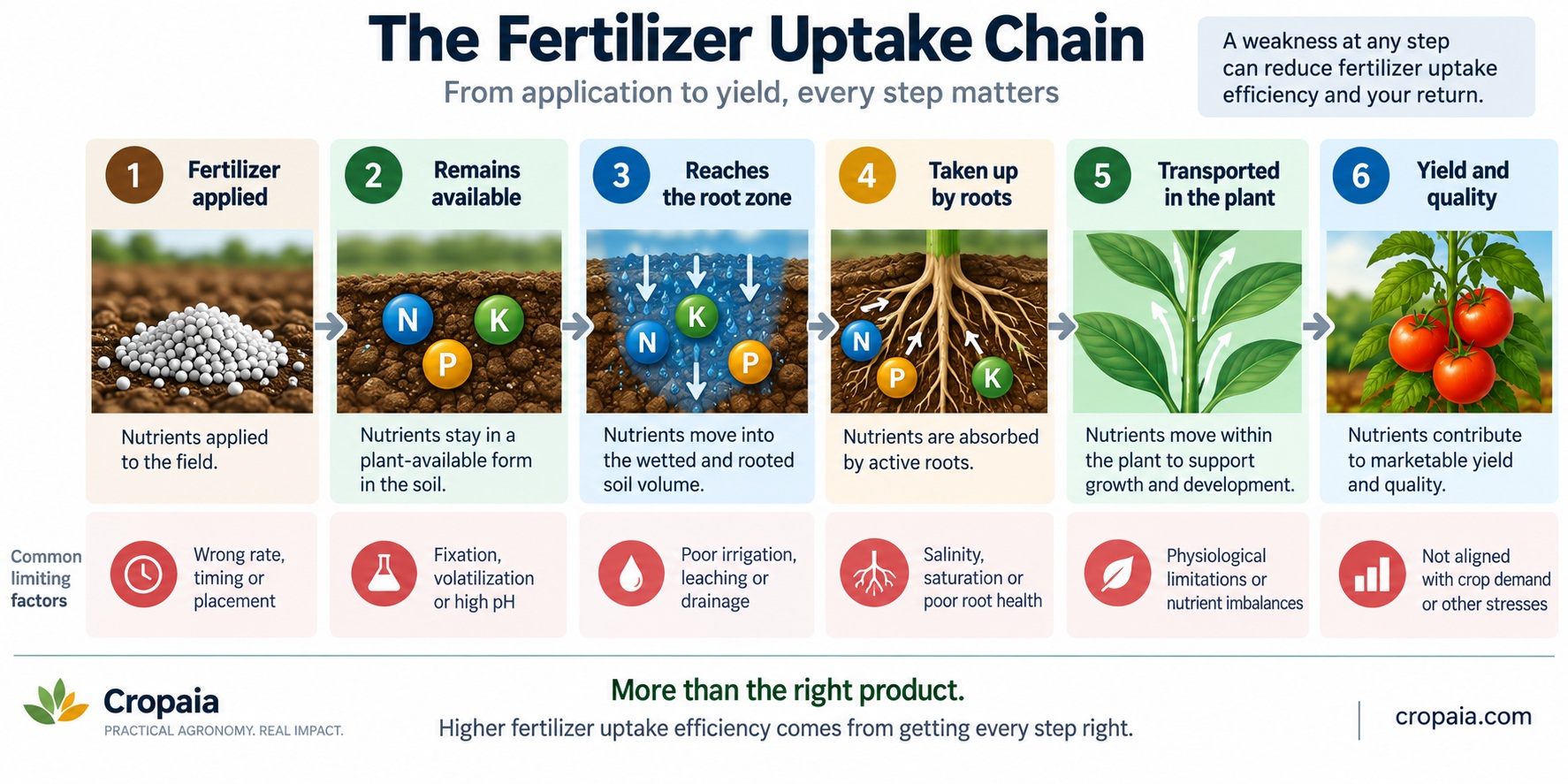
Fertilizer uptake efficiency is often discussed as a single metric, but it is better treated as a chain of processes. A nutrient must remain in a plant-available form, move into the wetted and rooted soil volume, be absorbed by active roots, translocate within the plant, and support a production objective. A failure at any point reduces the return on fertilizer investment.
This distinction matters because apparent low uptake does not always mean the fertilizer source was wrong. Nitrogen may be lost through volatilization, leaching, denitrification, or runoff. Phosphorus may be fixed in calcareous or highly weathered soils. Potassium may be present in soil tests but inaccessible where root density is low, soil moisture is inadequate, or cation balance is unfavorable. Micronutrients may be applied correctly yet become unavailable because of high pH, bicarbonates in irrigation water, or antagonism with other nutrients.
For a grower producing tomatoes, citrus, almonds, potatoes, grapes, or high-value greenhouse crops, poor efficiency has a direct commercial cost. It can reduce packout, delay maturity, weaken fruit size or quality, and increase nutrient losses. For an organization managing hundreds or thousands of growers, inconsistent nutrient efficiency also creates a program-level problem: recommendations may be technically sound, while field execution and verification are uneven.
Start With the Root Zone, Not the Fertilizer Product
The most common error in fertilizer program review is beginning with product selection. The root zone should come first. Nutrient availability depends on where the feeder roots are, how deep they are, how frequently the soil is wetted, and whether water and oxygen conditions allow them to function.
In drip-irrigated orchards, for example, a nutrient injected into a narrow wetted strip may be unavailable to a substantial portion of the root system. In a shallow-rooted vegetable crop, a heavy irrigation event after fertigation can move nitrate below the most active root zone. In compacted soil, roots may remain confined above a dense layer while nutrients accumulate below it. These are irrigation and soil-physical problems as much as nutrition problems.
Field evaluation should connect irrigation distribution uniformity, emitter discharge, irrigation duration, soil texture, rooting depth, and water quality. A uniform fertilizer injection into a nonuniform irrigation system will not produce uniform nutrient availability. Likewise, an excellent fertigation schedule cannot compensate for poor drainage and repeated saturation, where root respiration and nitrogen retention are both compromised.
Match Nutrient Delivery to Crop Demand
Efficiency improves when nutrient supply follows crop demand, but demand curves must be adapted to the crop, production target, climate, planting date, root development, and expected yield. A generic seasonal fertilizer schedule is rarely sufficient for commercial decision-making.
Nitrogen management is particularly sensitive. Early overapplication can promote excessive vegetative growth, increase salinity in the wetted zone, and expose nitrogen to loss before peak uptake begins. Late nitrogen may improve canopy color without improving yield, or may delay ripening and reduce quality in crops where maturity is commercially critical. Split applications generally reduce risk, but very frequent, low-dose fertigation can also become operationally unreliable if injection, field records, and quality control are weak.
Phosphorus and potassium require the same discipline, although their movement in soil differs. Phosphorus placement is often more important than frequent application in field crops with limited root exploration. Potassium timing must reflect crop load and the risk of antagonism with calcium and magnesium. In fruit crops, a high potassium program without tissue monitoring can produce imbalances that appear later as quality, firmness, or postharvest issues.
A few simple field examples show how root-zone conditions can affect fertilizer uptake:
| Field condition | Example | Likely consequence |
|---|---|---|
| Active rooting depth | 30 cm | Nutrients moved below this depth may contribute little to crop uptake |
| Irrigation depth after fertigation | 50 mm | Higher risk of nitrate movement below a shallow root zone |
| Distribution uniformity | 70% vs. 90% | Greater differences in water and nutrient delivery between plants |
| Soil EC | 1.5 vs. 4.0 dS/m | Higher osmotic stress and lower water and nutrient uptake |
Use Soil, Water, and Tissue Data as One Diagnostic System
No single test can diagnose fertilizer uptake. Soil analysis estimates nutrient supply and identifies chemical constraints. Water analysis identifies bicarbonates, sodium, chloride, calcium, magnesium, and salinity risks that influence both irrigation and fertilizer behavior. Tissue analysis shows what the plant has accumulated, but it must be interpreted by growth stage, sampled plant part, crop load, and recent management.
A leaf result below a reference range is not automatic proof that more fertilizer is required. The cause may be a damaged root system, cold or saturated soil, high salinity, poor irrigation uniformity, an incorrect sample, or nutrient antagonism. Applying more nutrient without identifying the cause can increase cost and worsen the imbalance.
The same caution applies to high tissue concentrations. High nitrogen in leaves may reflect oversupply, but it can also result from limited crop load or slowed growth. A valid recommendation therefore requires field history, irrigation records, yield targets, visual observations, and representative sampling. This is where an independent agronomic second opinion can prevent a costly correction based on incomplete data.
Control Salinity and Water Quality Before Chasing Deficiencies
In intensive production, salinity is one of the most underestimated limits on nutrient uptake. High electrical conductivity reduces the plant’s ability to take up water, even when soil moisture appears adequate. Root growth declines, nutrient movement changes, and symptoms may resemble nutrient deficiency. Adding fertilizer to a saline root zone often deepens the problem.
The risk is especially high under fertigation with saline water, poor drainage, insufficient leaching, or aggressive nutrient concentrations. It is also seasonal. A program that performs adequately in cool conditions can become restrictive during periods of high evapotranspiration, when salts concentrate rapidly in the wetted zone.
Monitoring should include irrigation-water EC, soil solution or saturation extract EC where relevant, fertilizer concentration in the irrigation water, drainage conditions, and periodic inspection of wetting patterns. The appropriate leaching fraction depends on water quality, soil texture, crop sensitivity, rainfall, and drainage capacity. More water is not automatically the answer. Excess irrigation may leach nitrate and potassium or create oxygen stress, while insufficient leaching can allow salts to accumulate around active roots.
Turn Recommendations Into Repeatable Field Execution
The gap between a sound recommendation and actual nutrient uptake often appears in execution. Farm managers need confirmation that the intended material was applied, at the specified rate, in the correct block, within the correct phenological window, and through an irrigation event that delivered it where intended.
At a single farm, this requires clear fertigation protocols, calibrated injection equipment, block-level records, irrigation verification, and a process for reviewing deviations. Across grower networks, the challenge is larger. Recommendations may be distributed through email or messaging groups, then modified informally or applied without a record of timing, rate, or field conditions.
This is where yieldsApp is relevant for organizations coordinating dispersed farms, growers, and extension teams. It can structure field protocols, standardize recommendation workflows, capture execution records, monitor adoption, and give supervisors visibility into where a fertilizer or irrigation plan was not followed. The platform does not replace agronomic judgment. Its value is making that judgment operational at scale, with traceable field-level actions and exceptions that can be reviewed before they become yield losses.
How to diagnose low fertilizer uptake in the field
When fertilizer uptake appears inefficient, start by identifying where the problem occurs and which factor is most likely limiting crop response. Compare yield and quality by block with nutrient inputs, irrigation volumes, water quality, soil conditions, tissue trends, and crop phenology. Repeated patterns across these data are usually more informative than an isolated soil, tissue, or yield result.
For example, low nitrogen use efficiency in one block may be linked to sandy soil and excessive irrigation. In another, the same symptom may result from poor drainage and denitrification. One citrus block may show potassium deficiency because of insufficient supply, while another may show it because high calcium and magnesium in water restrict uptake. Treating both blocks with the same correction wastes fertilizer and conceals the real cause.
Consider two fields that both receive 200 kg N/ha. If one field produces 80 t/ha and the other 60 t/ha, the fertilizer rate alone does not explain the difference. The lower-performing field may have received the same nitrogen input but lost more nitrate below the root zone, suffered from poor drainage, or had lower root activity. Comparing fertilizer rate without irrigation, soil, rooting, and yield data can therefore lead to the wrong correction.
Cropaia supports this type of work through fertilizer program review, irrigation and fertigation assessment, salinity and water-quality diagnosis, and crop-specific consulting. For technical teams, advanced training can help turn soil and tissue data into defensible field recommendations rather than routine fertilizer adjustments.
The best fertilizer program is not the one with the most products or the highest nutrient rate. It is the one that keeps roots active, places nutrients where roots can reach them, responds to the crop’s real demand, and creates enough field-level discipline to verify that the plan happened as intended.












About Post Author
