


How to Design a Regenerative Program Verification System
A regenerative program Might fall short on evidence rather than ambition. An annual grower declaration, a handful of field photographs, or a supplier questionnaire completed after harvest cannot establish what was agreed, what occurred in the field, what evidence supports it, and where exceptions took place. A regenerative practice verification workflow that cannot answer those four questions will not withstand an audit, a buyer review, or independent scrutiny.
The greater challenge is not collecting additional claims. It is designing a regenerative program that remains agronomically defensible across crops, regions, field teams, and seasons, without imposing an unmanageable reporting burden on growers.
A cover crop record that is never evaluated for establishment, termination timing, water demand, or its nitrogen effect on the following cash crop provides limited value to either the agronomy team or the buyer. A well-designed workflow should strengthen field decisions and support the production outcome the regenerative program is meant to protect.
Two Regenerative Programs, One Starting Point: Zero Visibility
A global food and beverage company sourcing through a multi-country supplier network needed grower-level records defensible enough to submit to a carbon program. A large flour milling company needed something more fundamental: a way to move several hundred to a couple thousand contracted farmers toward regenerative practices at all, with the control and visibility to know whether cover crops were actually established, whether soil tests were actually being taken, and whether any of it was actually happening in the field rather than on paper after the fact.
Both organizations started from the same position: zero visibility. Practice adoption existed as a claim, not a record. Neither had a system that let a field agronomist create a record with a farmer at the point of the activity, let alone one that connected that record to a broader monitoring layer.
At a program scale of 500 to 2,000 growers, that gap cannot be closed with better spreadsheets or more frequent phone calls. It requires a structure that combines agronomic protocol, field-level evidence capture, and independent monitoring in one system — which is the specific gap yieldsApp was built to close: cover crop establishment confirmed independently through satellite monitoring, soil health records kept alongside the practice data that explains them, and recommendations generated from that combined picture rather than from the practice record alone.
What Regenerative Practice Verification Must Establish
Regenerative programs frequently collapse three distinct elements into a single claim, and that collapse is typically where credibility breaks down: the practice itself, the quality of its implementation, and the resulting outcome. These elements are related, but each must be verified on its own terms.
A practice claim indicates that a grower used reduced tillage, maintained living roots, diversified crop rotations, applied compost, or adopted a deficit irrigation strategy. On its own, this is a simple declaration. Implementation quality addresses a more demanding question: whether the practice was carried out according to a defined protocol. Selecting “reduced tillage” within an application does not, by itself, verify the practice on a dryland soybean field. That requires a field-specific definition covering permitted soil disturbance, timing, number of passes, residue expectations, and the exceptions allowed for compaction, disease pressure, or a compressed planting window.
Outcomes represent the highest evidentiary bar, and programs that assert them prematurely are the ones most likely to face later scrutiny. Indicators such as soil organic carbon, infiltration, nutrient-use efficiency, ground cover, and biodiversity respond on different timelines and are influenced by soil type, climate, prior management, and sampling methodology. A single season of practice adoption demonstrates adoption, not a measurable regenerative outcome, regardless of how the claim is presented externally. In year one, the defensible position is typically verified implementation supported by a documented monitoring plan, ahead of any outcome figure the underlying data cannot yet substantiate.
This distinction serves both parties in the relationship. It protects growers from being penalized when weather conditions or historical soil status limit short-term results, and it protects buyers from making an environmental claim their evidence base does not support.
Structure the Workflow Around the Field
The field is the operational unit that determines whether a given practice was appropriate and whether it was actually carried out — a finer level of resolution than the farm or the grower, and one that an annual declaration cannot capture. A farm-level questionnaire tends to flatten precisely the variation that verification is designed to surface.
Every field record should begin with a consistent set of identifiers: grower, farm, field boundary, area, crop, season, and management zone where applicable. From that baseline, the verification plan can assign practices according to crop and field condition, since a permanent orchard, an irrigated corn field, a rainfed wheat block, and a vegetable rotation each carry different evidence requirements and agronomic thresholds. Regenerative programs that apply a single generic checklist across all of these tend to produce data that stakeholders do not trust.
An orchard program, for example, may verify inter-row cover management, compost application, irrigation scheduling, nitrogen adjustments, and erosion-control measures, supported by evidence such as dates, material source and rate, irrigation records, ground-cover observations, and relevant soil or tissue results. A row-crop program shifts emphasis toward residue retention, cover crop establishment, nutrient timing, rotation, and soil disturbance.
This level of specificity is only workable alongside a degree of flexibility. Without it, growers may follow a blanket rule to the letter even where the correct agronomic decision is to deviate from it, producing a record of compliance that does not reflect sound practice. A workflow built to last documents the deviation, its rationale, the agronomist who approved it, and any corrective action taken. That record carries more value than a satisfied checkbox.
The Verification Workflow
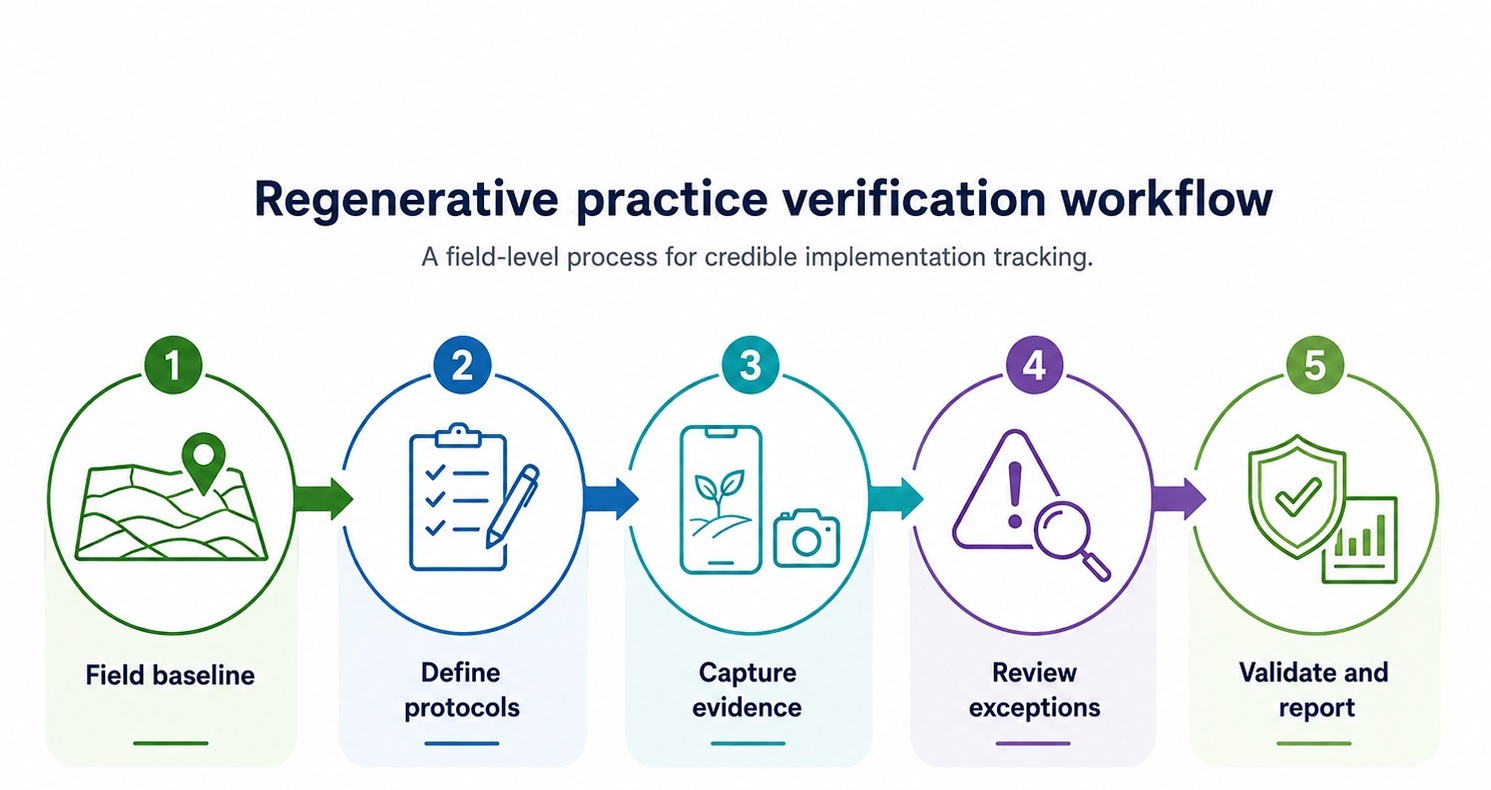
An effective workflow follows the crop cycle rather than requiring field teams to reconstruct a season’s activities from memory after harvest.
1. Establish eligibility and a field baseline
Prior to enrollment, the program should confirm land control, field boundaries, crop history, and the starting management condition, including tillage intensity, residue handling, nutrient sources, irrigation method, soil cover, and rotation history, depending on what the program intends to track.
Baseline data need not constitute a full research effort, but it must be sufficient to explain what is changing over time. Tracking salinity, nutrient balance, organic amendments, or irrigation efficiency requires baseline soil analysis, water quality data, application records, and irrigation-system information, along with a sampling plan that remains consistent across seasons. Samples drawn at different depths, locations, seasons, or laboratories can produce misleading conclusions.
2. Translate commitments into field protocols
Each approved practice should be governed by a concise operational protocol specifying its objective, field eligibility, required actions, timing window, minimum evidence, exclusions, and agronomic cautions.
A cover crop protocol for processing tomatoes, for instance, should define an establishment window following the prior crop, an approved seed mix or acceptable alternatives, a minimum period of soil cover, geotagged establishment evidence, and a termination record, along with any relevant trade-offs stated up front. Under water-limited conditions, the cover crop may draw down stored soil water; with high-carbon residues, nitrogen availability for the tomato crop may require adjustment. Verifying the practice without this agronomic context risks rewarding compliance while introducing unmanaged yield risk.
3. Capture evidence as work occurs
Evidence is strongest when captured close to the event. Planting, applications, irrigation changes, soil amendments, residue management, and field observations should be logged as they occur, time-stamped and geolocated, and supported by invoices, delivery notes, equipment logs, laboratory reports, and photographs where relevant.
No single evidence type is sufficient to substantiate a claim on its own. A photograph documents surface cover but not fertilizer rate. An invoice confirms a purchase but not a field application. Satellite monitoring can independently confirm whether a cover crop was actually established on a given field and when, which is a materially stronger form of evidence than a grower-submitted photo, though it still needs to be paired with ground-level records for termination timing, seed mix, and the agronomic reasoning behind them. Evidence should match the importance and risk of the claim, using stronger or multiple forms of evidence when needed. A regenerative program should apply this standard consistently across all fields.
| Evidence type | What it confirms | What it cannot confirm |
|---|---|---|
| Field photograph | Surface cover, crop stage, visible residue | Application rate, product identity, timing accuracy |
| Invoice or delivery note | Product purchased, quantity, supplier | Whether the product was actually applied in the field |
| Satellite monitoring | Cover crop establishment and timing, independent of grower reporting | Seed mix, termination method, soil-level outcomes |
| Soil or tissue lab report | Nutrient status, salinity, organic matter at time of sampling | Practice history that produced the result |
| Field-logged record (with farmer) | Activity, date, location, agronomist sign-off | Independent confirmation without a corroborating source |
4. Review exceptions before they become gaps
Agronomic conditions do not follow the conditions of a controlled trial. A grower may need to repair a damaged dripline through targeted tillage, terminate a cover crop early under water stress, or adjust nitrogen timing following a heavy rainfall event. Such decisions are frequently sound, even where they alter the recorded practice status.
Exceptions should be classified as approved, pending review, noncompliant, or not applicable, with the approval threshold set according to risk: local agronomists can manage routine adjustments, while material deviations should be escalated for regenerative program-level review. Requiring field teams to conceal exceptions undermines data quality, while requiring headquarters approval for every minor adjustment slows adoption considerably.
5. Validate, sample, and report at an appropriate confidence level
Automated checks should be applied first, identifying missing dates, implausible rates, duplicate fields, invalid crop stages, and evidence submitted outside the acceptable window. Outliers, high-risk claims, and a representative sample should then proceed to agronomic review.
Risk-based sampling is generally more effective than inspecting every field to the same standard. New growers, fields with limited history, unusually high claimed impact, and operations with repeated exceptions warrant closer scrutiny. Established participants with a consistent track record may require less frequent inspection, provided overall oversight remains sufficient to detect emerging drift.
Reporting should state plainly what has actually been verified, whether participation, practice adoption, implementation against protocol, or measured outcome, along with coverage, missing data, exceptions, and confidence limits. A regenerative program dashboardthat omits incomplete evidence may appear clean, but it does not constitute credible reporting.
Data Architecture Determines Whether the Regenerative Program Can Scale
Regenerative programs most often stall on fragmented spreadsheets, messaging threads, field notebooks, and consultant reports that cannot be reconciled with one another, a matter of data discipline as much as software. Shared field identifiers, standardized units, controlled practice definitions, clearly defined user roles, audit trails, and a version history for every protocol change are what allow a program to scale reliably.
For organizations coordinating regenerative programs in the 500-to-2,000-grower range, this is the specific problem yieldsApp addresses: field protocols, assigned tasks, evidence collection, agronomist review, exception management, and portfolio-level visibility inside one system, combined with independent monitoring (including satellite-based cover crop detection) and agronomic recommendations generated from the same dataset. Beyond digitizing paper forms, this structure allows a technical director to determine with confidence whether an irrigation practice was adopted, whether field evidence is complete, and whether a recurring exception reflects a protocol issue, a training gap, or a genuine agronomic constraint — the difference between a program with zero field-level visibility and one with a defensible, auditable record for every enrolled grower.
This data should also remain connected to core production information, including fertilizer programs, irrigation volumes, water quality, soil and tissue analyses, yield records, and crop observations. Where a regenerative requirement introduces salinity risk, avoidable water stress, or compromised crop nutrition, the program needs a mechanism to surface and address the issue before it outweighs the benefit it was intended to deliver.
Verification Depends on the People Executing It
No protocol implements itself. Growers require instructions that respect labor and timing constraints. Field technicians require a consistent standard for what qualifies as a valid observation and what constitutes evidence. Agronomists require the authority to flag conflicts between a protocol and the crop’s actual needs, along with sufficient familiarity with the reporting requirements underlying the program’s claims.
This is where technical training delivers commercial value. Cropaia supports commercial growers, agronomy teams, and extension programs with field-specific guidance on irrigation, fertigation, nutrient management, salinity, water quality, soil and tissue analysis interpretation, and protocol review, particularly as a regenerative program expands into a new crop or region, when assumptions carried over from one production system are most likely to be applied too broadly.
Verification improves considerably once a team understands why particular evidence is required and how it connects to crop performance. A technician able to identify poor cover crop establishment, a nutrient deficiency, irrigation nonuniformity, or salt accumulation can prevent a weak record from becoming a weak crop.
The strongest workflow is the one that makes the correct field action straightforward to document, makes an unsupported claim difficult to sustain, and surfaces agronomic consequences early enough for the team to act on them.










About Post Author
