

How to Manage Citrus Salinity Stress in Orchards
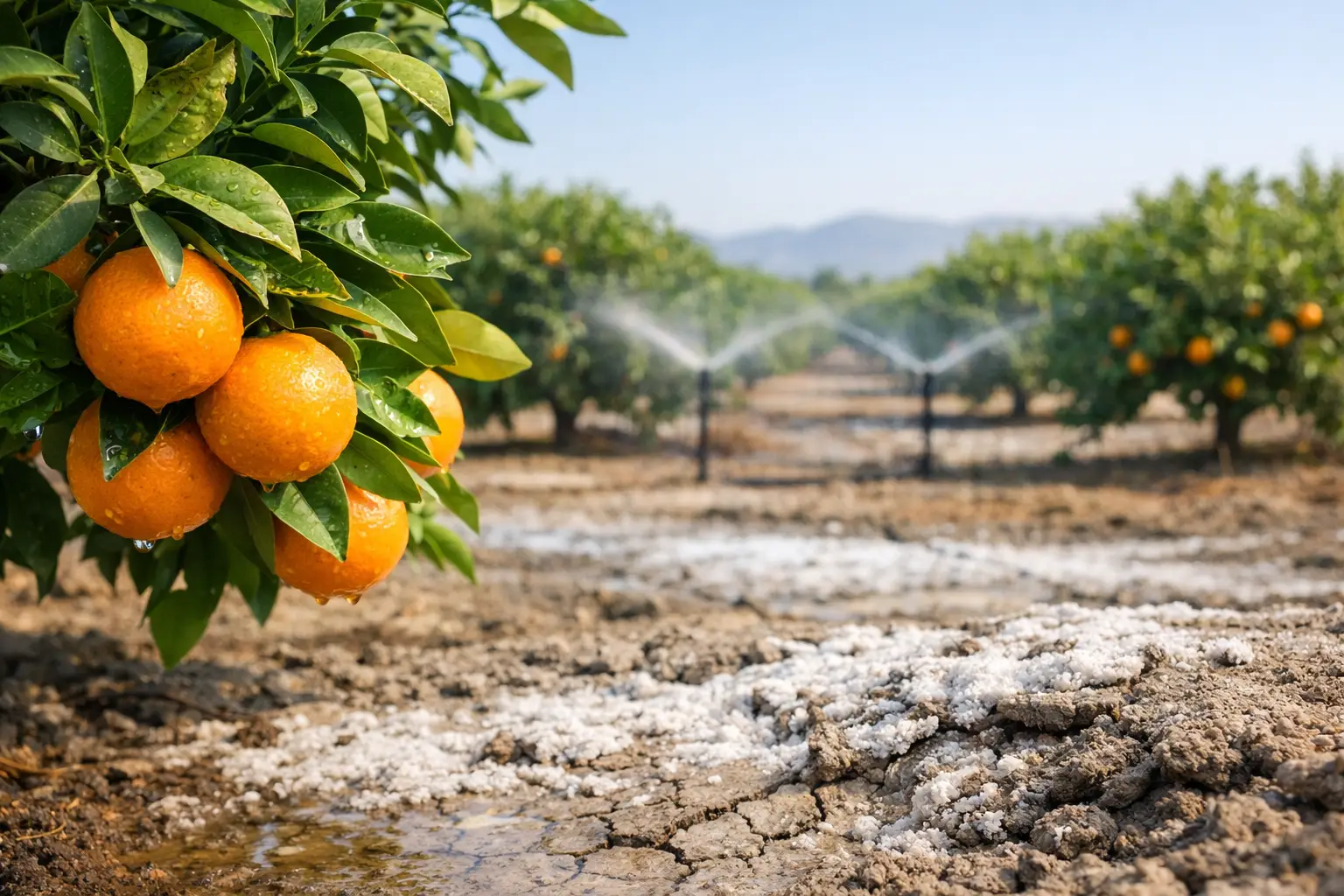
Salinity rarely announces itself with a single, unmistakable symptom. In commercial citrus, it often first appears as weaker spring flush, smaller fruit, uneven canopy density, marginal leaf burn, or blocks that require more water but still underperform. To manage citrus salinity stress, the first task is to separate a root-zone salt problem from similar-looking issues such as poor drainage, restricted roots, under-irrigation, nutrient imbalance, or Phytophthora damage.
Citrus is particularly vulnerable because much of its active root system is concentrated in the wetted zone, where salts can accumulate quickly when irrigation water quality, scheduling, drainage, and fertigation are not aligned. Effective management is therefore not a one-time amendment or a larger irrigation event. It is a measured program built around water analysis, soil salinity patterns, root-zone moisture, drainage capacity, rootstock choice, and nutrient delivery.
Diagnose the Salinity Mechanism Before Treating It
Electrical conductivity is useful, but a single EC result does not diagnose the orchard. Start with irrigation water EC, chloride, sodium, bicarbonate, calcium, magnesium, and sodium adsorption ratio. Then compare those results with soil measurements taken by depth and position relative to the drip line or microsprinkler pattern. Saturated paste extract ECe remains the reference method for interpreting root-zone salinity, although field sensors and 1:2 soil-water extracts can support more frequent operational monitoring if they are calibrated against laboratory data.
Sampling position matters. Under drip irrigation, salt commonly accumulates at the edge of the wetted bulb and below the main active root zone. A sample taken only beneath an emitter can look acceptable while roots at the wetting front are exposed to damaging concentrations. In microsprinkler orchards, the distribution may be broader but can still vary substantially between the wetted and dry zones.
Leaf analysis adds another layer. Elevated chloride or sodium in leaves can confirm ion accumulation, but tissue values should be interpreted with season, leaf age, cultivar, rootstock, crop load, and sampling protocol in mind. High chloride is common where irrigation water contains chloride, while high sodium may point to a combination of water quality, soil structure decline, and insufficient calcium in the root environment. Neither result should be interpreted in isolation.
Salinity and Sodicity Are Different Problems
Salinity reduces the ability of roots to take up water because dissolved salts lower soil water potential. A tree can show water-stress symptoms even when the soil is visibly moist. Sodicity is different: excess exchangeable sodium can disperse clay, reduce infiltration, seal the soil surface, and make leaching ineffective.
This distinction determines the response. If the principal issue is salinity and drainage is adequate, carefully managed leaching may reduce root-zone EC. If sodicity is impairing infiltration, adding more water may simply create ponding or push salts unevenly through the profile. Calcium amendments, often gypsum, can help displace sodium where soil chemistry supports that recommendation, but gypsum is not a universal salinity treatment. Its rate, placement, solubility, and expected response should be based on exchangeable sodium, soil texture, carbonate status, water chemistry, and drainage conditions.
Manage Citrus Salinity Stress Through Irrigation Design
The most immediate goal is to maintain enough moisture in the active root zone that salts do not become concentrated between irrigations. The correct strategy depends on soil texture, emitter discharge, root distribution, water salinity, rainfall, and the orchard’s drainage profile. In a coarse soil, frequent short irrigations may protect roots from rapid drying but may not provide sufficient leaching below the root zone. In a fine-textured soil, long events can increase leaching but may also create oxygen stress if infiltration and drainage are poor.
Leaching should be planned, not assumed. A leaching fraction is the portion of applied water intended to move below the active root zone and carry salts with it. Its practical value depends on uniform application. If one irrigation set applies 20% less water than another, the lowest-applied area may accumulate salts while the average farm water balance appears acceptable. Distribution uniformity testing, pressure checks, clogged-emitter detection, and flow verification are therefore salinity-management tools, not merely irrigation-maintenance tasks.
Rainfall can provide meaningful leaching in some production regions, but only when it infiltrates rather than runs off and when the soil profile can drain. Do not automatically reduce irrigation after rain without checking stored soil moisture and root-zone EC. Conversely, do not count seasonal rainfall as leaching if compaction, a shallow restrictive layer, or a high water table prevents downward movement.
Irrigation timing also matters. Trees under high evaporative demand are less able to tolerate high salt concentrations in the soil solution. During peak fruit sizing and hot periods, avoid allowing the wetted root zone to dry excessively. Soil-moisture measurements, ETc estimates, and irrigation records should be evaluated together. Moisture data without salinity data can lead to a false sense of security, because an adequately wet soil can still have an excessively saline solution.
Correct Fertigation and Nutrition Without Raising EC Further
Fertigation can either support salt-stressed citrus or intensify the problem. High fertilizer concentration in a short injection window raises EC around active roots, particularly when irrigation water is already saline. The risk is greatest with frequent applications in small wetted volumes, poorly mixed stock tanks, or irrigation systems with uneven distribution.
Use nutrient demand, irrigation volume, water chemistry, and soil-test results to set concentration and timing. Splitting nitrogen and potassium across more events may reduce peak salt concentration, but only if each event is long enough to distribute nutrients through the intended root volume. The solution is not simply to apply less fertilizer. Chronic under-fertilization reduces canopy function and root growth, making trees even less resilient to salinity.
Calcium deserves special attention because it can improve sodium tolerance at the root surface and supports soil structure where sodium is a concern. However, calcium products must be compatible with water bicarbonate, phosphorus sources, injection equipment, and the broader fertilizer program. In high-bicarbonate water, precipitation and emitter clogging can become operational constraints. Acidification may be justified in some systems, but it requires careful calculation, safety procedures, and monitoring rather than routine use.
Potassium management also requires restraint. Potassium is essential for fruit size and water relations, yet excessive potassium chloride is an obvious poor fit where chloride is already high. The appropriate source depends on the complete nutrient program, water quality, soil pH, and economics. A fertilizer program should be reviewed as a salt load as well as a nutrient supply plan.
Build a Block-Level Monitoring System
Salinity management fails when data are averaged across too large an area. A farm may report acceptable water quality and still have severely affected zones caused by lower pressure, heavier soil, shallow drainage, different rootstocks, or a compromised well. Divide orchards into practical management units based on irrigation zone, soil type, water source, tree age, rootstock, and historic yield performance.
For each unit, maintain a record of water analysis, applied irrigation, rainfall, soil moisture, root-zone EC by depth, leaf chloride and sodium where relevant, yield, fruit size, and visual canopy observations. Trends are more valuable than isolated readings. A rising EC at 12 to 24 inches while moisture remains adequate is an early warning that leaching is insufficient or water application is not uniform.
For organizations managing many farms or contract growers, this requires a common protocol. Field teams need the same sampling depths, laboratory methods, thresholds for escalation, irrigation audit format, and recommendation language. Otherwise, one adviser may call for gypsum, another may increase leaching, and a third may change fertilizer sources without identifying the actual constraint.
This is where yieldsApp can support distributed citrus operations by organizing block-level observations, standardized protocols, corrective actions, and follow-up evidence across farms and field teams. The value is not a dashboard alone. It is the ability to verify that a recommendation was implemented in the correct block, at the intended timing, and with measurable results.
Know When the Problem Is Structural
Some orchards cannot be corrected with irrigation scheduling alone. A shallow hardpan, poor internal drainage, saline groundwater, inadequate drainage outlets, severe emitter nonuniformity, or a rootstock poorly suited to the water source can limit every short-term intervention. In those cases, management may involve physical drainage work, irrigation-system redesign, blending water sources, changing the wetted pattern, or making rootstock decisions during replanting.
Rootstock tolerance can materially change risk, but it is not a license to ignore water quality or leaching. Tolerance varies by salt composition, scion-rootstock combination, soil conditions, and production target. A rootstock that maintains canopy growth under moderate salinity may still produce unacceptable fruit size, chloride accumulation, or long-term decline under the same conditions. Evaluate rootstock performance using local field data whenever possible.
A commercial salinity program should have clear decision points: when to increase monitoring, when to adjust irrigation, when an amendment is justified, and when the block requires structural investment or replant planning. Cropaia can help commercial citrus operations turn water, soil, tissue, and irrigation data into a field-specific recovery plan, while also training agronomy teams to apply the same diagnostic standard across future cases.
The most useful next step is usually not another broad treatment. It is a disciplined root-zone assessment in the weakest-performing irrigation units, followed by a corrective plan that can be measured over the next irrigation cycle and production season.











About Post Author
