

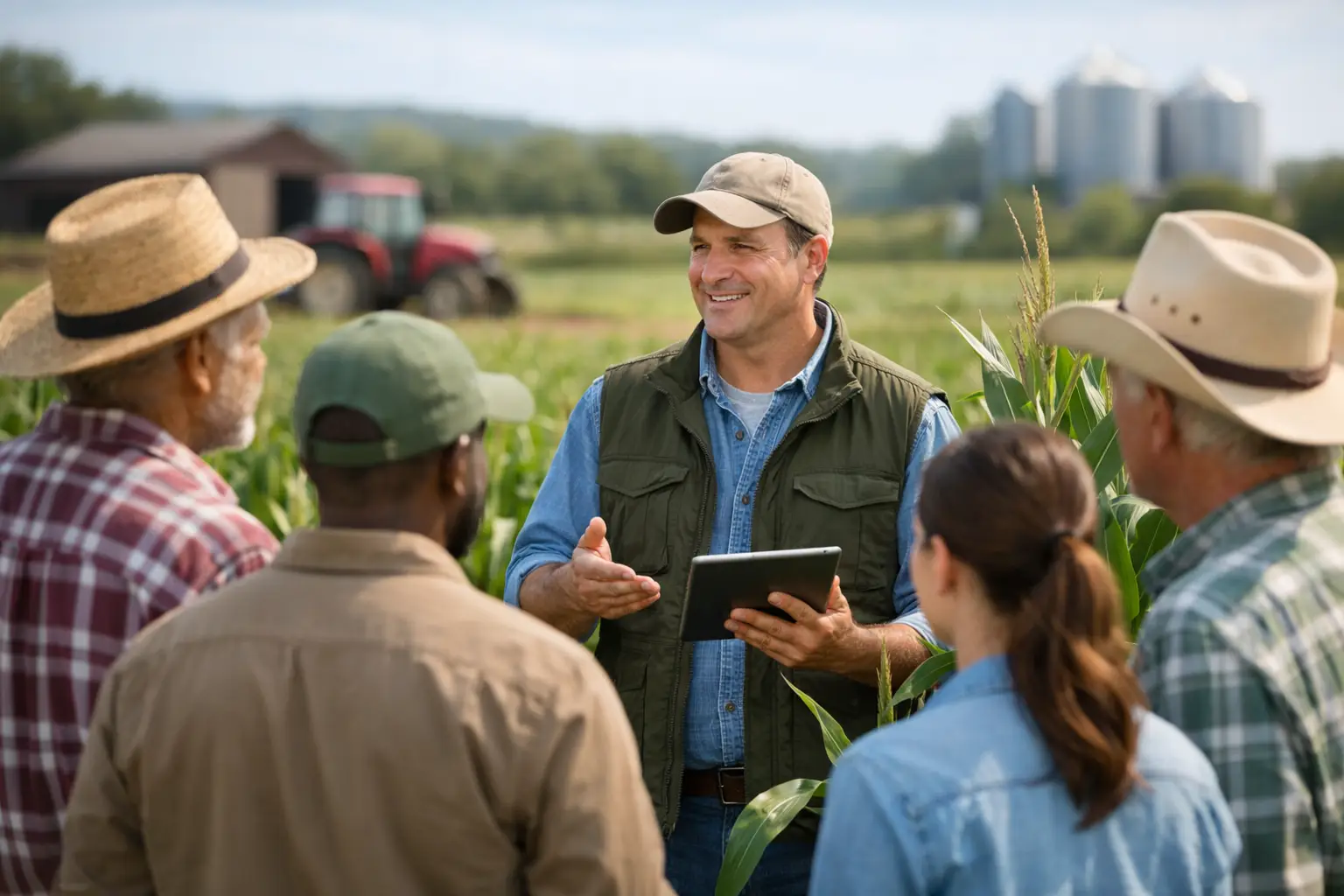
Agricultural Extension Training Programs
A fertilizer recommendation that looks correct on paper can still fail in the field if the advisor delivering it cannot translate soil data, crop stage, water limits, and grower constraints into a practical decision. That gap is exactly where agricultural extension training programs matter. For agronomists, farm managers, agribusiness teams, and public-sector organizations, the real value of training is not information alone. It is better field execution.
Many extension initiatives still rely on broad seasonal messaging, generic crop calendars, or one-time workshops. That model has limits, especially in commercial production systems where margins are tighter, weather is less predictable, and decisions on irrigation, fertility, pests, and labor must be made quickly. A strong training program builds technical depth, improves advisory consistency, and helps extension professionals turn recommendations into measurable agronomic results.
What agricultural extension training programs should actually deliver
The best agricultural extension training programs do more than teach concepts. They prepare professionals to diagnose production problems, prioritize actions, and communicate recommendations clearly to growers and operational teams. That means training must connect agronomy with decision-making.
In practice, this starts with crop-specific content. Extension staff serving almonds should not be trained the same way as those supporting open-field vegetables, citrus, corn, or potatoes. Crop physiology, nutrient uptake timing, irrigation sensitivity, pest pressure, and harvest quality targets differ too much for generalized instruction to be effective. If the training is not crop-specific, the advice often becomes too vague to support serious production decisions.
It also means the program should reflect field realities. A nutrient management module that ignores water quality, root health, labor limitations, or fertigation infrastructure will not hold up under commercial conditions. The same is true for pest and disease training that discusses biology but does not address scouting thresholds, resistance risk, spray timing, or economic trade-offs.
Why many training efforts fall short
The most common weakness is that training is designed around content delivery rather than capability building. Participants sit through lectures, receive slides, and leave with terminology but not with a repeatable process for solving field problems. That may work for awareness, but it rarely improves advisory performance.
Another issue is weak integration across disciplines. In the field, nutrient management is tied to irrigation scheduling, salinity, root development, and disease pressure. Yet training often separates these subjects into silos. An extension officer may finish a fertility module without understanding how over-irrigation changes nitrogen behavior, or complete a plant protection module without learning how canopy density and irrigation timing affect disease pressure.
There is also a persistent gap between extension theory and digital agriculture. Many organizations want advisors to use satellite imagery, crop monitoring software, weather data, or soil moisture sensors, but training often stops at tool awareness. Awareness is not enough. Advisors need to know when a tool improves decisions, when it creates noise, and how to validate digital signals with field observations.
Core components of a high-value program
A serious training program should be built around field decisions that participants are expected to make after completion. This changes the structure immediately. Instead of organizing the curriculum only by subject, it should also be organized by use case.
Crop-specific agronomy and production systems
Participants should learn crop development stages, rooting behavior, yield formation, and quality drivers for the crops they actually support. This is the basis for everything else. Without it, recommendations on irrigation intervals, nutrient timing, or pest risk remain disconnected from the crop’s biology.
For commercial agriculture, this section should include fertilization programs by growth stage, irrigation strategy under different water constraints, and major pest and disease scenarios with practical intervention logic. It should also address regional variation. Recommendations that work in one production environment may not transfer well to another because of water quality, soil texture, climate, or market requirements.
Diagnostics and field interpretation
This is where many programs become truly useful or remain theoretical. Participants should be trained to distinguish among symptoms that appear similar but require different actions. A chlorotic field might point to nitrogen deficiency, root damage, salinity, compaction, poor irrigation distribution, or disease. The training should teach structured diagnosis, not just symptom recognition.
This is also the right place to compare methods. For example, tissue analysis versus sap analysis is not a matter of one being universally better. Tissue analysis is often better for broader nutritional assessment and benchmarking over time, while sap analysis can be more responsive for short-term nutrient monitoring during active crop growth. The right choice depends on crop, growth stage, and the speed of adjustment required. Extension professionals need that level of decision logic.
Communication and advisory delivery
Strong agronomy can still fail if the recommendation is not communicated in a way that supports action. Extension teams need training in how to present trade-offs, how to adjust recommendations for budget and labor constraints, and how to explain uncertainty without sounding indecisive.
This matters particularly in enterprise agriculture and public programs. Advisors often work across growers with different levels of technical maturity, data access, and management capacity. A training program should prepare them to give recommendations that are technically sound but operationally realistic.
Agricultural extension training programs and digital agriculture
Digital tools have expanded what extension can do, but they have also exposed weak training design. A dashboard does not improve agronomy by itself. If a participant can read NDVI maps but cannot interpret whether the variation is tied to irrigation uniformity, stand establishment, compaction, disease, or nutrient stress, the tool remains superficial.
Good agricultural extension training programs teach digital tools as part of a decision chain. Satellite imagery can be valuable for identifying variability trends across large areas and prioritizing scouting. Drone imagery may offer more detail, but it is not always necessary or cost-effective for routine monitoring. Soil sensors can improve irrigation management, yet poor placement or weak interpretation can make the data misleading. Weather-based scheduling can support broad planning, but in many fields it needs to be adjusted using crop stage, soil conditions, and direct field measurements.
The right training does not promote technology for its own sake. It teaches when each tool is useful, what its limits are, and how to combine digital insight with field verification.
How to evaluate a training program before you invest
A credible program should make its outcomes clear. Not just what topics are covered, but what participants will be able to do afterward. If the description is heavy on awareness and light on application, expectations should be modest.
Look at the instructors as carefully as the curriculum. Subject expertise matters, but field credibility matters just as much. Trainers should understand commercial production systems, seasonal pressure, and the constraints under which growers and advisors operate. Programs led by people with only academic distance from field execution often miss the practical details that determine whether advice is adopted.
Assessment design also tells you a lot. If the program evaluates participants only through quizzes, it may not be testing real competence. Better programs use case-based assessments, field scenarios, data interpretation exercises, and recommendation writing. Those formats are much closer to actual extension work.
Finally, consider whether the program supports implementation after training. Follow-up clinics, field assignments, calibration workshops, and technical review sessions often matter more than the original classroom hours. Knowledge fades quickly if it is not used.
Who benefits most from this kind of training
Commercial growers with in-house agronomy teams benefit when recommendations become more consistent across sites and advisors. Farm managers benefit because training improves the quality of decisions on irrigation, nutrient timing, and crop protection, which affects both cost control and yield stability. Agribusinesses benefit when technical teams can support customers with more precise and credible guidance. Governments and NGOs benefit when extension staff can move beyond message distribution toward measurable field improvement.
This is especially relevant where organizations are trying to scale technical support across large geographies. Standardization helps, but only if it is built on agronomic rigor rather than generic messaging. That is one reason many organizations now look for training partners that combine technical education with consulting experience. Cropaia’s model reflects that need by linking instruction to field application and measurable crop performance.
The real standard is better decisions in the field
The value of extension training should not be measured by attendance, certificates, or presentation quality. It should be measured by whether participants make better recommendations under real production pressure. Can they identify the likely cause of poor crop performance faster? Can they adjust fertilization programs based on crop stage, irrigation system, and tissue data? Can they separate a useful digital signal from noise? Can they communicate a recommendation that a grower or farm manager can actually implement?
That is the standard worth using. Agricultural knowledge is widely available. Judgment is not. The best training programs are the ones that build that judgment, strengthen execution, and help agricultural professionals deliver advice that holds up when the season gets complicated.
When a training program improves how people think in the field, not just what they remember in the classroom, the return shows up where it matters most – in better decisions, stronger crops, and more reliable outcomes.











About Post Author
