

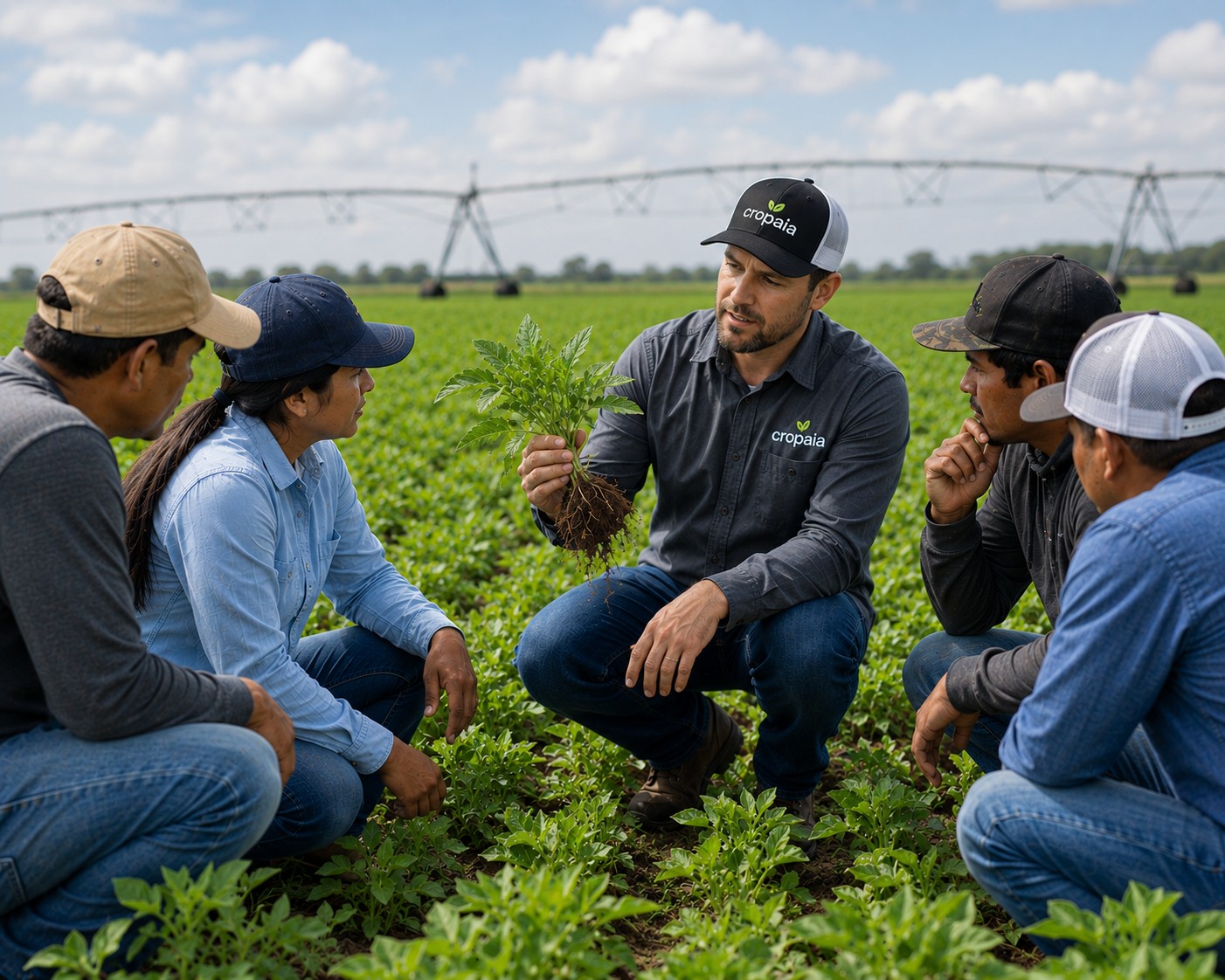
Onsite Agronomy Training for Farm Teams
A farm can invest in better inputs, better equipment, and better software, yet still underperform if the team in the field is not working from the same agronomic logic. That is where onsite agronomy training for farm teams has a distinct advantage. It turns agronomy from a set of recommendations on paper into a shared operating standard across irrigation, nutrition, crop protection, scouting, and daily decision-making.
For commercial farms, the gap is rarely a lack of effort. More often, it is inconsistency. One irrigator reads plant stress differently from another. A scout flags pest pressure, but the threshold for action is unclear. A nutrition plan exists, but the field crew applies it without understanding the reason behind timing, placement, or dosage. These gaps cost money, reduce yield potential, and make agronomic outcomes harder to predict.
Why onsite agronomy training works differently
Classroom learning has value. Online courses also have value, especially when teams need structured theory or when organizations operate across multiple regions. But onsite training changes the learning dynamic because it happens inside the farm’s actual production system.
That matters because agronomy is highly contextual. Water quality, soil variability, climate conditions, irrigation method, crop stage, labor structure, and local pest pressure all influence the right decision. Training delivered in the field allows teams to connect technical principles to the exact blocks, equipment, and crop conditions they manage every day.
A good trainer is not just transferring knowledge. They are translating agronomic principles into practical action for a specific operation. That may mean showing an irrigation manager how to assess distribution uniformity in a way that fits the farm’s system, or helping a crop team interpret leaf symptoms without confusing nutritional issues with disease pressure. The result is not just more knowledge. It is better judgment under real field conditions.
What onsite agronomy training for farm teams should improve
The strongest training programs are not broad lectures with limited operational relevance. They are targeted to the decisions that most affect crop performance and farm efficiency.
In many operations, irrigation is the first area where training creates measurable value. Teams often follow schedules, habits, or assumptions rather than crop demand, root zone conditions, and system performance. When field staff understand how irrigation timing, pulse strategy, water quality, soil texture, and plant development interact, they make better decisions with less waste. This has direct implications for yield, disease pressure, nutrient uptake, and labor efficiency.
Plant nutrition is another common weak point. Fertilizer programs can look correct on paper while failing in the field due to poor timing, incompatibility, uneven distribution, or a weak understanding of nutrient mobility and plant demand. Onsite instruction helps teams see how nutrition programs behave under actual farm conditions. It also improves communication between managers, agronomists, and applicators, which is often where execution breaks down.
Crop protection benefits as well, especially when training includes field scouting, threshold-based decisions, application quality, and symptom recognition. Misidentification is expensive. So is delayed intervention. A trained farm team can distinguish between issues that need immediate action and issues that require monitoring, diagnostics, or a change in cultural practices.
Beyond these technical areas, training often strengthens something less visible but equally important: operational alignment. Farms perform better when supervisors, irrigators, scouts, and applicators use the same terms, the same field observations, and the same decision criteria. That reduces confusion and improves accountability.
The difference between training and a one-day field talk
Not every field session qualifies as effective onsite agronomy training for farm teams. A one-time presentation may raise awareness, but it rarely changes farm performance on its own.
Useful training is structured around the farm’s production goals and recurring constraints. It starts with a diagnosis of where knowledge gaps are affecting results. Sometimes the problem is technical. Sometimes it is procedural. Sometimes the agronomic recommendation is sound, but the team responsible for implementation has not been trained to execute it consistently.
The best programs usually combine field observation, technical explanation, and follow-up. Teams need to understand what to do, why it matters, and how success will be measured. Without that structure, training can become informational rather than operational.
This is especially true on larger farms and agribusiness operations, where multiple teams may influence the same outcome. If the nutrition team, irrigation team, and crop protection team are not trained in a coordinated way, improvements in one area can be offset by mistakes in another.
What to look for in an onsite training program
The first requirement is technical credibility. Farm teams do not need generic motivation. They need instruction grounded in crop physiology, soil-water-plant relations, fertigation principles, pest and disease dynamics, and field diagnostics. Training should be based on evidence and practical agronomy, not product promotion.
The second requirement is relevance to the farm’s system. A permanent crop operation, open-field vegetable farm, greenhouse enterprise, and row crop business do not need the same level of detail or the same training emphasis. Even within the same crop, the right approach depends on infrastructure, water source, labor capacity, and production goals.
The third requirement is clarity. Strong agronomic training does not simplify the science to the point of distortion, but it does organize it in a way that field teams can apply. That means using the farm’s terminology, actual field examples, and direct explanations of cause and effect.
It also helps when training includes managers and technical leads alongside field staff. Farm performance improves faster when the people making strategic decisions understand the same technical framework as the people executing the work.
When onsite training delivers the highest return
Not every farm needs the same training intensity every season. It depends on crop value, team experience, current performance, and the cost of agronomic mistakes.
Onsite training tends to deliver the highest return when a farm is expanding, onboarding new staff, shifting to a more intensive crop management strategy, or facing recurring issues that standard recommendations have not solved. It is also valuable after infrastructure changes, such as a new irrigation system, changes in fertigation equipment, or the adoption of digital crop management tools.
There is also a strong case for training when farms rely on external recommendations but struggle with implementation. Many operations already receive advice. The weak point is converting that advice into consistent field practice. Onsite instruction helps bridge that gap.
That said, there are trade-offs. Field training requires time from key personnel, and timing matters. Running sessions during peak operational pressure can reduce attention and retention. There is also the question of depth. A short program may be enough to correct a specific practice, while a more advanced operation may need a staged approach over time. The right scope depends on whether the farm needs skill correction, system improvement, or broader agronomic capacity building.
How farm managers can make training stick
The most effective training does not end when the trainer leaves the field. Managers play a central role in whether the lessons become routine practice.
Start by choosing a narrow set of performance priorities. If the farm tries to fix everything at once, the team usually retains less and applies less. Focus might begin with irrigation scheduling, fertigation execution, or scouting quality, depending on the farm’s biggest source of variability.
Then connect training to field procedures. If staff are taught how to evaluate root zone moisture or identify nutrient imbalance symptoms, there should be a clear process for recording, reporting, and acting on those observations. Otherwise the training remains theoretical.
It also helps to define what improvement looks like. That could be fewer irrigation-related stress events, more uniform crop development, lower input waste, better spray timing, or better consistency across blocks. Measurable indicators make training easier to evaluate and easier to reinforce.
Finally, repeat matters. Agronomy is learned through observation, discussion, correction, and repetition across the season. One reason some organizations work with technical partners such as Cropaia is that blended support, combining education with field-based advisory input, helps teams move from isolated training events to sustained performance improvement.
Building a stronger farm through better decisions
The real value of onsite agronomy training is not that it gives farm teams more information. It gives them a better framework for decisions that affect yield, quality, cost, and risk every week of the season.
When teams understand the agronomic reason behind field actions, they execute with more precision. When managers and staff share the same technical language, communication improves. And when training is tailored to the farm’s actual conditions, the results are far more practical than generic instruction delivered far from the field.
Better crops are not produced by recommendations alone. They are produced by capable teams making sound decisions, block by block and day by day. That is why investing in field-based agronomic training is often one of the most direct ways to improve farm performance over the long term.










About Post Author
