


Soil testing vs tissue analysis: why results disagree
A field can show adequate soil potassium and still produce a crop with potassium deficiency symptoms. It can also show low soil nitrate and still carry a crop that looks fully supplied at that growth stage. A tomato field may have high soil calcium, but fruit can still develop calcium deficiency symptoms when water stress, irregular transpiration, weather conditions, or poor irrigation timing restrict calcium movement into the plant during critical growth stages. That gap is why soil testing vs tissue analysis remains one of the most practical comparisons in agronomy. These tools do not answer the same question, and using one as a substitute for the other often leads to weak nutrient decisions.
For commercial growers, agronomists, and farm managers, the real issue is not which method is better in the abstract. The better question is which method fits the decision in front of you: pre-season fertilizer planning, in-season correction, diagnosis of hidden hunger, or post-season program evaluation. The answer depends on timing, crop, nutrient mobility, root environment, and how quickly management can respond.
After reviewing many soil and tissue reports in commercial crop production, one pattern is clear: the most expensive mistakes rarely come from the lab result itself. They come from using the right laboratory number to answer the wrong agronomic question.
Soil testing vs tissue analysis: different questions, different value
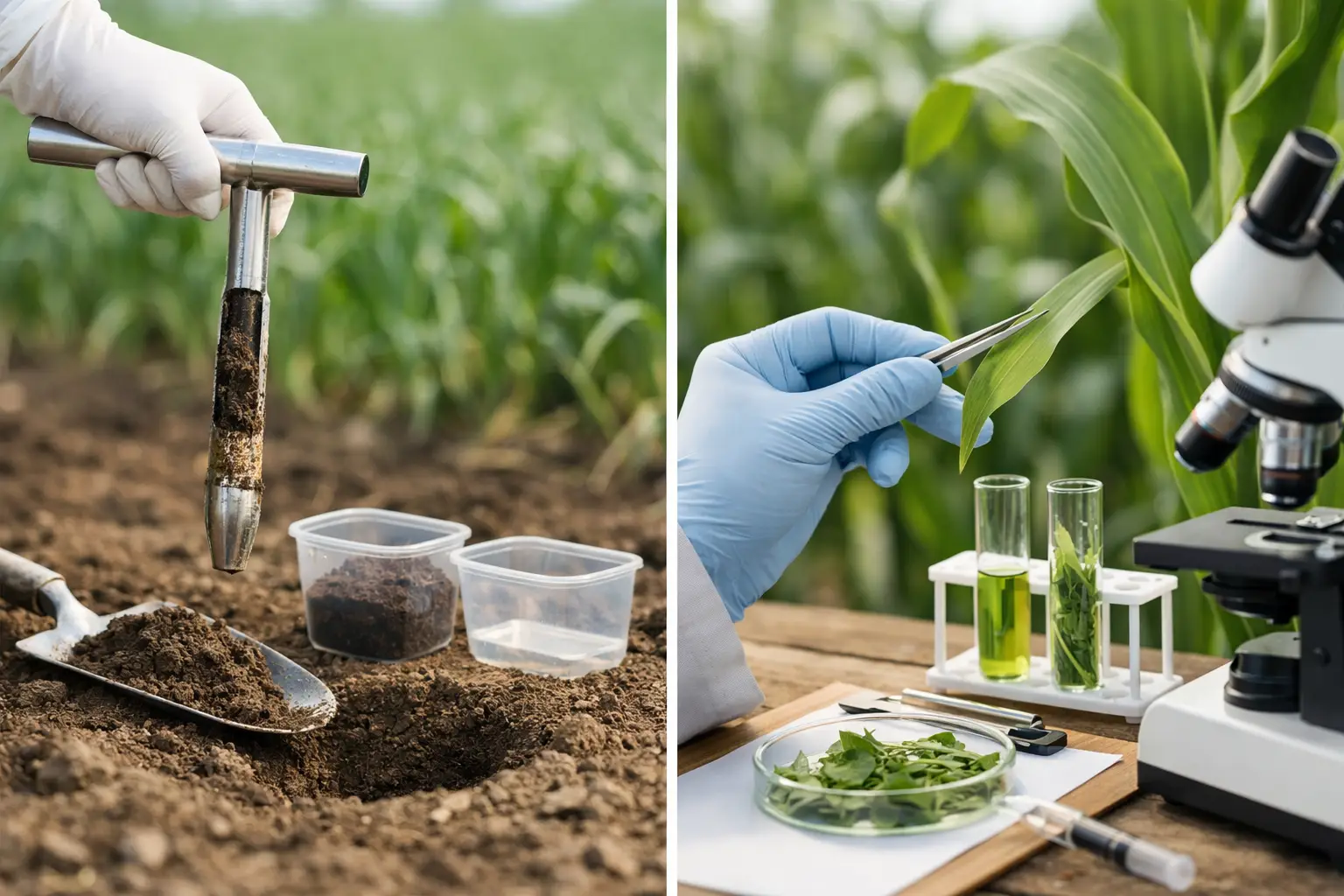
Soil testing estimates the nutrient supply potential and chemical condition of the root zone. Tissue analysis measures what the plant actually took up and retained in its tissues at the time of sampling. One is a test of the production environment. The other is a test of crop nutritional status.
Simple framework: soil testing shows what the soil can potentially supply, tissue analysis shows what the crop actually absorbed, and the final recommendation depends on crop stage, root activity, irrigation, weather, expected yield, and the specific decision that must be made.
That difference matters. A soil test can indicate whether phosphorus is likely to be limiting, whether pH is reducing micronutrient availability, whether salinity may restrict uptake, or whether cation balance is affecting root function. Tissue analysis cannot reliably replace that information because it does not describe the soil processes causing the problem.
At the same time, a tissue test can reveal that nitrogen, zinc, boron, or sulfur levels in the plant are below sufficiency even when soil test values appear acceptable. That usually points to a delivery problem rather than simple nutrient absence. Restricted rooting, cold soils, compaction, poor irrigation uniformity, root disease, excessive antagonism, or timing mismatch may all reduce uptake.
That is why growers and agronomists should not treat soil testing and tissue analysis as competing methods. Serious nutrient management uses both, because each answers a different part of the decision.
What soil testing does well
Soil testing is strongest before the season starts and whenever long-term nutrient strategy is being set. It supports fertilizer budgeting, pH correction, salinity management, and field zoning. For broadacre crops, orchards, vineyards, and high-value vegetables alike, soil testing remains the foundation for knowing what the rooting environment can supply.
Its main value is predictive. If sampling is done correctly and interpretations are calibrated for the crop and region, soil testing helps estimate the probability of response to applied nutrients. It also helps identify constraints that fertilizer alone will not fix, such as poor pH, sodicity, chloride accumulation, or low organic matter mineralization potential.
Soil testing is also operationally useful because it can guide variable-rate application, support block-level nutrient mapping, and help distinguish between chronic field differences and seasonal in-crop issues. For agribusinesses managing many fields, that planning function matters as much as the lab number itself.
But soil testing has limits. It does not measure root activity, transpiration, cultivar uptake efficiency, or short-term weather effects on nutrient flow. A good soil test can still fail to predict in-season deficiency if the crop cannot access the nutrients that are technically present. This is especially relevant for phosphorus in cold soils, calcium in rapidly expanding fruiting tissues, and micronutrients in high pH conditions.
Why sampling depth can change the interpretation
Sampling depth is often the bottleneck. A soil report may show that a nutrient is available somewhere in the sampled layer, but the active roots may not be reaching that layer at the time the crop needs the nutrient. In broadacre crops, a shallow sample can miss deeper nitrate reserves, while a deep composite sample may hide a deficiency in the active young root zone. In vegetables, where nutrient demand and irrigation frequency can change quickly, the location of nutrients relative to the active root system is often more important than the average value in the sample.
What tissue analysis does well
Tissue analysis is strongest when the goal is to verify plant uptake, monitor nutritional balance, and detect deficiency before clear visual symptoms reduce yield or quality. It is a direct measure of plant status, which makes it particularly valuable in-season.
In fertigated systems, intensive horticulture, seed production, and high-value perennial crops, tissue analysis often becomes a management tool rather than only a diagnostic tool. Repeated sampling across growth stages can show whether the crop is tracking within sufficiency ranges, whether a correction is needed, and whether the fertilization program is actually delivering what was intended.
Tissue analysis is especially useful for nutrients where timing is critical or where soil tests are less reliable as stand-alone indicators. Nitrogen and boron are obvious examples in many crops. Micronutrient monitoring in fruit and nut systems is another. In these cases, the crop can move out of balance quickly, and waiting for visible symptoms is too slow.
Still, tissue analysis also has constraints. Results depend heavily on sampling protocol. Plant part, growth stage, cultivar, irrigation status, and recent spray history all affect interpretation. A tissue value without the right reference standard can be misleading. A low concentration may reflect dilution from rapid growth rather than true shortage, while a normal concentration may still coexist with localized deficiency in a critical organ.
The plant part and sampling time are not technical details. They are part of the test. Many reference values are built for a specific tissue at a specific growth stage, such as the most recently mature leaf, whole aboveground plant tissue at early vegetative stages, ear leaf at silking in corn, or a defined leaf position in vegetables. If the wrong tissue is sampled at the wrong time, the result may look precise but carry weak agronomic meaning.
Why one test often seems to contradict the other
When soil and tissue results do not align, that is not a failure of testing. It is usually a clue.
High soil nutrient levels with low tissue concentrations often indicate that nutrients are present but unavailable or not being absorbed. Poor root distribution, waterlogging, compaction, dry topsoil, root pathogens, unfavorable pH, or antagonism from other ions may be involved. Potassium uptake can be suppressed by excess magnesium or calcium in some settings. Iron chlorosis in calcareous soils is another classic example: the soil contains iron, but the plant cannot access enough of it.
Calcium in tomato is another useful example. The soil may contain enough calcium, and the soil test may not suggest a calcium shortage. But calcium moves mainly with the transpiration stream and has limited redistribution inside the plant. If irrigation is irregular, root activity is restricted, humidity is high, transpiration is unstable, or fruit growth is rapid, calcium may not reach the developing fruit in sufficient amounts. In that situation, the practical solution is not simply to add more calcium. The priority is to avoid water stress and irrigation fluctuations during the critical stages of fruit development.
Low soil test values with adequate tissue concentrations can also happen. Mineralization, deeper rooting, previous applications, irrigation water contribution, or a conservative crop demand period may explain it. In annual crops, this can occur early in the season before peak nutrient uptake begins. It does not always mean the field is safe from future deficiency.
For that reason, neither test should be interpreted in isolation from crop stage, weather, irrigation performance, root health, and expected yield level.
Soil testing vs tissue analysis by decision stage
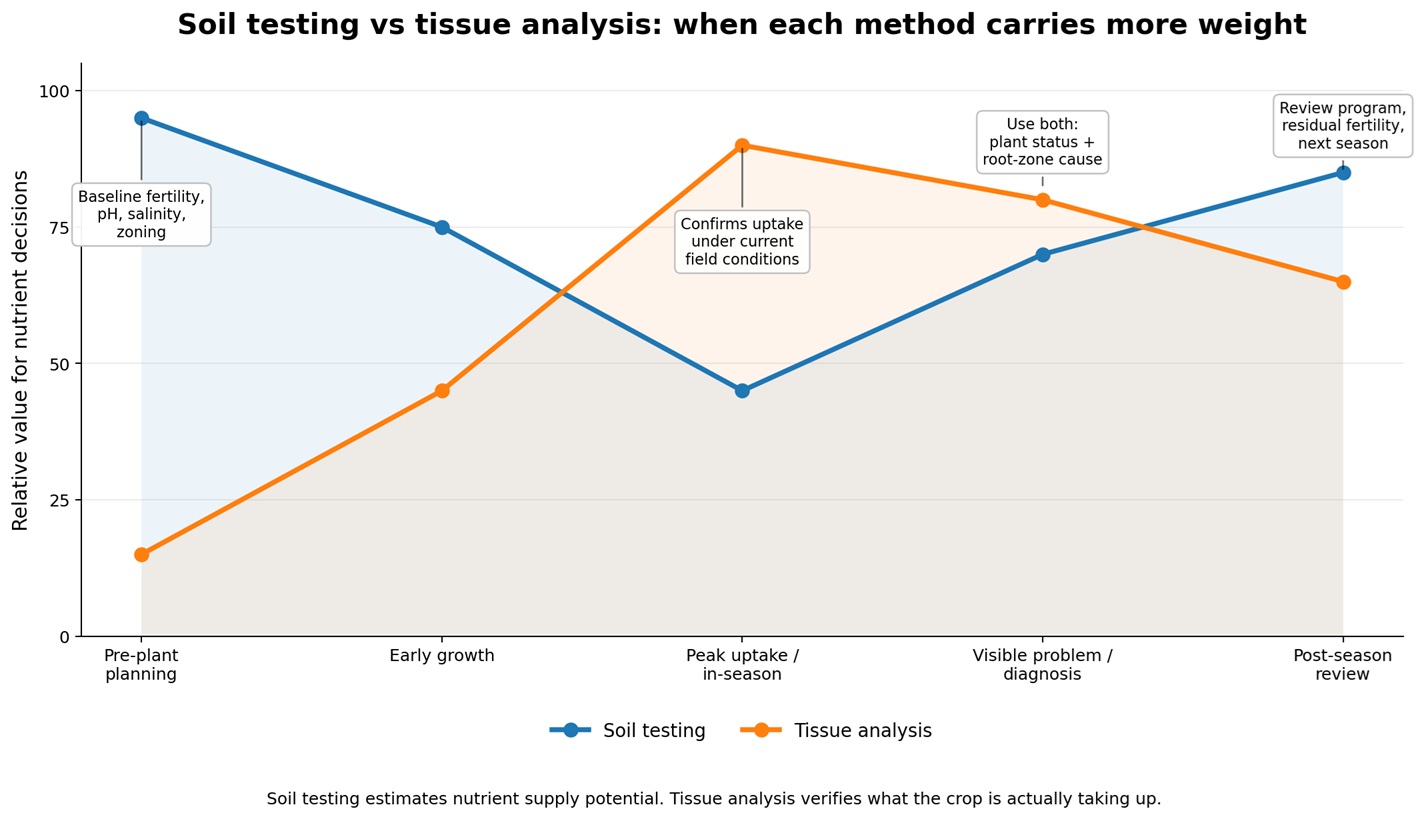
For pre-plant and dormant-season planning, soil testing usually carries more weight. It is the right tool for estimating base fertility needs, adjusting pH, managing salinity, and setting nutrient rates by management zone. Tissue analysis has little value before there is enough crop biomass to sample.
For in-season monitoring, tissue analysis becomes more important. It can show whether the crop is actually receiving adequate nutrition under current field conditions. In drip-irrigated vegetables, orchards, and berries, this can support timely adjustments in fertigation or foliar nutrition.
For troubleshooting a visible problem, both are often needed. Tissue analysis can confirm whether the plant is deficient or imbalanced. Soil testing can help identify why. A chlorotic crop with low leaf zinc is only half diagnosed until the soil environment, pH, and placement strategy are reviewed.
For post-season review, the strongest programs use both. Soil testing helps assess nutrient drawdown, residual fertility, and field variability. Tissue analysis helps evaluate whether the crop remained in range during key growth stages. That combination improves next season’s recommendations more than either dataset alone.
| Decision | More useful test | Why |
|---|---|---|
| Pre-season fertilizer planning | Soil testing | Defines baseline fertility, pH, salinity, and amendment needs before crop uptake begins. |
| In-season nutrient monitoring | Tissue analysis | Shows whether the crop is actually absorbing nutrients under current field conditions. |
| Visible deficiency diagnosis | Both | Tissue analysis confirms plant status; soil testing helps identify the cause. |
| Variable-rate fertilizer planning | Soil testing | Supports mapping, zoning, and spatial management of base fertility. |
| Program evaluation after harvest | Both | Soil testing shows residual fertility; tissue analysis shows whether nutrition stayed on track during the season. |
Crop examples: how the interpretation changes
In broadacre crops such as corn, wheat, soybean, and cotton, soil testing is often central to pre-season nutrient planning and field zoning. Tissue analysis is usually more valuable when used to check whether the crop is tracking correctly during key stages, especially where yield goals are high, soil variability is strong, or weather conditions limit nutrient uptake.
In vegetables such as tomato, pepper, potato, cucumber, and leafy crops, tissue analysis can become more important during the season because nutrient demand changes quickly and correction windows are short. Soil testing still defines the starting point, but tissue trends, irrigation performance, salinity, and root-zone conditions often determine whether the crop actually receives what the program was designed to supply.
The same lab number can therefore carry different meaning in different crops. A nutrient level that is acceptable before peak demand may become insufficient during rapid biomass accumulation, tuber bulking, fruit set, or fruit filling. The crop stage is part of the interpretation.
Sampling and interpretation details that matter
For soil testing, sampling depth, sampling pattern, field zoning, recent fertilizer placement, row position, irrigation pattern, and soil variability all affect the result. Use a composite sample only when the sampled area is agronomically similar. Mixing poor and good areas, wet and dry zones, different soil textures, or different management histories can produce an average value that describes no real part of the field.
For tissue analysis, the sampled tissue must match the interpretation standard. The wrong plant part can change the result enough to create a false deficiency or hide a real one. Sampling should also avoid leaves contaminated by dust, fertilizer, pesticides, or recent foliar sprays. When monitoring trends over time, collect samples at the same growth stage, time of day, and field condition whenever possible.
Laboratory extraction methods also matter. For example, different extraction methods – such as Olsen, Bray, Mehlich, or others – can lead to different interpretations of soil phosphorus. Micronutrient values may depend on methods such as DTPA extraction. Exchangeable potassium, calcium, and magnesium may depend on the extraction method and the soil chemistry behind it. This is one reason soil test interpretation should be calibrated to the crop, region, soil type, and laboratory method, rather than copied from a generic table.
Regional calibration is especially important. A soil test does not directly say how many kilograms of fertilizer to apply. It estimates the likelihood of crop response under conditions where the test has been calibrated. A value considered sufficient in one region, soil type, or production system may not carry the same meaning elsewhere.
Nutrient mobility affects which test is more useful
| Nutrient | Important behavior | Practical implication |
|---|---|---|
| Nitrogen | Mobile in soil and plant, strongly affected by mineralization, leaching, and growth rate. | Soil nitrate can change quickly; tissue analysis helps verify in-season crop status. |
| Phosphorus | Relatively immobile in soil and sensitive to pH, temperature, root growth, and placement. | Soil testing is critical for planning, but cold or restricted roots can still cause deficiency. |
| Potassium | Moderately mobile in the plant; uptake depends on root activity, moisture, and cation interactions. | Soil K may look adequate while tissue K is low if uptake is restricted. |
| Calcium | Moves mainly with water flow and has limited redistribution in the plant. | Fruit and young tissues may show deficiency even when soil calcium is high. |
| Boron | Often has a narrow range between deficiency and excess and limited mobility in many crops. | Tissue monitoring is useful, but sampling timing and plant part are critical. |
| Zinc and iron | Availability is strongly affected by pH, carbonate, root activity, and soil conditions. | Soil presence does not guarantee plant availability, especially in high pH soils. |
Where sap analysis fits
Agronomists sometimes use sap analysis as a more immediate indicator of nutrient movement in the plant, especially for nitrate, potassium, calcium, and other soluble nutrients. It can help in intensive systems that require frequent monitoring. However, sap analysis does not replace soil testing or standard tissue analysis. It has its own sampling rules, interpretation limits, and reference values. For most growers, it is best treated as an additional monitoring tool, not as a substitute for the basic soil and tissue testing framework.
The biggest mistakes in field use
The first mistake is treating soil test values as a guarantee of crop sufficiency. They are not. They are an estimate of supply potential under field conditions that may change quickly.
The second mistake is using tissue analysis only after symptoms appear. By then, the crop may have already lost part of its yield or quality potential. In crops with narrow correction windows, routine monitoring is far more valuable than late diagnosis.
The third mistake is poor sampling discipline. Composite samples that mix different soil types, inconsistent sampling depths, leaves taken from the wrong growth stage, and contamination from foliar sprays can all make the lab result less useful than it should be.
The fourth mistake is making nutrient decisions from a single number without context. Sufficiency ranges, critical values, nutrient ratios, expected yield level, and crop phenology all matter.
The fifth mistake is ignoring whether the sampled zone is the zone the roots are actually using. In a dry surface layer, compacted subsoil, shallow-rooted crop, or unevenly irrigated field, the laboratory may describe nutrient supply in a soil volume that is not functioning as the active nutrient uptake zone.
A practical way to use both methods
A strong nutrient management program usually starts with soil testing to define baseline fertility, pH, salinity, and amendment needs. Then it uses tissue analysis at planned intervals to confirm uptake and adjust in-season decisions. In operations with precision agriculture capability, those datasets become even more useful when paired with soil maps, irrigation records, yield history, and remote sensing patterns.
This integrated approach is where professional agronomy adds real value. The issue is not collecting more data. It is choosing the right diagnostic tool for the right decision and interpreting it against actual field conditions.
If the goal is better fertilizer efficiency, stronger crop performance, and fewer avoidable surprises, soil testing and tissue analysis should work as a pair. The most reliable nutrient decisions come from understanding both what the soil can supply and what the crop is truly receiving at the moment it matters.
For agronomists and growers who want to strengthen their decision-making in fertilization, irrigation, and crop nutrition, the Fertilization and Irrigation course provides a structured way to connect soil data, plant analysis, water management, and field-specific fertilizer decisions.
Frequently asked questions
Is tissue analysis better than soil testing?
No. Tissue analysis is not better than soil testing. It answers a different question. Soil testing evaluates the nutrient supply potential and chemical condition of the root zone. Tissue analysis evaluates what the crop actually absorbed at the time of sampling.
Can soil testing predict nutrient deficiency?
Soil testing can estimate the probability of nutrient deficiency or crop response to fertilizer, but it cannot guarantee crop sufficiency. Root activity, soil moisture, temperature, compaction, salinity, disease, and growth stage can all affect whether nutrients in the soil are actually taken up by the crop.
When should growers use plant tissue analysis?
Plant tissue analysis should be done at the crop stage and plant part for which reliable reference values are available. The correct timing depends on the crop and the nutrient being monitored. Sampling too early, too late, or from the wrong tissue can make the result difficult to interpret.
Why can soil and tissue test results disagree?
Soil and tissue results can disagree because nutrient availability and nutrient uptake are not the same thing. A nutrient may be present in the soil but unavailable to the plant because of pH, poor root growth, dry soil, waterlogging, compaction, salinity, antagonism, or weather conditions. The opposite can also happen: soil test values may look low, but the crop may still receive enough nutrients from deeper roots, nutrient mineralization, irrigation water, or previous fertilizer applications.
Should fertilizer recommendations be based on soil testing or tissue analysis?
Fertilizer recommendations should usually be based on both, but their weight changes by decision stage. Soil testing is usually more important for pre-season planning and base fertility. Tissue analysis is usually more important for in-season monitoring and diagnosing crop nutritional status.
Can sap analysis replace soil testing or tissue analysis?
No. Sap analysis can provide useful short-term information about soluble nutrients in the plant, especially in intensive crop systems, but it does not replace standard tissue analysis or soil testing. It should be interpreted with its own sampling protocol and reference values.












About Post Author
