

How Crop Yield Forecasting Software Helps
A 5 percent yield gap can change far more than harvest revenue. It can alter irrigation scheduling, fertilizer timing, labor planning, storage needs, contract fulfillment, and financing decisions. That is why crop yield forecasting software has become a serious management tool rather than a nice-to-have dashboard. For growers, agronomists, and agribusiness teams, the real value is not simply predicting tonnage. It is improving decisions early enough to influence the outcome.
What crop yield forecasting software actually does
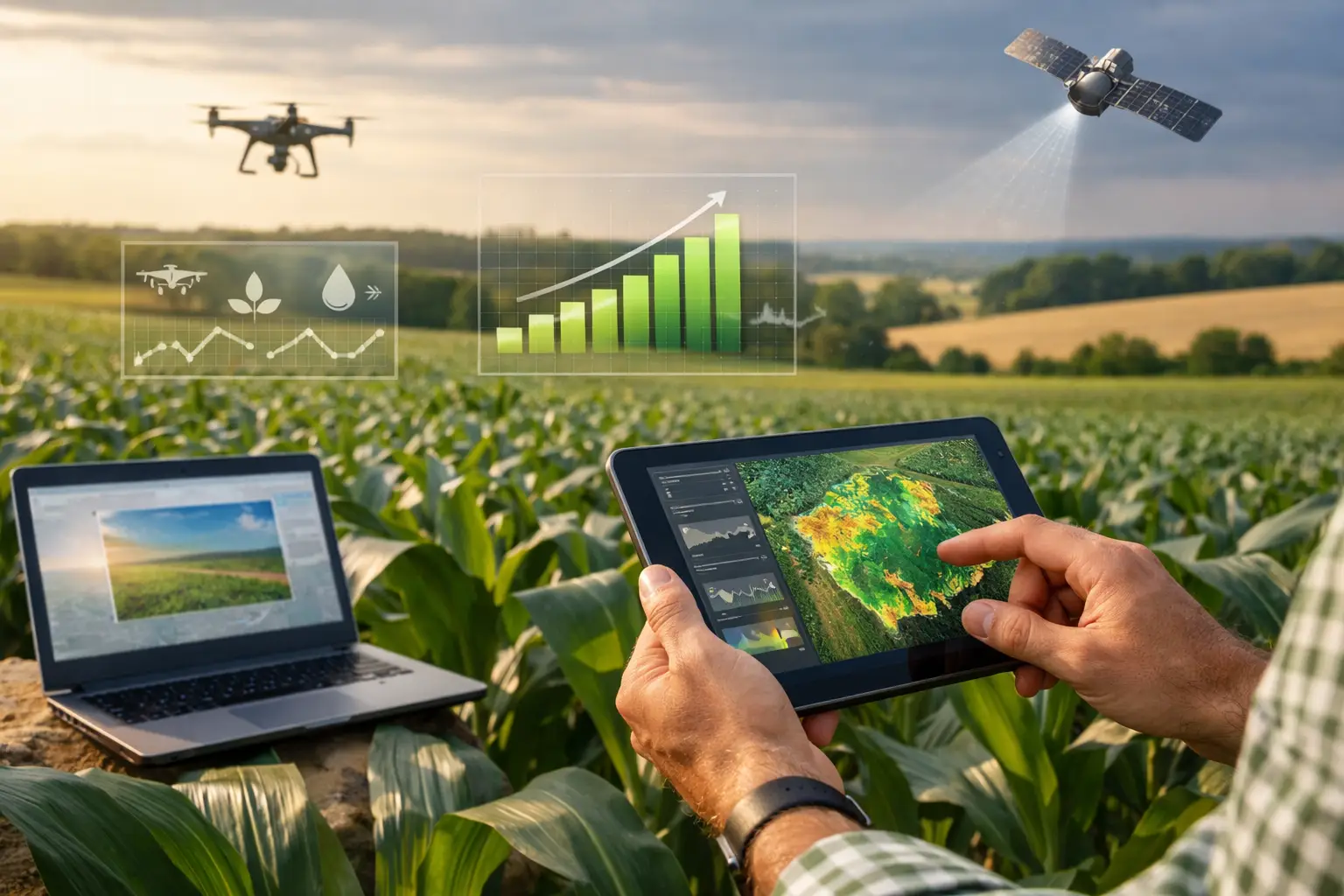
At its core, crop yield forecasting software estimates expected production before harvest by combining field observations, weather data, crop models, satellite imagery, sensor inputs, and historical performance. The software may produce a single forecast for a field, or it may generate rolling forecasts by block, variety, planting date, or management zone.
That distinction matters. A seasonal estimate delivered once is useful for high-level planning, but operational decisions require something more dynamic. A strong platform updates forecasts as the season develops and shows why estimates change. If a forecast drops after a heat event, irrigation disruption, or disease pressure, the user needs enough context to respond with confidence.
This is where many buyers misunderstand the category. Not all forecasting tools are built for agronomy. Some are essentially business intelligence platforms with agricultural data layered on top. Others are crop-specific decision systems designed to reflect plant development, stress, and management impacts in a more agronomically meaningful way.
Why yield forecasting is difficult in real field conditions
Forecasting yield sounds straightforward until field variability enters the picture. Soil texture shifts across short distances. Plant population is uneven. Irrigation uniformity is less than ideal. Pest pressure does not spread neatly. Weather stations may be too far from the field to capture actual conditions, and historical averages can hide the extremes that drive crop response.
Then there is the management factor. Two fields with similar weather and soil can finish very differently because of timing. A well-timed irrigation event, an earlier nitrogen application, or faster disease intervention may protect yield potential in one field and not the other. Good software tries to account for management, but this is also where forecast quality often depends on disciplined data entry and realistic model assumptions.
For that reason, crop yield forecasting software should not be treated as a substitute for agronomic judgment. It is a decision support layer. The best results usually come when forecasts are interpreted by farm managers and agronomists who understand the crop, the local environment, and the production constraints.
What good crop yield forecasting software should include
A useful platform begins with data quality. If the inputs are weak, the forecast will look precise but still be wrong. Weather integration should be field-relevant, not generic. Remote sensing should help detect crop variability and stress, not just generate attractive maps. Historical yield records should be clean enough to compare fields fairly across seasons.
The software should also reflect the biological reality of the crop. A forecasting approach for corn grain is not automatically suitable for almonds, tomatoes, grapes, or potatoes. Different crops respond to stress at different growth stages, and harvestable yield is influenced by different components such as fruit set, kernel number, tuber bulking, or biomass partitioning.
A practical system usually includes three capabilities. First, it estimates expected yield based on current crop status and expected weather patterns. Second, it identifies the factors limiting yield relative to potential. Third, it helps the team decide what actions still have economic value.
This third point is often overlooked. A forecast is only useful if it changes a decision. If the software shows a likely reduction in yield but does not help the team decide whether to adjust irrigation, revise fertilizer plans, change harvest logistics, or update sales commitments, it is not doing enough.
Where the software adds value across the season
Pre-season, forecasting tools can support budgeting and scenario planning. Historical field performance, water availability, and long-range climate signals can help estimate expected productivity under different management strategies. This is especially useful for enterprises balancing multiple farms, variable water allocations, or contract volumes.
During the growing season, the value shifts from planning to control. Rolling forecasts can help prioritize scouting, flag underperforming zones, and identify where intervention may still protect marketable yield. In irrigated systems, the connection between forecast trends and water management can be especially valuable. If the platform shows a decline in yield expectation following repeated soil moisture deficits or heat stress periods, the agronomic team can review whether irrigation timing, application depth, or distribution uniformity is part of the problem.
Closer to harvest, forecasts become operational. Growers can align labor, packaging, transportation, and storage with more realistic production expectations. Agribusinesses can adjust procurement, processing schedules, and customer commitments. Public-sector and development programs may use the same type of forecasting logic at a broader scale to anticipate regional supply changes and support response planning.
Common limitations and where buyers should be cautious
The strongest marketing claims in this category usually deserve the closest scrutiny. Forecasting software is not equally accurate across all crops, climates, and farm data environments. Performance often depends on model calibration, local validation, and the consistency of data collection.
One common limitation is overreliance on satellite imagery. Remote sensing is valuable, but canopy appearance does not always translate cleanly into final yield. A crop may look strong vegetatively while suffering reproductive losses that become visible too late. Another issue is weak integration of management records. If the software cannot interpret irrigation events, nutrient applications, or field disruptions, it may misread the cause of yield changes.
There is also a scale issue. Some platforms perform reasonably well at regional forecasting but lose reliability at the individual field or block level, where management decisions actually happen. Others are good for stable commodity systems but less dependable in specialty crops with high variability in fruit load, quality, and marketable yield.
This is why validation matters. Ask how the forecast is tested, under what conditions, for which crops, and against what kind of observed yield data. Ask how often the model is recalibrated and whether local agronomic support is available to interpret the outputs.
How to evaluate crop yield forecasting software for your operation
Start with the decision you want to improve. If your goal is contract planning, a broad forecast may be enough. If your goal is in-season intervention, you need stronger field-level sensitivity and faster updates. The software should match the management question, not just the desire to have more data.
Next, look at crop fit. A platform that works well in row crops may not offer the same value in orchards or vegetables. Review whether the system reflects the crop stages, stress responses, and yield components that matter in your production system.
Then examine the data burden. Some tools promise advanced forecasting but quietly require extensive manual inputs that teams do not maintain after the first season. A better system fits the reality of the operation. It uses available data effectively, integrates with existing workflows where possible, and does not depend on perfect recordkeeping to remain useful.
Finally, evaluate the human layer. Even strong software performs better when paired with experienced interpretation. This is one reason some organizations prefer a model that combines technology with agronomic expertise. Platforms such as yieldsApp are most valuable when forecasting is connected to crop management decisions, not isolated as a reporting exercise.
The bigger shift behind forecasting tools
The rise of crop yield forecasting software reflects a broader change in agriculture. Farms and agribusinesses are under pressure to make earlier, faster, and more defensible decisions with less margin for error. Weather volatility, input costs, labor constraints, and market uncertainty make intuition alone a weaker planning method than it used to be.
Still, better forecasting does not come from software alone. It comes from combining field knowledge, sound agronomy, disciplined data, and decision systems that respect the complexity of crop production. When those elements work together, forecasting becomes more than prediction. It becomes a practical way to reduce uncertainty and act earlier, while there is still time to protect value in the field.










About Post Author
