

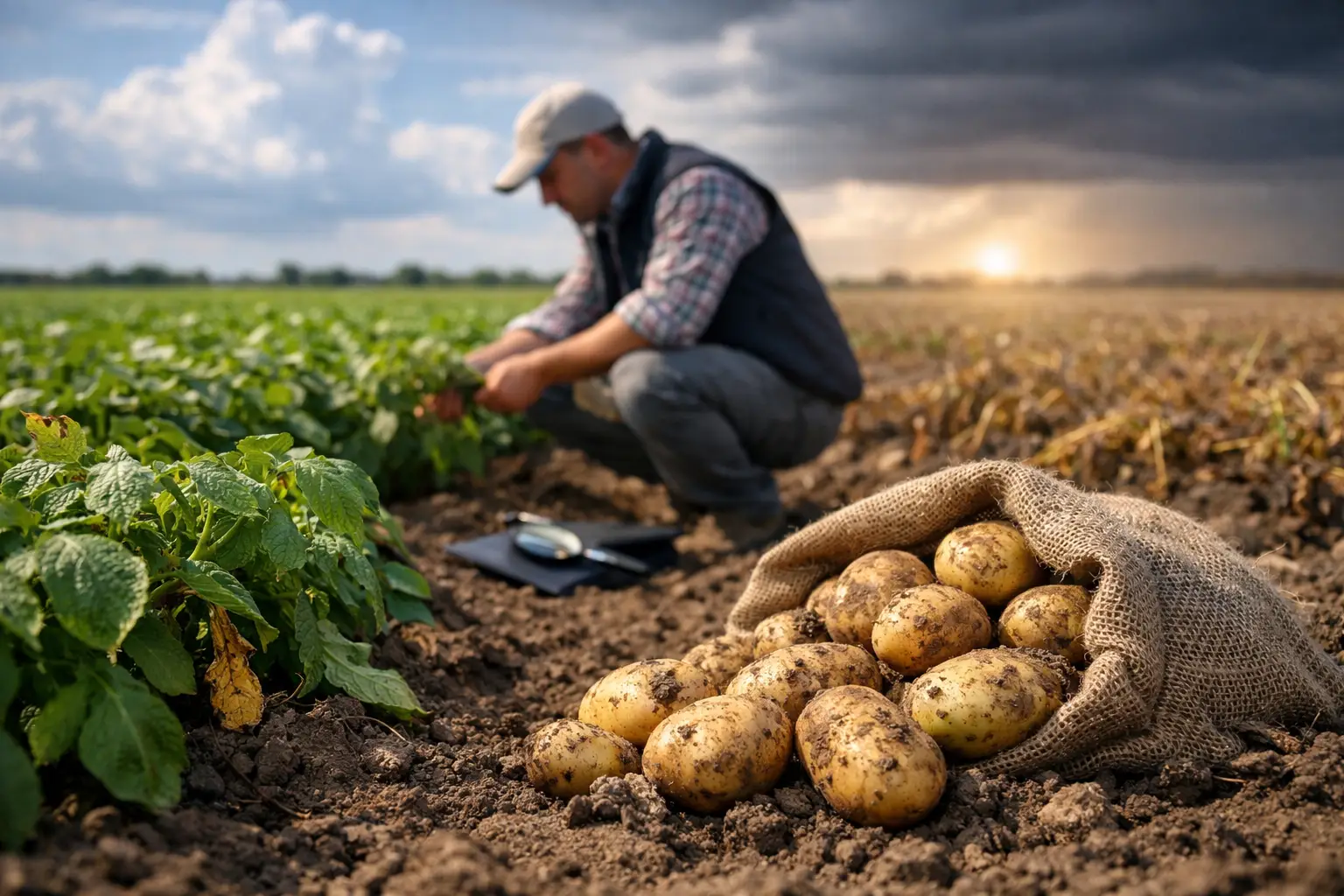
Potato Yield Decline: Find the Limiting Factor
A potato yield decline often becomes visible too late. By the time a field shows uneven canopy cover, early senescence, poor tuber bulking, or an unfavorable packout, the limiting factor may have been operating for weeks. The practical question is not simply why yield fell. It is when the crop first departed from its attainable growth path, in which zones, and whether the constraint can still be corrected.
For commercial potato production, yield is only part of the result. Tuber size distribution, specific gravity or dry matter, skin quality, defects, storage behavior, and marketable packout determine the economic outcome. A field can produce acceptable total tonnage yet still underperform financially because of oversized tubers, undersized tubers, hollow heart, heat damage, growth cracks, or internal defects. Diagnosis therefore needs to connect crop physiology with irrigation, nutrition, soil conditions, seed quality, and the consistency of field execution.
Why Potato Yield Decline Is Usually a System Problem
Potatoes respond quickly to changes in root-zone conditions, but they do not always show immediate visual symptoms. A short water deficit during tuber initiation can reduce tuber number. Excess water or poor aeration can reduce root function and make nutrient uptake unreliable. A nutritional imbalance may first appear as uneven growth, delayed canopy closure, or weak bulking rather than a textbook deficiency symptom.
This is why a single explanation is often incomplete. Low nitrogen may be the visible issue, but the root cause may be poor irrigation uniformity, saline irrigation water, a compacted layer restricting roots, or nitrogen applied at the wrong phenological stage. Adding fertilizer without resolving the underlying constraint can increase cost, delay maturity, worsen quality, or raise leaching risk without restoring yield.
A disciplined investigation starts by separating field variability from whole-farm trends. If the problem occurs in low areas, high areas, sandy strips, specific irrigation blocks, or fields supplied by a particular water source, those patterns are evidence. If every field declines under the same management program, the review should focus on common decisions such as seed sourcing, fertilizer strategy, planting date, irrigation scheduling, or disease pressure.
Establish the Yield Gap Before Looking for Causes
The first step is to define what the field reasonably could have produced under its environment and market target. Comparing this season only with a farm average can be misleading. A cool season, a delayed planting window, or a cultivar change may alter the realistic yield ceiling.
Review historical yield and quality by field, variety, planting date, soil type, irrigation system, and market destination. Then identify the gap between expected and actual outcomes. A 10% reduction in yield with stable tuber size distribution points to a different problem than the same reduction accompanied by excessive small tubers or variable specific gravity.
Crop stage matters. Potato yield formation has several sensitive periods: establishment and canopy development, tuber initiation, early bulking, and late bulking through maturity. The timing of stress often explains the result better than the final soil test or a single tissue sample. A field that lost tuber number at initiation cannot fully compensate later by extending nitrogen supply or increasing late-season irrigation.
Use Field Data That Can Explain Physiology
Useful data include planting date, emergence uniformity, stand counts, seed lot and physiological age, irrigation records, rainfall, ETc estimates, fertilizer and fertigation applications, water analyses, soil analyses, tissue results, disease observations, and harvest maps where available. The quality of these records matters more than the quantity.
For example, a weekly irrigation total does not show whether the root zone experienced repeated depletion before irrigation, whether an application exceeded the soil’s infiltration capacity, or whether one block received materially less water than another. Likewise, a total seasonal nitrogen rate says little about whether nitrogen was available during canopy development and early bulking, or whether it was lost, immobilized, or placed outside the active root zone.
Water Management Can Reduce Yield Without Obvious Wilt
Potatoes have a relatively shallow and sensitive root system. Their water demand rises rapidly as canopy cover develops, and water stress during tuber initiation can have lasting consequences. Yet visible wilt is a late indicator. By then, stomatal closure and reduced photosynthesis may already have limited growth.
The target is not to keep soil constantly saturated. Excess water is also damaging because it reduces oxygen around roots, favors some soilborne diseases, and can move nutrients below the effective root zone. The correct irrigation strategy depends on soil texture, effective rooting depth, system application rate and uniformity, water quality, weather demand, variety, and growth stage.
Irrigation water quality deserves equal attention. Elevated salinity, high bicarbonate, sodium hazards, chloride, and unsuitable pH can affect soil structure, nutrient availability, and root activity. In potatoes, modest salinity issues can become economically significant when combined with inconsistent irrigation or inadequate leaching. Water analysis should be interpreted with soil conditions and irrigation management, not treated as an isolated laboratory report.
Nutrition Programs Must Follow Crop Demand
Potatoes require a balanced nutrient program, not a high-rate program. Nitrogen supports canopy development and bulking capacity, but excess late nitrogen can delay maturity, reduce dry matter in processing crops, and create overly vigorous canopies that are difficult to manage. Insufficient early nitrogen can limit canopy size before the crop intercepts enough light to support high yield.
Potassium is especially relevant to tuber bulking, water relations, and quality, but its availability depends on soil supply, placement, irrigation, competing cations, and the fertilizer source. Phosphorus is most critical early, particularly in cool soils or where root development is restricted. Calcium management requires caution: a soil test alone may not indicate calcium delivery to developing tubers, while unnecessary calcium applications can create imbalance or add cost without benefit.
Tissue analysis is valuable when sampling is representative, timed to crop stage, and interpreted alongside irrigation and growth observations. One tissue sample cannot diagnose an entire field with strong soil variation. In variable fields, separate management zones and sample healthy versus affected areas at the same time. The comparison often provides more useful direction than a single average value.
Seed, Soil, and Root Health Set the Ceiling
A strong fertility and irrigation program cannot fully overcome uneven emergence, weak seed vigor, poor seed handling, compacted soil, or compromised root health. Seed physiological age, storage conditions, cutting quality, seed piece size, and planting conditions influence stem number, canopy establishment, and tuber set.
Soil constraints are frequently underestimated because they sit below the surface. Compaction, poor drainage, shallow rooting depth, localized salinity, and uneven organic matter can create zones where the crop cannot access water or nutrients consistently. Digging plants is still one of the most useful diagnostic practices. Compare root depth, root color, stolon development, tuber set, soil moisture, and compaction between high-performing and low-performing zones.
Disease diagnosis also needs precision. General canopy decline may result from pathogens, but it can also be caused by water stress, nutrient imbalance, root damage, heat, or chemical injury. Confirm suspected disease through field pattern, symptom progression, plant examination, and laboratory testing when the decision has significant financial consequences. Treating an assumed disease while ignoring root-zone conditions is a common and costly error.
Turn Diagnosis Into Consistent Field Execution
A yield recovery plan should identify the few decisions most likely to change the outcome. These may include revising irrigation thresholds by soil zone, correcting fertigation timing, adjusting nitrogen release later in the season, improving drainage in recurring wet areas, separating seed lots, or changing sampling protocols. The plan should also state who is responsible, what evidence confirms completion, and when results will be reviewed.
This is where agronomy often fails at scale. A technically sound recommendation may be issued, but not applied consistently across fields, growers, or irrigation blocks. Cropaia supports commercial growers and technical teams with independent diagnosis, fertilizer and irrigation program reviews, and practical training when potato performance no longer matches the farm’s potential.
For organizations managing many growers or production sites, yieldsApp can standardize crop-stage protocols, assign field actions, document observations, monitor adoption, and preserve traceability across the season. Digital records do not replace field agronomists. They make it easier for agronomists to see where recommendations were executed, where they were delayed, and which conditions repeatedly precede yield loss.
The most useful next step is to select one underperforming potato field and reconstruct its season from emergence through harvest. Compare it with a nearby successful field of similar variety and planting date. That side-by-side review usually turns a vague yield complaint into a specific management question worth solving.












About Post Author
