

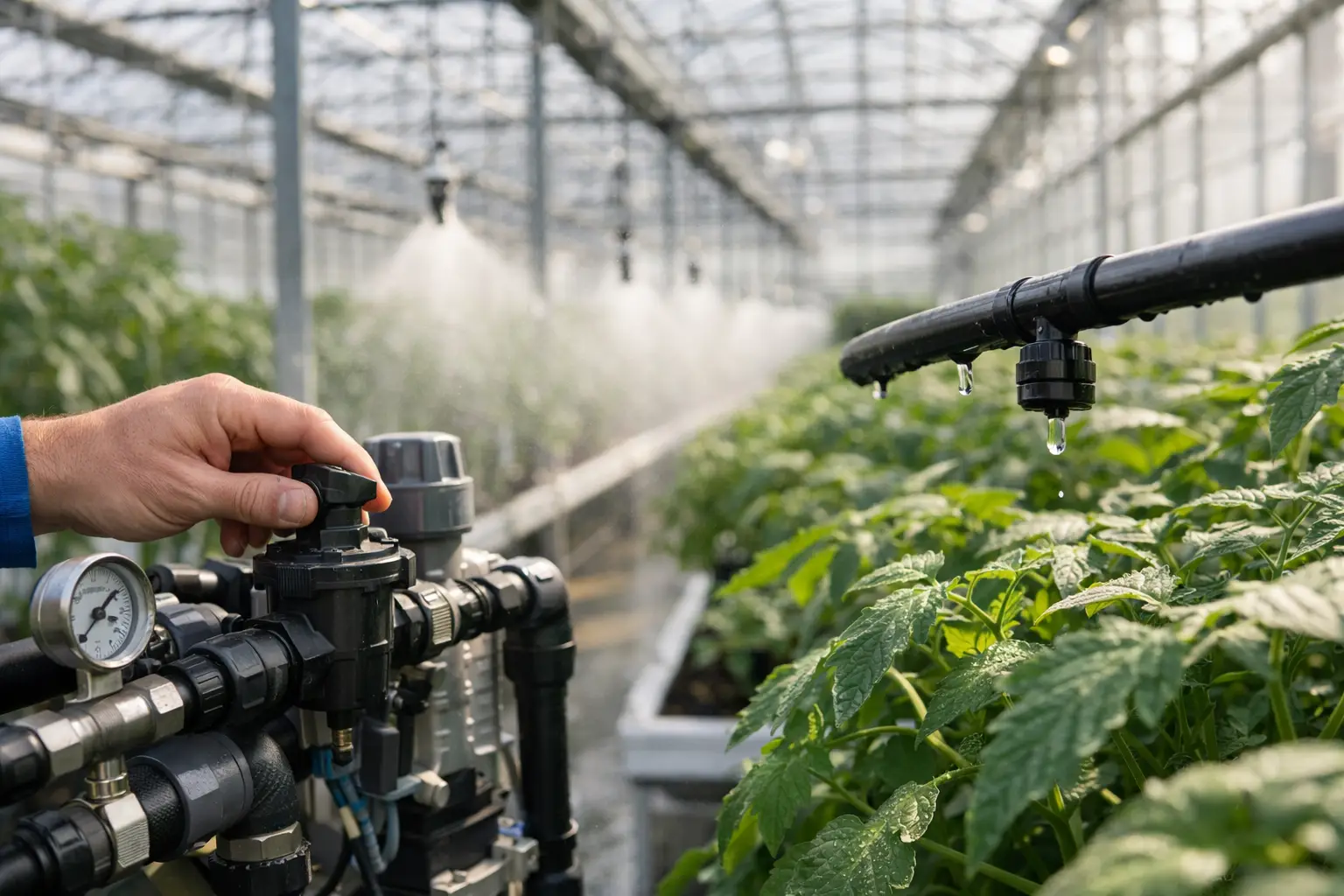
Commercial Greenhouse Irrigation Guide for Managers
A commercial greenhouse irrigation guide should begin with a production reality: irrigation is not a daily volume to apply. It is a controlled process for maintaining root-zone water content, oxygen, salinity, nutrient availability, and plant balance while responding to weather, crop stage, substrate, and cultivar. A schedule that performs well in a mild week can create water stress, excessive drainage, or root-zone EC accumulation after a change in radiation, ventilation, or crop load.
For commercial tomato, pepper, cucumber, berry, leafy green, and ornamental production, the goal is not simply to avoid wilting. It is to deliver the right water and nutrient solution to a uniform crop, at the right time, with enough drainage to manage salts but not so much that fertilizer, water, and labor are wasted. That requires measurable targets, disciplined verification, and a clear response protocol when field data and crop appearance do not agree.
Commercial Greenhouse Irrigation Guide: Start With the Root Zone
The root zone is where irrigation decisions prove their value. Whether the crop is grown in rockwool, coco coir, peat-based media, perlite, or soil, the irrigation program must maintain an acceptable range of moisture and EC. The acceptable range is crop-specific and stage-specific. Young plants with limited roots require a different strategy from a heavily loaded tomato crop in peak summer production.
Substrate-grown crops are particularly sensitive to timing. A high-frequency program may keep moisture stable, yet it can also reduce aeration if pulses start too early or continue too late. Conversely, long intervals may encourage stronger generative behavior in some crops, but excessive drying can restrict calcium movement, reduce fruit size, and cause uneven nutrient uptake.
Do not rely on one measurement alone. Root-zone EC, drain percentage, drain EC, solution EC, pH, slab or container weight, moisture sensors, radiation, and crop observations each describe only part of the system. A crop can show acceptable drain EC while still experiencing uneven water availability between irrigation lines, zones, or benches. Sampling must represent the actual variation in the greenhouse, not only the best-performing block.
Define operating targets before changing pulses
Set operating ranges for moisture, substrate EC, drain percentage, irrigation start time, final irrigation time, and daily water volume. These targets should be written by crop, variety, block, and growth stage. A single greenhouse-wide target is often too crude when planting dates, substrate volumes, and crop loads differ.
Drainage is a useful control point, not a universal target. More drainage generally lowers the risk of salt accumulation, but it also increases water and fertilizer losses and may mask an overly aggressive irrigation program. Low drainage can improve fertilizer-use efficiency when water quality is good and root-zone EC is stable, but it leaves less margin for error. The correct drainage level depends on source-water EC, fertigation concentration, climate, substrate properties, and the crop’s current demand.
Build Irrigation Around Demand, Not the Clock
A timer-based program is necessary for execution, but it should not be the basis of agronomic decisions. Crop water demand is driven largely by radiation, vapor pressure deficit, canopy size, temperature, airflow, and plant developmental stage. Radiation is often the most practical primary driver in controlled environments because it relates directly to transpiration and can be measured consistently.
Start with an estimated daily demand, then distribute that volume in pulses that suit the substrate and crop. The first irrigation should begin when plants are active enough to take up water, not merely because the workday has started. Starting too early can keep the root zone excessively wet after the night period. Starting too late can produce a morning moisture deficit that limits transpiration and nutrient transport during a high-value part of the day.
The final irrigation is equally important. A late final pulse may leave the medium too wet overnight, reducing root-zone oxygen and increasing disease pressure in vulnerable crops. Ending too early may create an excessive overnight dry-down, raise EC, and reduce next-day vigor. The preferred endpoint depends on substrate water-holding capacity, night climate, plant size, and the intended balance between vegetative and generative growth.
Use weather forecasts carefully. Forecasts are useful for preparing a starting schedule, especially when a hot or cloudy period is expected, but greenhouse microclimate can differ materially from outdoor measurements. Roof shading, vent position, screen use, humidity control, and compartment orientation all influence actual demand. Compare forecast assumptions against measured radiation, internal climate records, and irrigation outcomes.
Manage Water Quality and Fertigation as One System
Irrigation water quality determines how much flexibility the fertigation program has. High bicarbonate water complicates pH control. Elevated sodium or chloride narrows the salinity margin. High source-water EC means the crop reaches a stressful root-zone EC at a lower fertilizer concentration or lower drainage fraction than it would with cleaner water.
The relevant question is not whether water is good or bad. It is how its ions interact with the nutrient recipe, substrate, crop sensitivity, and intended leaching strategy. For example, a nutrient program may appear balanced on paper but become problematic when source water already contributes substantial calcium, magnesium, bicarbonate, sodium, or chloride.
Monitor irrigation-solution EC and pH at the point of delivery, not only at the fertilizer room. Injector calibration errors, stock-tank precipitation, pressure variation, and dosing failures can create a different solution at the plant than the recipe indicates. Periodic laboratory analysis of source water, feed water, and drain water provides the ion-level information that handheld EC and pH meters cannot provide.
For fruiting vegetables, changes in water supply also influence crop quality. Irregular root-zone moisture can contribute to cracking, blossom-end rot risk, soft fruit, uneven sizing, or reduced shelf life, depending on the crop and cultivar. The response should not automatically be more water. Diagnose whether the problem is related to timing, EC, calcium availability, climate, root health, or distribution uniformity before revising the program.
Verify Uniformity Before Blaming the Recipe
A technically correct irrigation schedule fails when distribution is uneven. Pressure differences, partially clogged drippers, line length, poorly matched emitters, blocked filters, and elevation changes can create substantial variation within a block. In hydroponic crops, even small delivery differences become significant over repeated daily pulses.
Measure emitter flow and delivery volume at representative points: near and far ends of laterals, different benches or gutters, and high- and low-pressure locations. Check that drainage samples represent multiple positions rather than a single convenient collection point. If one zone consistently has high drain EC and another remains wet, changing the central recipe will not solve the underlying hydraulic problem.
Filter maintenance and irrigation-line sanitation are operational controls, not maintenance details. Biological growth, mineral deposits, and suspended solids affect uniformity gradually, so teams often notice the issue only after crop variation is visible. Maintain records of filtration pressure differential, flushing, acidification or sanitation treatments where appropriate, dripper tests, and corrective actions.
Create a Daily Decision Routine
The best greenhouse teams combine automated data with structured crop walks. Each morning, review the previous day’s delivered volume, number of pulses, drain percentage, feed and drain EC and pH, internal radiation, climate conditions, alarms, and any zone-level exceptions. Then inspect plant posture, substrate moisture, root condition where visible, fruit load, and crop uniformity.
A practical decision routine separates observations from actions. If drain EC rises, determine whether the likely cause is insufficient volume, excessive dry-down, higher feed EC, increased source-water EC, reduced uptake due to climate, or restricted root activity. If drainage rises unexpectedly, check for a change in irrigation duration, emitter flow, plant demand, substrate saturation, or a leak. This discipline prevents repeated adjustments based on symptoms alone.
For organizations managing multiple greenhouses, farms, or contract growers, the challenge is consistency without ignoring local conditions. Cropaia can support irrigation and fertigation reviews, water-quality interpretation, root-zone diagnostics, and practical training for production and technical teams. The objective is to turn isolated observations into a crop-specific operating standard that staff can apply and improve.
At network scale, yieldsApp can organize irrigation protocols by crop and production stage, record field or greenhouse observations, assign corrective actions, monitor completion, and compare operational indicators across sites. A platform does not replace the agronomist’s judgment. Its value is ensuring that measurements, recommendations, exceptions, and follow-up are visible rather than remaining in separate spreadsheets, messages, and individual memory.
When to Escalate Beyond Routine Adjustments
Routine tuning is appropriate when the crop is uniform, sensors are credible, and deviations are small. Escalate when high drain EC persists despite reasonable drainage, when there is a widening gap between zones, when quality defects increase, or when root performance declines without a clear climate explanation. These cases often involve interacting causes such as water chemistry, nutrient antagonism, disease pressure, substrate degradation, or irrigation-uniformity failures.
The practical standard is simple: every irrigation change should have a stated reason, a measurable expected response, and a review point. When a greenhouse team works this way, irrigation becomes less dependent on intuition during a difficult week and more capable of protecting yield, quality, and margins throughout the crop cycle.











About Post Author
