

How to Correct Nutrient Antagonism
A field can show potassium deficiency in tissue tests while soil potassium levels look adequate. Or calcium disorders persist even when calcium is being applied. In many commercial cropping systems, that gap is explained by nutrient interactions – and knowing how to correct nutrient antagonism is often the difference between a fertilizer program that looks good on paper and one that performs in the field.
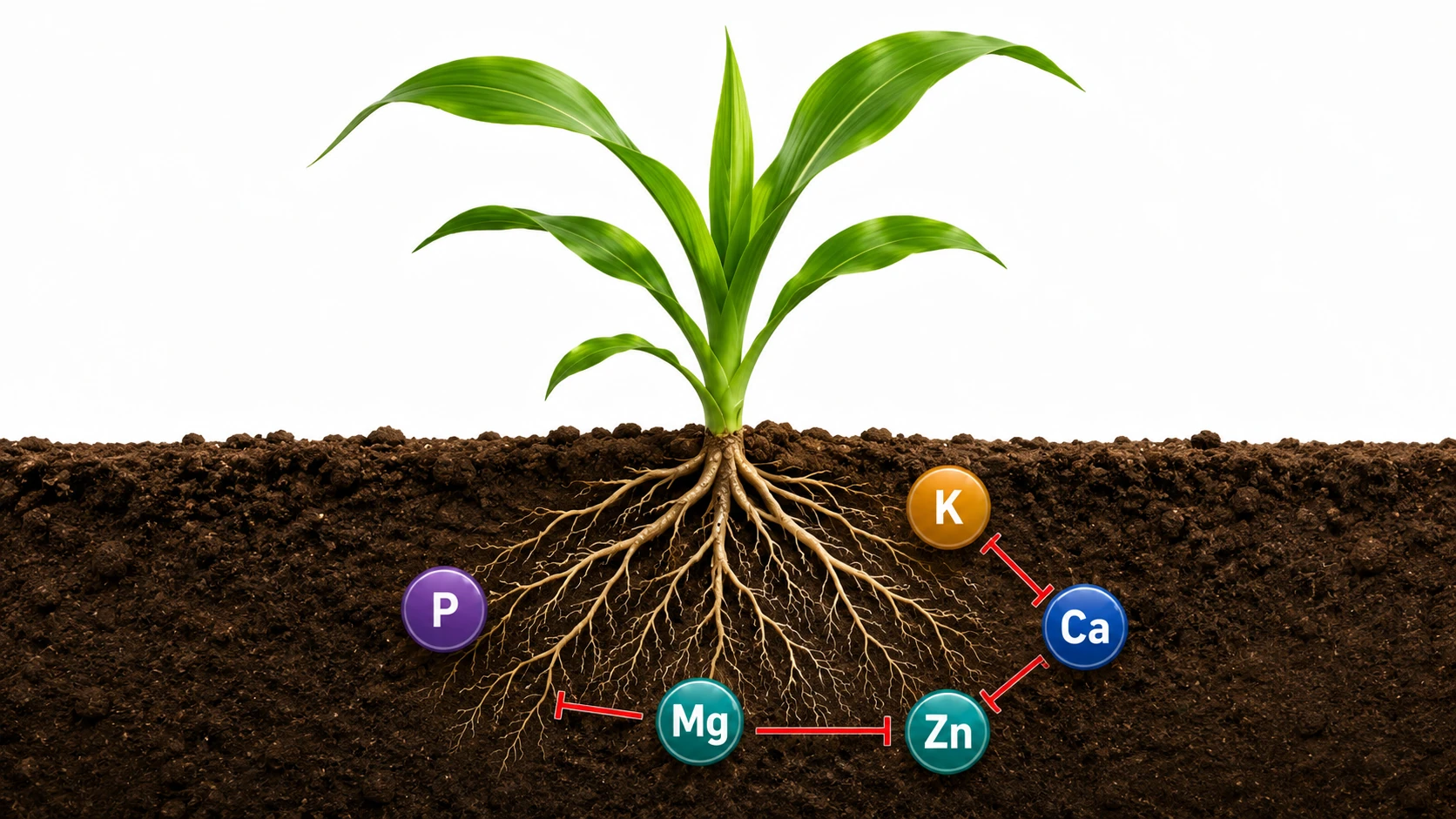
Nutrient antagonism occurs when one nutrient reduces the uptake, transport, or utilization of another. The mechanism may be chemical, physical, or physiological. In practice, growers and agronomists usually see it as uneven crop response, hidden hunger, lower fertilizer efficiency, or recurring quality issues that do not match the total nutrient supply. This is not just a fertility problem. It is a systems problem involving soil chemistry, irrigation water, root activity, fertilizer timing, crop demand, and placement.
What nutrient antagonism looks like in commercial production
The most common mistake is treating antagonism as a simple deficiency. A field team sees magnesium deficiency symptoms, so magnesium gets added. Symptoms soften for a while, then return. The underlying issue may be excessive potassium competing with magnesium uptake, a high ammonium load suppressing calcium absorption, or elevated sodium in the root zone changing cation balance and root function.
In tree crops, this often shows up as poor fruit quality, bitter pit risk, weak sizing, or inconsistent packout despite substantial nutrient investment. In row crops, it may appear as uneven canopy development, weak stalks, lower grain fill, or poor stress tolerance. In high-value vegetable systems, antagonism can drive tip burn, blossom-end rot, uneven maturity, and reduced shelf life. The agronomic signal is usually not a dramatic collapse. It is a persistent performance ceiling.
How to diagnose before you correct nutrient antagonism
If the goal is to know how to correct nutrient antagonism, diagnosis has to come before product selection. Adding more fertilizer without confirming the interaction often makes the imbalance worse.
Start by comparing four datasets rather than relying on one. Soil analysis shows nutrient reserves and ratios in the root zone. Irrigation water analysis identifies bicarbonates, sodium, chloride, sulfate, and other factors that influence uptake and soil conditions. Tissue analysis shows what the plant is actually acquiring. Field observation adds the pattern – where symptoms occur, when they appear, and whether they align with irrigation sets, soil type changes, or growth stage.
This is where many programs improve quickly. A tissue test alone can suggest deficiency, but not always the cause. A soil test alone can suggest sufficiency, but not always availability. Water quality can explain why a balanced fertility plan still underperforms. When all three are interpreted together, antagonism becomes easier to isolate.
Common antagonistic relationships to investigate
Several interactions deserve close attention in commercial systems. Excess potassium can suppress magnesium and sometimes calcium uptake, especially in crops with heavy potassium programs. High calcium can reduce magnesium availability in some calcareous conditions, although the field response depends heavily on soil texture, CEC, and irrigation management. Elevated ammonium can interfere with calcium, magnesium, and potassium uptake. Excess phosphorus can reduce zinc availability, particularly in cool soils or high-pH conditions. High sodium can compete with potassium and calcium while also degrading soil structure.
These are not fixed rules. The same nutrient ratio may be tolerated in one field and problematic in another because rooting depth, salinity, pH, oxygen status, and crop demand all change the outcome.
How to correct nutrient antagonism in the field
Correcting antagonism usually means restoring balance, not maximizing a single nutrient. The right response depends on whether the problem is driven by supply, placement, timing, pH, salinity, or water quality.
First, reduce the source of excess where possible. If potassium is crowding out magnesium, the answer is not always to pour on more magnesium. Often the stronger move is to moderate potassium applications, especially during growth stages where crop demand does not justify aggressive loading. The same logic applies when phosphorus is repeatedly applied in fields already testing high and zinc issues continue.
Second, match the corrective nutrient to the delivery pathway. If root uptake is restricted by root-zone chemistry, foliar feeding may provide short-term relief but rarely solves the whole problem. Foliar applications can help stabilize the crop during a critical stage, especially for micronutrients such as zinc or manganese, yet the root-zone imbalance still needs correction. In contrast, if a fruiting crop has an urgent calcium-related quality issue, a foliar program may support the immediate need while fertigation and irrigation strategy are adjusted underneath.
Third, review fertilizer form, not just nutrient totals. Nitrogen source matters. Heavy ammonium programs can intensify cation competition and acidify localized zones. Nitrate-based nutrition may support better calcium uptake in some situations. Potassium source can also matter depending on salinity sensitivity and chloride load. Sulfate, chloride, and nitrate carriers all influence the broader root environment differently.
Fourth, fix the water and soil conditions that amplify antagonism. Poor drainage, compaction, cold soils, and oxygen stress can all mimic or worsen nutrient imbalance. A technically balanced nutrient program will still fail if roots are not functioning well. In irrigated systems, frequency and volume also matter. Overirrigation can push nutrients below active roots or create transient anaerobic conditions that reduce uptake efficiency.
pH, salinity, and bicarbonates often sit behind the problem
In many commercial operations, the visible antagonism is only the surface issue. The real constraint is pH management, salinity, or irrigation water chemistry.
High soil pH reduces availability of several micronutrients, especially zinc, iron, and manganese. In those cases, what appears to be phosphorus-zinc antagonism may be partly a pH-driven zinc availability problem. Likewise, bicarbonates in irrigation water can gradually raise rhizosphere pH and reduce micronutrient efficiency, even when fertilizer rates appear adequate.
Salinity complicates everything. Elevated EC increases osmotic stress and can change nutrient selectivity at the root surface. Sodium and chloride become particularly disruptive in sensitive crops or poorly drained soils. Under saline conditions, a textbook nutrient ratio may no longer predict uptake well because the root system is operating under stress.
This is why nutrient correction should not be separated from water management. Agronomically, they are part of the same decision.
Crop stage matters when correcting nutrient antagonism
One reason nutrient antagonism is frustrating is that timing changes the severity of the impact. A mild magnesium restriction during vegetative growth may be recoverable. The same restriction during grain fill, fruit sizing, or tuber bulking can translate directly into lower marketable yield or quality.
Calcium is a good example. Because calcium movement depends strongly on transpiration and xylem flow, a crop can have adequate calcium in the system and still show deficiency symptoms in low-transpiring organs. That is why fruit quality disorders are not solved by calcium rate alone. Irrigation uniformity, nitrogen balance, canopy vigor, root health, and weather all influence the result.
The practical implication is simple: correction should be staged around crop demand. Broad seasonal balance is necessary, but high-risk growth periods deserve tighter monitoring through tissue testing and field observation.
A better decision framework than chasing ratios
Agronomists often discuss cation ratios because they can be useful warning signs. But ratios alone are not enough to make corrective decisions. A ratio without context can lead to overcorrection.
A better framework asks five questions. Is the nutrient truly low in the plant? Is another nutrient present at a level likely to suppress uptake? Is pH or salinity altering availability? Is the root system healthy enough to respond? And is the problem affecting current yield or only future risk?
This approach keeps the program grounded in field economics. Not every antagonism needs a major correction. Some require immediate intervention because they threaten quality, packout, or yield. Others can be managed gradually over the next fertilizer cycle.
For large operations, this is also where digital agronomy becomes useful. Layering soil maps, irrigation blocks, tissue trends, and yield history helps identify whether antagonism is field-wide or limited to certain management zones. That supports more precise corrective action rather than blanket applications across an entire farm.
How to prevent nutrient antagonism from recurring
Prevention usually delivers better returns than rescue. Build fertility programs around crop removal, realistic yield targets, irrigation water quality, and root-zone conditions rather than habit or standard recipes. Repeatedly applying one nutrient because it has worked before is how many antagonisms begin.
Use seasonal testing strategically. Pre-plant soil analysis, in-season tissue monitoring, and periodic water testing provide a more reliable picture than any single snapshot. In perennial systems, compare trends year over year instead of reacting only to one lab result. In annual crops, align sampling with key uptake windows so corrections can still influence outcome.
Most importantly, treat nutrient management as a dynamic process. Commercial fields change with variety, rootstock, weather, water source, soil moisture pattern, and yield level. The same program that worked last season may push the crop out of balance this season.
Knowing how to correct nutrient antagonism is less about finding a single cure and more about improving the quality of agronomic decisions. When diagnosis is disciplined and corrections are tied to field conditions, fertilizer efficiency improves, crop response becomes more predictable, and the nutrition program starts working with the crop instead of against it.












About Post Author
