

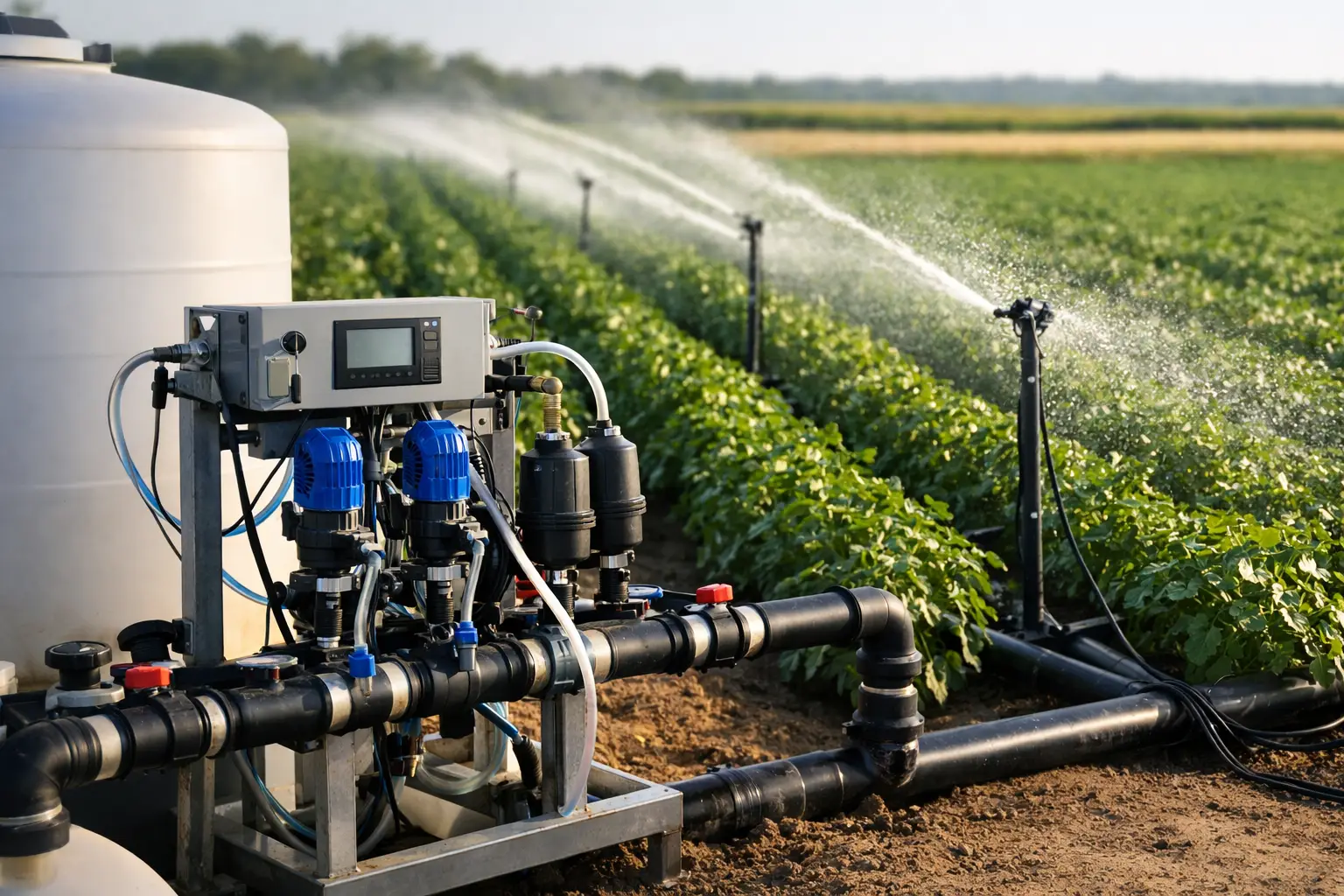
Fertigation Management That Holds Up in the Field
A tomato block with excellent leaf color can still be underperforming because nitrogen arrived too early, potassium was restricted by a dry root zone, or calcium movement slowed during a hot irrigation cycle. Fertigation management is not the act of injecting fertilizer into irrigation water. It is the disciplined control of nutrient dose, timing, water volume, water quality, and distribution uniformity so the crop receives what it can actually use.
For commercial farms, the difference is material. A fertilizer program may look correct on an annual nutrient budget yet fail at field level because the irrigation schedule, injector calibration, root-zone salinity, or crop stage was not considered. The same problem becomes harder when an organization manages hundreds of growers or multiple regions. A recommendation is only valuable when it can be executed consistently, verified, and adjusted when field conditions change.
Start Fertigation Management With the Root Zone
The crop does not absorb nutrients from a spreadsheet. It absorbs nutrients from a wetted root zone with a specific water content, oxygen status, temperature, salinity level, and pH. This is why a sound fertigation plan starts with irrigation performance and soil conditions, not with a fertilizer catalog.
In drip-irrigated vegetables, orchards, and vineyards, the first question is whether the applied water reaches the active roots uniformly. Short, frequent pulses can maintain nutrient availability in a light soil, but they may leave deeper roots dry or concentrate salts at the edge of the wetted bulb. Longer sets can improve wetting depth, but may leach nitrate or displace oxygen in poorly drained soil. Neither approach is universally correct.
A practical review should examine irrigation water analysis, emitter flow variation, pressure differences, application rate, wetting pattern, soil texture by management zone, and drainage constraints. In perennial crops, root distribution also changes with tree age, soil compaction, and irrigation history. A uniform recipe across every block is often convenient and often wrong.
Match Nutrient Delivery to Crop Demand
Seasonal nutrient requirements are useful for budgeting, but they do not tell a manager how much to inject this week. Fertigation decisions should follow crop phenology, expected growth rate, fruit load, weather demand, and the nutrient supply already present in the root zone.
Early vegetative growth generally requires enough nitrogen and phosphorus to establish canopy and roots, without encouraging excessive vigor. As fruiting crops move into high fruit set and fill, potassium demand often rises sharply. Calcium requires special attention because it moves primarily with transpiration, not because more calcium was simply injected. High humidity, poor root aeration, excessive ammonium, and erratic water supply can all limit calcium delivery to sensitive tissues even when the fertilizer analysis appears adequate.
For crops such as greenhouse tomato, pepper, strawberry, citrus, avocado, and table grape, nutrient ratios must be evaluated in context. A high-potassium program may support fruit sizing in one stage and suppress magnesium uptake in another. Aggressive nitrogen correction may recover leaf color but delay maturity, reduce quality, or increase susceptibility to physiological disorders. The goal is not to chase every tissue result. It is to identify the limiting factor and correct it without creating the next one.
Use Field Measurements as Decision Inputs
Soil solution tests, saturated paste extracts, soil moisture data, tissue analysis, irrigation records, yield maps, and packout data each answer different questions. Tissue analysis indicates what the plant has accumulated. It does not directly reveal whether poor uptake resulted from low supply, excess salinity, root disease, cold soil, or restricted moisture.
Likewise, an electrical conductivity reading without sampling depth and irrigation context can mislead. Elevated EC near the surface may be manageable if salts remain outside the active roots. The same reading within the primary uptake zone during fruit fill can reduce water uptake and quality. Sampling strategy matters as much as laboratory accuracy.
The most reliable process combines measurements with field observation. Check irrigation duration, inspect wetting depth, compare representative weak and strong zones, and review recent fertilizer events before changing the program. This prevents the common error of treating symptoms with more fertilizer.
Protect the System From Water Quality and Compatibility Problems
Water quality sets the boundaries for fertigation management. High bicarbonate water can raise pH and contribute to carbonate precipitation. Calcium and magnesium in the source water affect the nutrient balance before fertilizer is added. Chloride and sodium can accumulate in sensitive crops or poorly drained soil. Iron, manganese, and biological growth can restrict filters and emitters.
Acidification may be justified, but it should be based on alkalinity, target pH, flow rate, fertilizer compatibility, and safety controls. Acid is not a default treatment. Over-acidification can damage components, create handling risks, and destabilize a program that was otherwise functioning.
Fertilizer compatibility also deserves operational discipline. Calcium fertilizers should not be concentrated with phosphates or sulfates in the same stock tank unless compatibility has been verified. Precipitation may begin in the tank, in the injection line, or at a point where water chemistry changes. The outcome is not just lost nutrients. It is uneven application, blocked emitters, and a field problem that may not be visible until crop performance declines.
A clear injection sequence, stock solution limits, filtration protocol, and post-injection flushing procedure should be documented for every site. This is basic risk control, especially where several people operate the same irrigation system.
Turn Recommendations Into Repeatable Execution
The technical challenge expands when a cooperative, exporter, food company, or input supplier supports many growers. Agronomists may agree on the principles but use different units, sampling methods, crop-stage definitions, and thresholds. Recommendations then become difficult to compare, audit, or improve.
A scalable fertigation program needs standardized field protocols: defined management zones, crop-stage calendars, water and fertilizer records, approved product options, compatibility rules, sampling windows, and escalation criteria. It also needs room for local adjustment. A sandy block with saline water should not follow the same pulse schedule as a heavier soil supplied by low-salinity water, even if both grow the same cultivar.
This is where operational agronomy matters. yieldsApp can help organizations coordinate field recommendations, record planned versus completed applications, monitor exceptions, and maintain traceability across growers and regions. The value is not replacing agronomists with software. It is giving agronomists a shared operating system so important details do not disappear into messages, spreadsheets, or inconsistent field notes.
For example, a regional manager can identify blocks where planned fertigations were missed, where irrigation volumes deviated from protocol, or where repeated high-EC observations require review. Technical teams can compare adoption and crop response across similar management zones. That visibility supports faster intervention and more credible reporting to sourcing, sustainability, finance, and program stakeholders.
Know When to Reduce, Pause, or Rebuild the Program
More frequent fertigation is not always better. In waterlogged soils, nutrient injection can worsen a root-zone oxygen problem. During low transpiration periods, high nutrient concentration may raise salinity without increasing uptake. After a major irrigation failure, applying a full fertilizer dose immediately may compound crop stress rather than restore performance.
There are also situations where the program needs rebuilding rather than adjustment. Persistent unevenness along laterals, unexplained nutrient deficiencies in specific zones, chronic high EC, poor drainage, and large gaps between expected and actual yield all justify a broader diagnosis. Review the hydraulic system, water source, soil variability, root health, fertilizer records, and crop history together.
Cropaia supports this type of work through independent fertigation and irrigation review, crop nutrition diagnosis, and advanced practical training for growers, agronomists, and technical teams. The objective is not a generic schedule. It is a defensible program that fits the crop, water, soil, infrastructure, and commercial target.
The most useful fertigation plan is one the field team can run accurately on a difficult week, not just one that looks precise before the season begins.











About Post Author
