

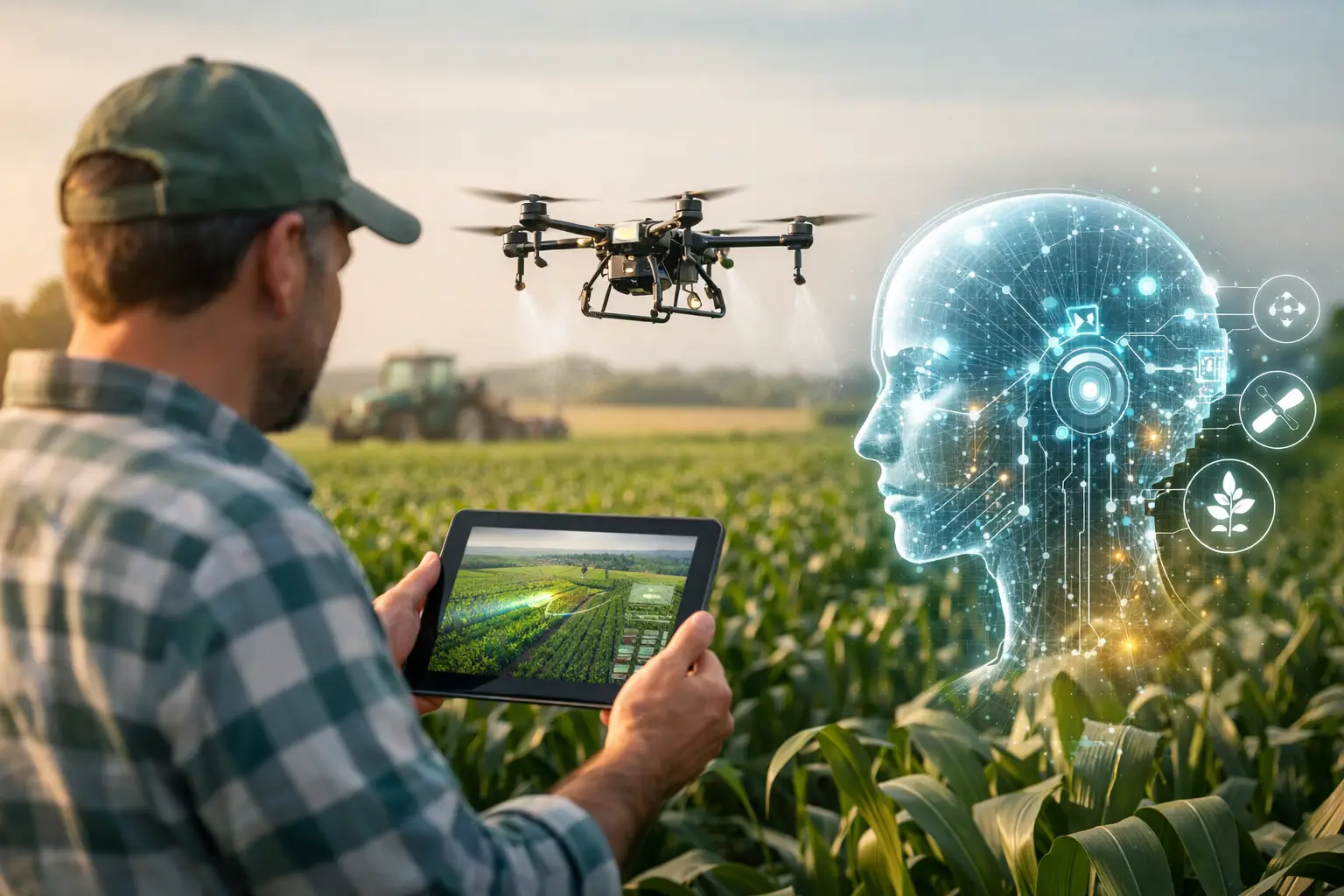
AI in Crop Advisory for Better Field Execution
A block showing early potassium deficiency, a greenhouse compartment with rising drainage EC, or a grower repeatedly irrigating beyond the effective root zone cannot be managed well by a generic alert. AI in crop advisory becomes valuable when it helps an agronomist identify the affected fields, interpret the agronomic context, prioritize action, and verify whether the recommendation was executed.
For commercial production, the question is not whether artificial intelligence can produce a recommendation. Many systems can. The operational question is whether the recommendation reflects the crop stage, soil and water conditions, irrigation system, production target, prior applications, and the constraints facing the grower or field team. A useful advisory must also arrive early enough to change the next decision.
Where AI in Crop Advisory Creates Real Value
AI is most effective when it is assigned to specific, repeatable advisory tasks. It can combine weather data, reference evapotranspiration, field records, irrigation events, satellite observations, soil analysis, tissue analysis, sensor readings, and scouting reports faster than a person working from disconnected files. That speed matters in crops where a three-day delay in irrigation correction, fertigation adjustment, or disease-risk response can affect yield or quality.
In a citrus program, for example, AI can flag blocks where water application has remained high while crop water demand has declined after a weather shift. In processing tomatoes, it can identify fields approaching a critical phenological stage where nitrogen timing and water management need closer review. In greenhouse peppers, it can compare drainage percentage, drainage EC, irrigation frequency, and climate conditions across compartments to identify where root-zone conditions are departing from the intended strategy.
These are not autonomous agronomic decisions. They are structured signals that help a qualified agronomist direct attention to the fields with the highest likely economic impact. The model may identify an anomaly, but it cannot reliably determine whether the cause is a blocked filter, poor emitter uniformity, an incorrect field record, shallow roots, a salinity issue, or a deliberate management choice without adequate field context.
From data collection to decision priority
Most organizations do not lack agricultural data. They lack a disciplined process for turning data into prioritized work. Weather stations may sit in one platform, fertilizer records in spreadsheets, grower visits in messaging groups, and satellite imagery in another system. As a result, field teams spend time locating information instead of reviewing crop performance.
AI can organize this information into an exception-based workflow. Rather than asking an agronomist to inspect every field equally, the system can rank fields based on conditions such as water deficit risk, unusually low vegetation development relative to comparable blocks, missed crop-protection follow-ups, nutrient program deviations, or incomplete field observations. The ranking should remain transparent. Agronomists need to see the inputs and reasoning behind a priority score, not receive an unexplained instruction.
This distinction is especially important for cooperatives, exporters, input companies, and development programs supporting hundreds or thousands of growers. Their technical teams cannot visit every plot at the same frequency. AI can help allocate scarce agronomy resources, but the operating model still requires clear thresholds, escalation rules, and field verification.
The Advisory Must Be Agronomically Grounded
A crop advisory model is only as useful as the agronomic rules, records, and assumptions behind it. A recommendation to apply more nitrogen may appear reasonable if a vegetation index is low. It may be wrong if the actual constraint is poor aeration, high soil salinity, restricted rooting depth, low water quality, a root disease, or uneven irrigation distribution.
For this reason, AI should work within a crop-specific decision framework. That framework defines the relevant crop stages, production targets, allowable water stress, nutrient uptake patterns, irrigation-system characteristics, soil limitations, and warning signs that require human review. It also distinguishes between a recommendation and a diagnosis. A recommendation might be to inspect pressure variation and compare soil moisture at two depths. A diagnosis requires sufficient evidence to identify why the field is underperforming.
Water management provides a clear example. AI can calculate estimated crop water use from ETc, forecast demand, and compare this with recorded irrigation. But ETc is not an irrigation prescription by itself. The final decision depends on effective rooting depth, soil texture, salinity, wetting pattern, rainfall effectiveness, irrigation uniformity, drainage, and the production objective. A deficit-irrigation strategy for wine grapes is not transferable to fresh-market berries or greenhouse cucumbers.
The same applies to nutrition. Tissue analysis, soil analysis, and fertilizer records can be analyzed at scale, but a low leaf nutrient concentration must be interpreted against growth rate, sampling method, cultivar, phenology, root-zone moisture, and interactions with other nutrients. AI can make interpretation more consistent. It cannot eliminate the need for sound crop nutrition expertise.
What a Scalable AI Advisory Workflow Looks Like
The strongest systems connect agronomic intelligence to execution. They do not stop at a dashboard or a weekly report. A practical workflow has four connected stages:
- Standardize field data. Each field needs a reliable identity, crop, variety, planting date, area, irrigation method, production objective, and responsible grower or manager. Field observations and recommendations should use consistent categories.
- Generate and review exceptions. Models identify unusual conditions or pending decisions, while agronomists review material risks and add local judgment before recommendations are issued.
- Assign actions and capture evidence. The recommendation is assigned to a person, due date, and field. Photos, application records, irrigation records, and follow-up observations establish whether the action occurred.
- Measure response and improve protocols. Teams compare execution and crop outcomes across fields, regions, and seasons. This is how recommendations become more precise and operational standards improve.
This workflow is where yieldsApp has a distinct role. It supports organizations that need to coordinate recommendations across growers and field teams, monitor adoption, document field activity, and maintain traceability from an agronomic alert through to completed action. The platform is not a replacement for the technical director or local agronomist. It is an operating layer that makes their decisions visible, repeatable, and auditable across a distributed program.
Data Quality Is the Main Constraint
The appeal of AI can distract from the more difficult work: creating usable field data. Incomplete irrigation logs, uncertain crop dates, inconsistent units, incorrectly mapped plots, and missing scouting records can generate false alerts with impressive-looking charts. If teams lose confidence in the alerts, adoption falls quickly.
Organizations should begin with the minimum data needed for high-value decisions. For irrigation, that may include field boundaries, crop dates, irrigation events, weather data, basic soil information, and periodic field observations. For nutrient management, it may include fertilizer applications, water analysis, soil and tissue results, crop stage, and yield or quality records. More data is useful only when someone can validate it and act on it.
There is also a trade-off between standardization and local flexibility. A regional protocol may require every advisor to record the same irrigation checks, but individual farms will differ in water source, soil depth, system design, and labor capacity. The right approach is to standardize the decision process and evidence requirements while allowing field-specific recommendations within defined technical boundaries.
Human Expertise Remains the Control Point
AI can reduce routine analysis and improve consistency, but it should not be allowed to create unreviewed recommendations for high-risk decisions. Fertilizer rates, irrigation changes under salinity conditions, crop-protection interventions, and decisions with major economic consequences require qualified professional oversight.
Agronomists also need training to challenge the system properly. They must understand which data sources are used, how alerts are prioritized, where uncertainty enters the model, and what field observations can confirm or reject a signal. Without that capability, teams may either follow weak recommendations too readily or ignore useful alerts because they appear disconnected from field reality.
Cropaia supports this practical side of digital agronomy through consulting and technical training focused on irrigation, fertigation, crop nutrition, diagnostics, and the design of field protocols. For an organization deploying AI-supported advisory, the most valuable investment is often not the model itself. It is the shared technical standard that allows advisors to interpret data consistently and act with confidence.
The best use of AI in crop advisory is therefore disciplined rather than dramatic: identify the fields that need attention, put the right evidence in front of the right agronomist, convert judgment into a clear field action, and confirm that the action was carried out. That is how digital intelligence becomes better crop execution rather than another source of reports.











About Post Author
