


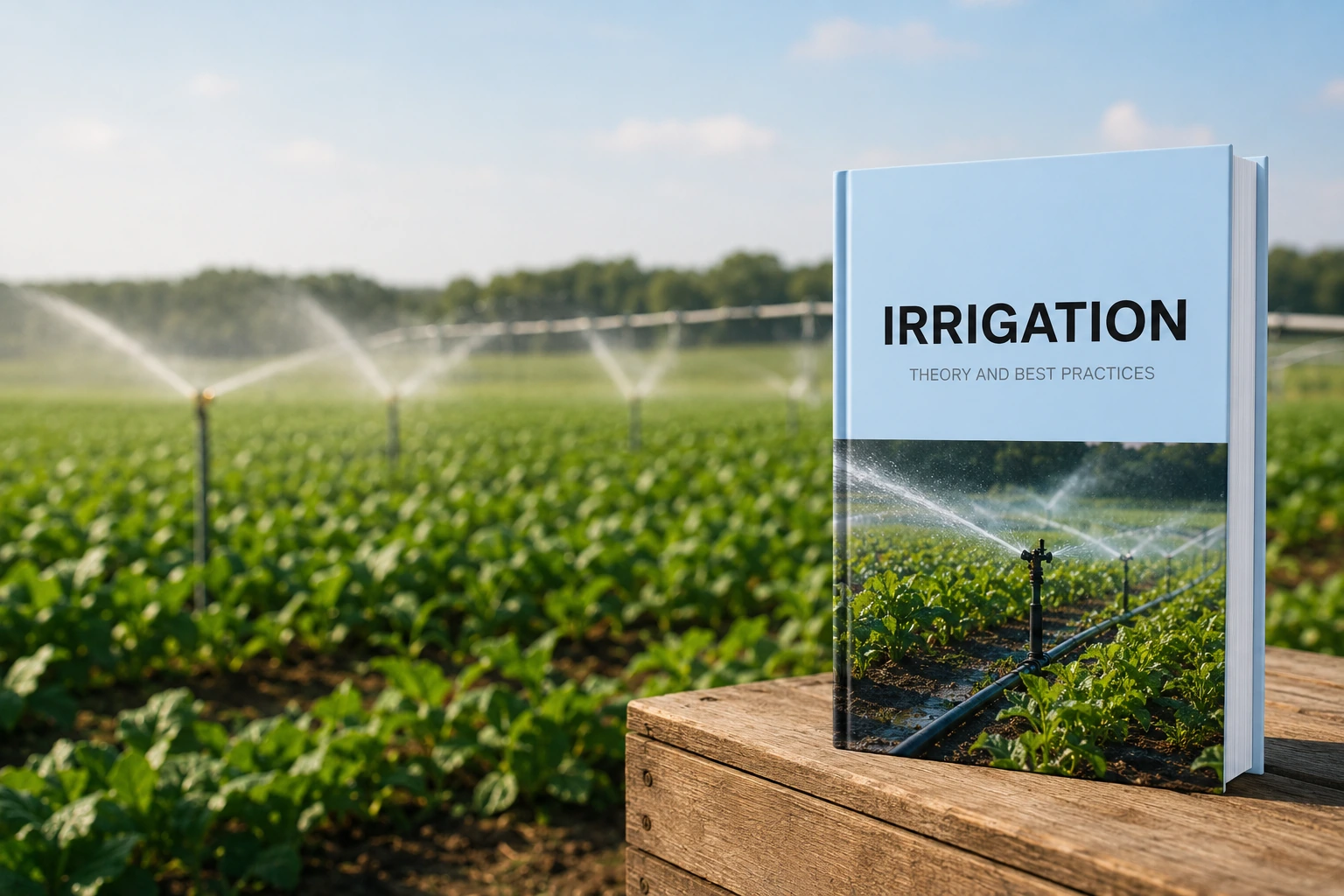
Choosing an Irrigation Book for Practical Field Decisions
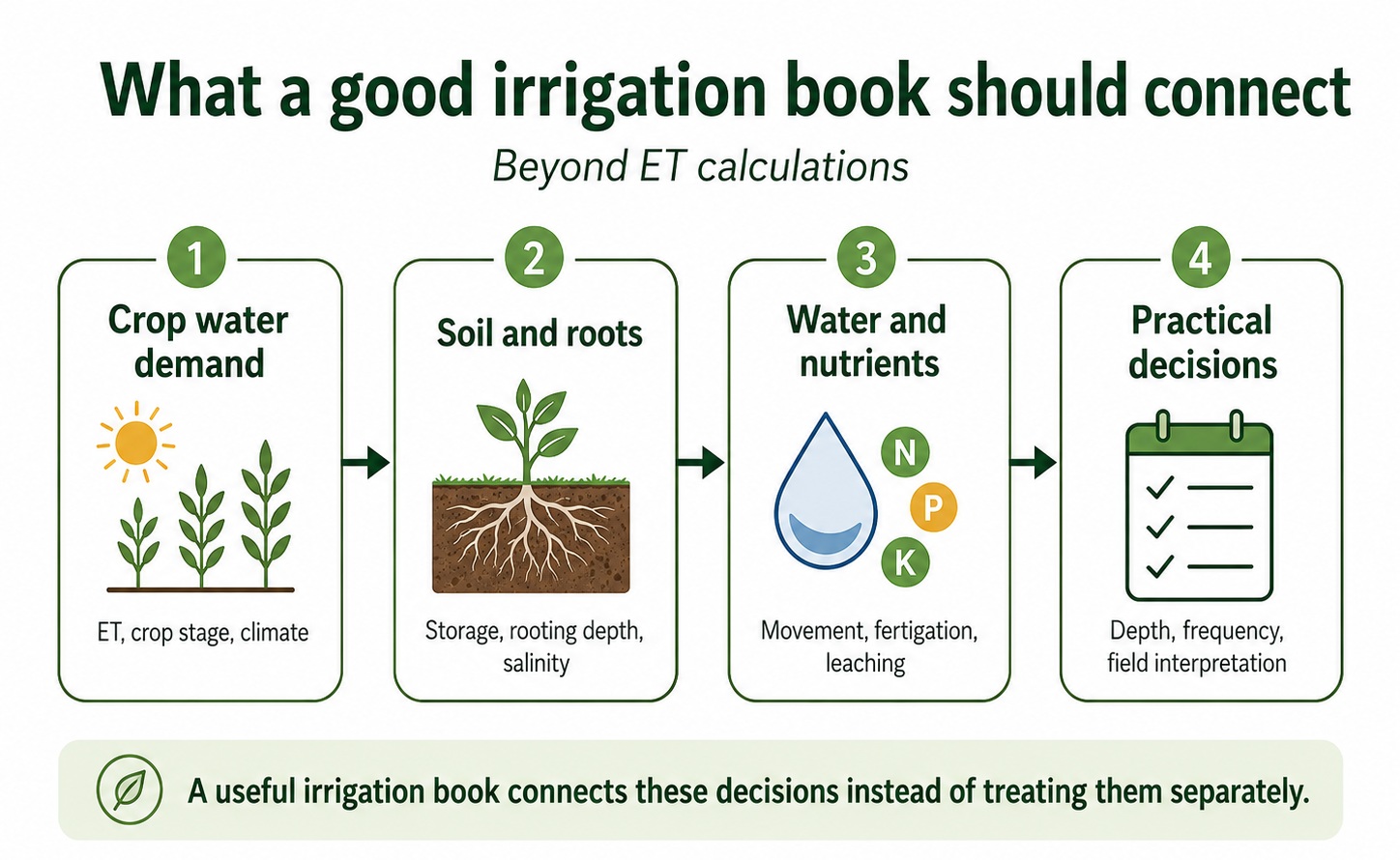
A useful irrigation book for agronomists, growers, consultants, and farm managers should do more than explain evapotranspiration formulas. It should help the reader connect crop water demand with soil properties, root development, water quality, salinity, nutrient movement, and practical scheduling decisions.
The calculations matter, but water-management decisions can still fail when the assumptions behind them are wrong. An estimated crop requirement may be reasonable while the application produces runoff, uneven wetting, excessive drainage, poor aeration, salt accumulation, or nutrient losses.
This guide explains what professionals should look for in an irrigation book, where simplified references fall short, and why water and fertilizer management should be studied as connected root-zone processes.
A practical reference should connect five levels of decision-making:
- Crop water demand
- Soil and root-zone water storage
- Application constraints
- Water, salt, and nutrient movement
- Monitoring and interpretation
Crop water demand is only the starting point
Any serious reference must explain evapotranspiration. Reference evapotranspiration, crop coefficients, crop stage, canopy development, climate, and planting density all affect estimated crop water demand.
These concepts are essential for scheduling, seasonal water budgeting, and comparisons between fields or management zones. However, evapotranspiration does not define the complete schedule.
After estimating crop water use, the manager still has to determine:
- How much water can be depleted from the active root zone
- How frequently applications should be repeated
- Whether the soil can absorb the planned amount
- How much can be applied in one event
- Whether salinity, drainage, or aeration impose additional constraints
The same crop evapotranspiration value can therefore lead to different schedules under different soil and root conditions.
| Soil and root condition | Practical response |
|---|---|
| Sandy soil, low plant-available water, and shallow roots | Apply a smaller depth at a higher frequency |
| Deep, well-structured soil with greater plant-available water and deeper roots | Use a larger application depth and a longer interval where crop conditions permit |
| Salinity risk within or around the root zone | Include leaching requirements and salt distribution in the schedule |
| Poor infiltration, crusting, compaction, or surface sealing | Reduce application intensity or divide the planned amount into pulses |
A young crop with a limited root system cannot be managed at the same frequency as a mature crop with deeper active roots. A saline field may require additional water for leaching. A field with restricted infiltration may require smaller applications, pulse operation, or a lower application intensity.
A book that stops at evapotranspiration calculations leaves many of these practical decisions unresolved.
Soil variability changes the schedule
Agronomists and growers often apply soil information too broadly. They may treat an entire field as a single soil unit because a soil map presents it that way or because they analyzed only one composite sample. In practice, water behavior can vary substantially within the same field.
Important sources of variability include:
- Texture and soil layering
- Structure and aggregate stability
- Compaction and traffic patterns
- Infiltration rate
- Internal drainage
- Salinity and sodicity
- Organic matter
- Gravel and stone content
- Land preparation and previous tillage
- Slope and surface condition
These properties affect how quickly water enters the soil, how it spreads, how much remains available to the crop, and whether part of the applied volume is lost through runoff or deep percolation.
Two areas planted with the same crop and exposed to the same atmospheric demand may therefore require different application depths, frequencies, or management strategies.
Accuracy is not the same as representation
The opposite mistake is relying too heavily on one localized measurement. A soil sample, tensiometer, capacitance probe, or other sensor may accurately describe conditions near the measurement point without representing the entire management block.
This distinction is critical. A precise reading has limited operational value when the instrument is installed in an unrepresentative zone, at the wrong depth, beside an atypical emitter, or outside the crop’s effective root system.
A practical guide should explain both how measurements are obtained and how to determine whether they represent the area being managed.
Effective root depth controls available water
Plant-available water is often presented as a soil property derived from field capacity, permanent wilting point, and soil texture. For scheduling purposes, however, the usable reservoir also depends on the depth and distribution of active roots.
A crop with active roots extending to 30 cm has access to a much smaller soil-water volume than a crop using an 80 cm profile. This difference directly affects:
- Application frequency
- Maximum depth per event
- Allowable depletion
- Crop sensitivity to delays
- Nutrient uptake
- Leaching risk
- The interpretation of soil-moisture measurements
Effective root depth is especially important in young plantings, recently transplanted crops, compacted soils, shallow soils, saline profiles, poorly drained fields, and crops affected by root disease or poor establishment.
A rooting-depth value taken from a reference table can support preliminary planning, but it should be treated as an assumption rather than an established field fact.
How to assess the active root zone
Evidence about effective rooting depth can come from root inspection, soil augering, moisture-pattern evaluation, crop vigor, salinity distribution, nutrient distribution, and crop-water-status measurements where appropriate.
A soil profile may physically allow deep rooting while the crop functions with a shallow active zone because of compaction, salinity, waterlogging, low oxygen, disease, or poor establishment.
The relevant question is therefore not only how much water the soil can theoretically store. It is how much the crop can access before water stress, oxygen limitation, salt stress, or nutrient loss becomes a problem.
Application rate must match soil intake
One of the most common technical failures is applying water faster than the soil can absorb it.
The calculated depth may be correct, but the event can still produce runoff. The effective amount entering the root zone will then be lower than planned, even though the recorded duration or total volume appears correct.
This problem is common in sprinkler and surface systems, but it can also occur under localized application when discharge, spacing, slope, duration, soil texture, and wetting patterns are not considered together.
For example:
- A soil with a low intake rate may require lower application intensity, pulse operation, or pauses between pulses.
- A sandy soil may accept water rapidly but store relatively little, increasing the risk of deep percolation and nutrient leaching.
- A sloping field may generate runoff even where the average infiltration rate appears acceptable.
- A compacted surface layer may restrict entry even when the underlying soil has substantial storage capacity.
This is where crop demand, soil physics, and application characteristics meet. The field result depends on their interaction.
Frequency affects roots and oxygen
Application frequency affects water availability, aeration, nutrient movement, salinity distribution, root development, and disease risk.
Frequent applications may be necessary for shallow-rooted crops, sandy soils, substrates, young plants, periods of high atmospheric demand, or systems with limited root-zone storage. However, unnecessarily frequent watering in mineral soil can keep part of the root zone excessively wet.
When soil pore space remains filled with water for extended periods, oxygen diffusion becomes restricted. Root respiration and nutrient uptake can decline, and conditions may become more favorable for certain root diseases.
Frequency also affects root distribution. Where water is continuously available near the surface, roots may remain concentrated in the upper soil layer, depending on the crop, soil, climate, and management system.
In practice, excessively frequent watering can restrict the volume explored by the root system. Roots tend to proliferate where water, oxygen, and nutrients remain readily available. If these resources are continuously concentrated within a shallow soil layer, the crop may develop a smaller and more spatially restricted root system.
This weakens the plant’s ability to absorb water and nutrients from a larger soil volume and can make it more vulnerable to short interruptions, high atmospheric demand, nonuniform application, and temporary system failures. In loam and clay soils, the additional risk is prolonged saturation, oxygen deficiency, reduced root activity, and greater susceptibility to root diseases.
This does not mean that watering should be delayed to force deeper rooting without evidence. It means that frequency should be selected according to:
- Soil-water storage
- Effective root depth
- Crop sensitivity to water stress
- Soil aeration and drainage
- Salinity conditions
- Application capacity
- Fertigation requirements
A fixed daily schedule may be operationally convenient, but convenience alone does not make it agronomically appropriate.
Irrigation and fertilization are connected
Water application controls nutrient placement. This is most visible in fertigation systems, but water movement affects nutrient availability in every irrigated crop.
It influences:
- Nitrate movement and leaching
- Salt accumulation and displacement
- The distance nutrients move from an emitter or application point
- The volume of soil explored by roots
- Nutrient transport toward the root surface
- The uniformity of nutrient supply across the field
Excess water can move nitrate and other mobile nutrients below the active root zone. Insufficient application may restrict nutrient movement or leave part of the fertilizer outside the wetted root volume.
Under drip systems, the wetting pattern strongly influences nutrient distribution. Duration, frequency, discharge, spacing, soil properties, and fertigation timing all affect where nutrients and salts accumulate.
A fertilizer recommendation can therefore be correct in terms of total nutrient rate but still perform poorly because nutrient placement is wrong. The applied nutrients may accumulate too shallow, move too deep, remain too close to the emitter, or fail to reach enough of the active root volume.
Water and fertilizer management should therefore be studied as connected root-zone processes rather than as isolated subjects.
Sensors, models, and the problem of representation
Modern water management may use weather stations, soil-moisture sensors, controllers, satellite imagery, crop models, and plant-based measurements.
These tools can improve decisions, but the quality of the recommendation still depends on field context.
The representation problem
A soil-moisture sensor may measure volumetric water content accurately within a small soil volume. It does not automatically represent the full field, the entire root zone, or the crop’s physiological water status.
In my field work, I generally assign soil-moisture sensors a lower decision priority than crop water demand, soil characteristics, effective root depth, and crop condition. This may seem counterintuitive because the sensor provides a precise numerical reading. However, it measures only the soil immediately surrounding the sensing element, and that small volume may not represent the wider field or management zone.
A small stone, an air gap, slight differences in texture or compaction, preferential water movement, distance from an emitter, or a minor difference in elevation can materially affect the reading. This is particularly relevant in raised beds, where the position within the bed can change water distribution over a very short distance.
Sensor placement can substantially change the interpretation:
- A shallow sensor may react quickly to light watering or rainfall while missing deeper crop extraction.
- A sensor below the active root zone may record moisture that the crop cannot use.
- Installing the sensor too close to an emitter may represent the wettest part of the pattern.
- A sensor in a compacted, saline, unusually wet, or unusually dry area may bias the schedule.
The technology also matters. Measurements may be affected by soil texture, salinity, installation quality, calibration, soil contact, and the volume of influence around the sensor.
In many field situations, the trend and response to a water application are more useful than an unverified absolute water-content value.
Use data to test assumptions
When a sensor is installed correctly, in a representative location and at suitable depths, I use it mainly to verify what happened rather than to determine the water requirement for the entire field. It can show whether an application occurred, whether water reached a particular depth, and how moisture changed between events. A single point measurement should not, by itself, determine the amount applied across a full management zone.
The strongest use of sensors and models is to test the assumptions behind the schedule:
- Did water reach the intended depth?
- From which soil layers is the crop extracting water?
- Was the application too shallow or too long?
- Is the interval between events appropriate?
- Has part of the applied water moved below the root zone?
- Does field behavior differ from the model?
Technology supports decisions. It does not remove the need to understand roots, soil behavior, salinity, crop stage, and nutrient movement.
What a professional irrigation book should cover
A practical book for agronomists, consultants, growers, farm managers, and technical teams should connect the technical foundations of crop water management with soil, roots, water quality, salinity, and fertilization.
Crop water requirements
- Reference evapotranspiration
- Crop coefficients
- Crop evapotranspiration
- Growth stages and canopy development
- Climate and atmospheric demand
- Seasonal water requirements
- Crop sensitivity to water stress
Soil and root-zone processes
- Field capacity and permanent wilting point
- Plant-available water
- Soil texture and structure
- Effective root depth
- Soil aeration
- Soil salinity and sodicity
- Spatial variability
Scheduling principles
- Allowable depletion
- Application depth and frequency
- Soil-moisture monitoring
- Weather-based scheduling
- Crop water stress
- Young and shallow-rooted crops
- Scheduling under saline conditions
Water quality and nutrient management
- Irrigation-water analysis
- Salinity and leaching requirements
- Sodicity and infiltration hazards
- Fertigation principles
- Nutrient movement in the soil
- Fertilizer compatibility
- Root-zone salt distribution
- Prevention of nutrient leaching
The strongest references help the reader understand why a calculated recommendation may not perform as expected and how soil, roots, water quality, and nutrient behavior influence the final result.
Cropaia’s fertilization and irrigation book
Fertilization and Irrigation – Theory and Best Practices, by Guy Sela, was written for agronomists, growers, consultants, farm managers, fertilizer professionals, students, and technical teams that need to make practical soil, water, fertilizer, and crop-management decisions.
The book connects crop water requirements and scheduling with soil-water relations, water quality, salinity, fertigation, fertilizer behavior, soil testing, nutrient management, and hydroponic production.
This integrated structure reflects how decisions are made in the root zone:
- Water availability affects nutrient uptake.
- Water movement determines nutrient and salt distribution.
- Root development affects both water and fertilizer efficiency.
- Water quality can alter soil infiltration and salinity conditions.
- Application depth and frequency influence nutrient placement and leaching.
The book is based on Guy Sela’s practical work in plant nutrition, fertigation, water treatment, soil management, and commercial crop production across different farming systems.
The content reflects a unique combination of academic knowledge and field experience. The academic foundation explains the physical, chemical, and physiological principles behind crop water and nutrient management. Field experience shows where standard assumptions fail, how several constraints interact, and why a technically correct calculation may still produce a poor result under commercial conditions.
Many references explain the individual concepts correctly but remain too theoretical. This book was written to help readers connect those concepts and apply them to practical decisions involving soil, roots, water quality, salinity, fertilizers, and crop response.
Fertilization and Irrigation – Theory and Best Practices
Study crop water management together with soil-water relations, water quality, salinity, fertigation, fertilizer behavior, and nutrient management.
Frequently asked questions
What is the best irrigation book for grrowers and agronomists?
The best choice depends on the decisions the reader needs to make. For practical agronomic work, the book should connect evapotranspiration, soil-water storage, effective root depth, water quality, salinity, and crop response rather than treating them as isolated subjects.
Is evapotranspiration enough for scheduling?
No. Evapotranspiration estimates crop water use, but the final schedule must also account for root-zone storage, allowable depletion, soil conditions, salinity, aeration, crop sensitivity, and the characteristics of the application system.
Should irrigation and fertilization be studied together?
Yes. Water movement controls nutrient placement within the root zone. Application depth, frequency, wetting patterns, drainage, and salinity all affect the efficiency of a fertilizer program.
Can soil-moisture sensors determine the schedule?
They can support the decision, but they should not be used without agronomic interpretation. Sensor depth, location, calibration, soil contact, salinity, and representativeness determine whether the readings describe the crop’s active root zone.










About Post Author
