

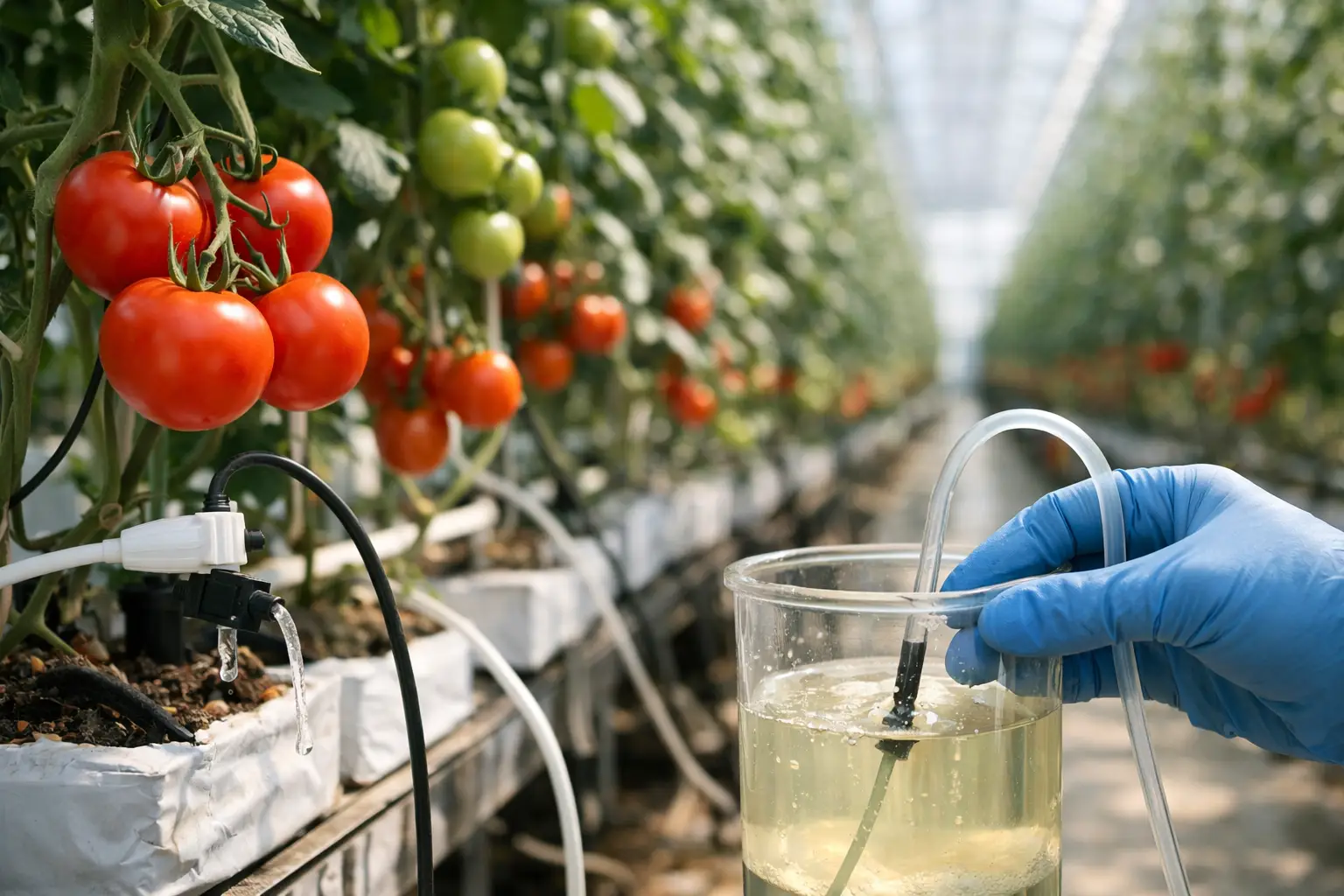
Greenhouse Tomato Fertigation Guide for Yield
A greenhouse tomato crop can look vigorous while its fertigation program is already limiting yield. Excessive vegetative growth, weak trusses, uneven fruit size, blossom-end rot, rising root-zone EC, and reduced flavor often begin as small mismatches between water volume, nutrient concentration, climate demand, and drainage. A sound greenhouse tomato fertigation guide must therefore start with measurement, not a fixed recipe.
Commercial tomato production requires a program that changes with crop stage, substrate or soil conditions, irrigation-water quality, cultivar vigor, and the target market. The objective is not to apply the highest nutrient concentration. It is to maintain an active, balanced root zone while delivering enough water and nutrients to support transpiration, fruit load, and consistent quality.
Start With Water and Root-Zone Data
Before selecting fertilizer grades or setting stock-tank ratios, analyze the source water. Its EC, pH, bicarbonate, sodium, chloride, calcium, magnesium, sulfate, and boron concentrations determine what can safely be added. Water that already contains substantial calcium or magnesium changes the fertilizer calculation. Water with high bicarbonate increases acid demand and can cause the applied solution pH to drift if acidification is poorly controlled.
The irrigation solution should usually be managed within a pH range that keeps phosphorus and micronutrients available while avoiding unnecessary acid use. For many soilless tomato systems, an inlet pH around 5.5 to 6.0 is a reasonable operating range, but the correct target depends on water alkalinity, substrate buffering, and the fertilizer system. In soil, pH behavior is slower and root-zone monitoring carries more weight than the pH leaving the mixing tank.
EC must be interpreted as a management indicator, not a stand-alone fertility target. A higher feed EC can improve fruit firmness, dry matter, and flavor under some conditions, particularly when plants are excessively vegetative. The same increase can restrict water uptake during hot periods, reduce fruit size, or intensify calcium-related disorders if drainage and climate control are inadequate. Root-zone EC, measured from representative slab samples, drain water, or a validated extraction method, is more useful than feed EC alone.
The operational rule is simple: compare feed water, applied nutrient solution, drain water, and root-zone measurements on the same day. If drain EC rises persistently above the applied EC, salts are accumulating or drainage is insufficient. If drain EC stays very close to or below feed EC under high demand, irrigation frequency, runoff, or nutrient concentration may be too low. Neither pattern should be corrected automatically without checking radiation, substrate moisture, root health, and drainage volume.
Build the Fertigation Program Around Crop Stage
Tomatoes do not require the same nutrient balance from transplanting through late harvest. A program designed for early root establishment will not necessarily support a heavy fruit load, and a generative strategy applied too early can restrict canopy development.
Establishment and canopy development
After transplanting, the priority is rapid root exploration, uniform plant establishment, and sufficient leaf area. Frequent, modest irrigation events are generally preferable to large, infrequent doses in inert substrates. The first irrigation timing should reflect substrate moisture and early-morning plant demand, not a rigid clock schedule.
Nitrogen is essential at this stage, but excess ammonium or excessive total nitrogen can produce soft, overly vegetative plants. Maintain adequate calcium from the start, because later correction does not fully reverse calcium transport problems in young fruit. Phosphorus should be sufficient for early root activity, yet high concentrations are rarely justified when root-zone pH and temperature are appropriate.
Flowering and early fruit set
As fruit load begins, nutrient management must support both vegetative continuity and reproductive development. Potassium demand increases, but simply raising potassium without maintaining calcium, magnesium, and nitrogen balance can create antagonisms. Very high potassium relative to calcium and magnesium may depress their uptake, especially where water supply is irregular or EC is elevated.
This is also the stage when irrigation scheduling becomes more responsive to radiation. In greenhouses with reliable climate data, radiation-based pulse scheduling is often more stable than fixed daily volumes because transpiration follows light and vapor demand. The system still needs manual review during cloudy periods, heat events, and after pruning or rapid changes in canopy size.
Peak fruit load and harvest
At peak production, daily water uptake can change sharply with radiation, humidity, fruit load, and ventilation strategy. The crop needs enough water to maintain calcium transport to fruit, but excessive late-day irrigation can leave substrates too wet overnight and encourage weak roots or unnecessary leaching.
Potassium commonly becomes a major component of the program during sustained harvest because it supports fruit filling and quality. However, a high-potassium approach should be tested against actual leaf analysis, drain analysis, fruit quality, and plant balance. A crop with small fruit and high root-zone EC does not necessarily need more potassium. It may need lower salinity, more uniform water availability, or a correction to climate and crop-load management.
Late-season strategies depend on the remaining harvest window. When the crop is approaching termination, there may be a commercial case for reducing nutrient inputs or allowing a more generative balance. This decision should be based on expected marketable yield, water quality, and the risk of sacrificing fruit size or shelf life in the final clusters.
Irrigation Pulses, Drainage, and Timing
Fertigation succeeds or fails through irrigation execution. The best nutrient formula cannot compensate for a substrate that oscillates between saturation and water stress.
In soilless systems, divide the daily volume into pulses that match the crop’s uptake curve. Start after the crop begins active transpiration, increase frequency as radiation rises, and avoid excessive late-day applications unless the substrate is becoming too dry. The final irrigation should leave an appropriate overnight water content, which varies with substrate volume, root density, season, and greenhouse climate.
Drainage percentage is a control variable, not a universal target. Too little drainage raises the risk of salt accumulation. Too much drainage wastes water and fertilizer, reduces oxygen in the root zone in some systems, and may mask poor scheduling. A commercial operation should define acceptable drainage ranges by block, season, water quality, and recirculation capability, then investigate deviations rather than rewarding high runoff.
In soil-grown greenhouse tomatoes, the same principles apply, but the measurement tools differ. Soil texture, wetting pattern, emitter discharge, bed geometry, and salinity distribution determine how water and nutrients move. Soil-solution monitoring, periodic profile sampling, and tissue analysis are usually more informative than applying soilless-substrate drainage rules directly to the crop.
Use Nutrient Ratios With Caution
Nutrient ratios are useful for diagnosis and formulation, but they are not a substitute for concentration, uptake, and water-management data. Calcium-to-potassium, potassium-to-magnesium, and nitrate-to-ammonium relationships can indicate risk, yet a ratio may look correct while total EC is too high or irrigation volume is inadequate.
Micronutrients also deserve routine attention. Iron availability is highly sensitive to pH and chelate selection. Boron has a narrow margin between deficiency and excess, particularly where source water already contains boron. Manganese, zinc, and copper can accumulate in recirculating systems if inputs are not adjusted to actual water and drain analysis.
Tissue analysis provides context, especially when paired with known crop stage, leaf position, cultivar, and recent fertigation records. It should not be interpreted as a pass-fail report. A leaf sample reflects past uptake and dilution effects, while root-zone analysis indicates the current supply environment. Both are needed when diagnosing persistent deficiencies, excesses, or yield loss.
Standardize Decisions Across Greenhouse Operations
For one greenhouse, a disciplined daily record can expose most fertigation problems: irrigation volume, pulses, feed EC and pH, drainage volume, drain EC and pH, radiation, climate conditions, labor observations, and crop response. Across multiple sites or grower networks, the challenge becomes consistency. Different teams may sample at different times, use different labels, or respond to alerts with no documented rationale.
This is where agronomy becomes an operating system. YieldsApp can help organizations standardize block-level protocols, collect field observations, assign corrective actions, document compliance, and compare execution across farms or growers. The value is not a generic dashboard. It is the ability to connect a rising drain EC or recurring blossom-end rot observation to a specific irrigation protocol, water source, responsible team, and follow-up action.
A standardized protocol should still allow agronomists to override recommendations when local conditions justify it. Water quality, substrate type, cultivar, climate, and market requirements create legitimate variation. The system should make those decisions visible and traceable, not force identical fertigation recipes across unlike sites.
When a Program Needs a Technical Review
Request a detailed fertigation review when fruit disorders repeat despite formula changes, root-zone EC is unstable, water quality is marginal, drainage varies widely between blocks, or yield differs materially among similar houses. These cases often involve several interacting causes rather than one missing nutrient.
Cropaia supports commercial tomato operations with fertilizer-program review, water and salinity interpretation, irrigation diagnosis, and practical training for agronomy and technical teams. The most productive review begins with records: water analysis, fertilizer recipes, injection ratios, irrigation logs, drainage data, climate records, crop-load information, and representative tissue or substrate results.
The goal is a program that operators can execute reliably under real greenhouse conditions. Measure the root zone, adjust to crop demand, document why changes were made, and treat every recurring symptom as a signal to investigate the full water-nutrient-climate system.












About Post Author
