


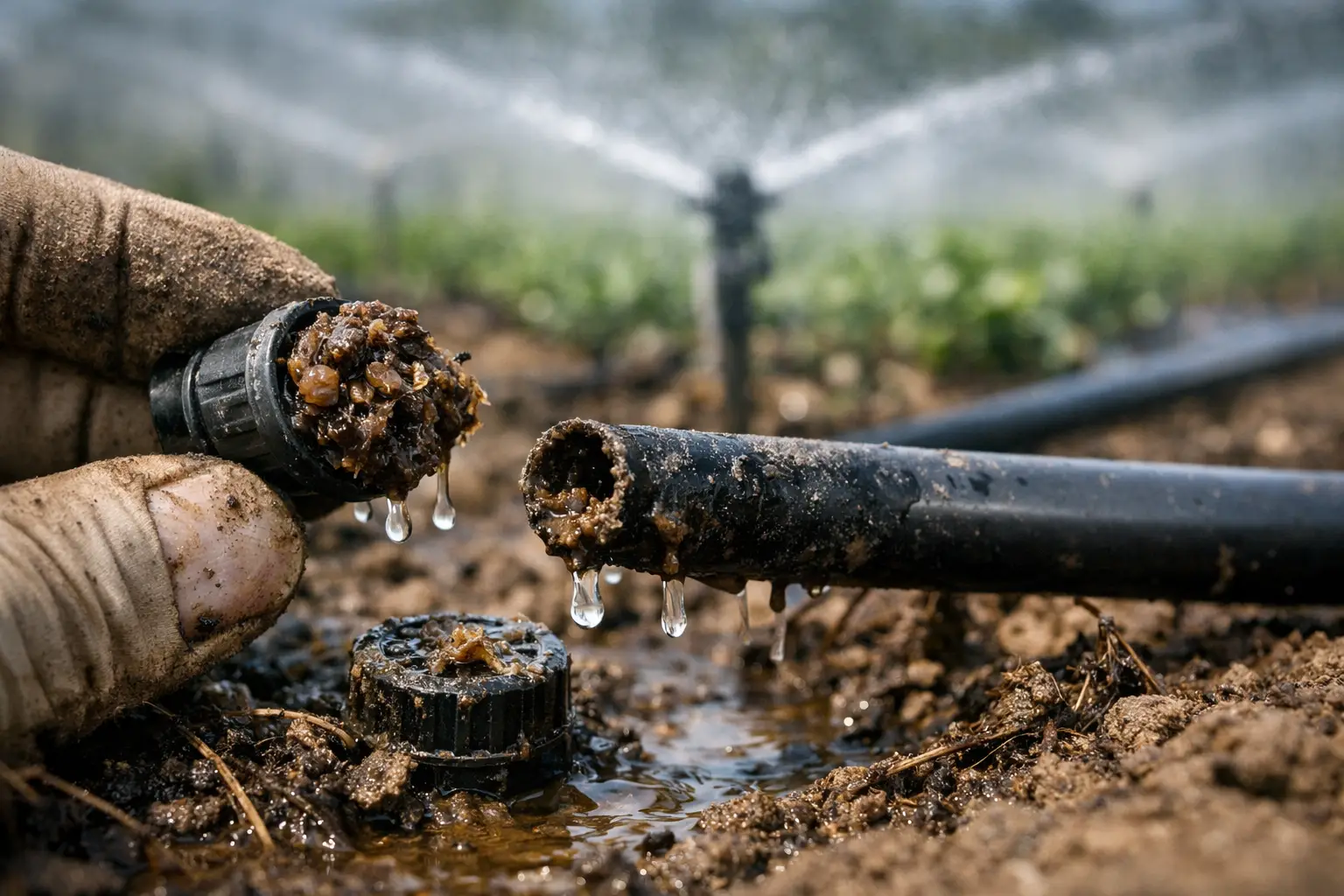
Why Irrigation Clogging Happens
(And What’s Actually Inside Your Dripper)
A block with dry plants near the end of a drip line is often blamed on pressure, poor uniformity, or a damaged emitter. The underlying issue is frequently water quality. Why does irrigation water clogging happen? More precisely, why do materials carried or formed in irrigation water block filters, pipelines, valves, and emitters? Because physical particles, mineral precipitation, biological growth, or a combination of all three accumulates faster than the system can remove it.
For commercial farms, clogging is not a maintenance inconvenience. It changes irrigation uniformity, fertilizer distribution, crop response, labor requirements, and the reliability of production records. In high-value crops such as citrus, vineyards, berries, vegetables, and orchards, a moderate loss of emitter performance can create substantial differences in root-zone moisture and nutrient availability within the same block.
Why irrigation water clogging happens in drip systems
Clogging begins when the water source, the chemistry of the water, and the hydraulic design of the system are not managed as one system. A water analysis may look acceptable on paper, yet still cause recurring blockage if sampling misses seasonal changes, injection practices change pH, or filtration does not match the particle load.
The risk is especially high in drip irrigation because emitter labyrinths have small flow paths. They are designed to regulate discharge, not to tolerate uncontrolled solids, mineral scale, slime, or precipitated fertilizer. Once deposits start forming, they alter flow velocity and create more surfaces where additional material can attach.
Physical clogging: suspended solids and fine particles
Physical clogging comes from sand, silt, clay, organic debris, algae fragments, and particles released from deteriorating pipelines or reservoirs. Surface water typically has more variable loads than groundwater, particularly after rain, wind events, canal maintenance, or reservoir turnover. Groundwater may appear clear but still carry fine sand or iron-bearing particles that settle or oxidize later in the system.
A screen filter may retain large debris while allowing smaller particles through. That does not necessarily mean the filter is failing. It may be the wrong filtration technology, mesh size, or flow capacity for the source water. Media filtration is often necessary where organic matter and algae are significant; hydrocyclones can reduce heavy sand loads upstream. The correct arrangement depends on the water source and measured particle characteristics, not on a standard installation diagram.
Fine clay deserves particular attention. It can pass through filters as individual particles, then flocculate in the presence of calcium, iron, organic compounds, or fertilizer solutions. The blockage may then occur far from the filter, giving the false impression that the issue is localized.
Chemical clogging: scale and fertilizer reactions
Chemical clogging occurs when dissolved minerals precipitate as solids. Calcium carbonate is the most familiar example. Water with elevated bicarbonate and calcium can form carbonate scale when pH rises, pressure changes, water warms, or dissolved carbon dioxide escapes. White deposits around emitters are a common field signal, but laboratory confirmation is better than assumption.
In practice, bicarbonate above 150 mg/L – especially paired with calcium above 80 mg/L – is a reliable warning sign for carbonate scale risk and worth flagging before it becomes a field problem.
Iron and manganese create a different pattern. In groundwater, they can be dissolved under low-oxygen conditions. After pumping and exposure to air, they oxidize and form insoluble particles. These particles may accumulate in filters and emitters, often together with biological growth. Acid injection can help manage some mineral deposits, but acid is not a universal answer and must be selected based on water chemistry, system materials, safety procedures, and the source of the deposit.
Fertigation can intensify chemical clogging. Mixing calcium-containing fertilizers with phosphate or sulfate fertilizers in concentrated stock solutions can create immediate precipitates. Even if each fertilizer is suitable on its own, incompatibility can occur in the tank, manifold, or irrigation water. Temperature, concentration, mixing order, water alkalinity, and pH all matter. A fertilizer program should therefore be reviewed as a chemistry and delivery problem, not only as a nutrient-rate calculation.
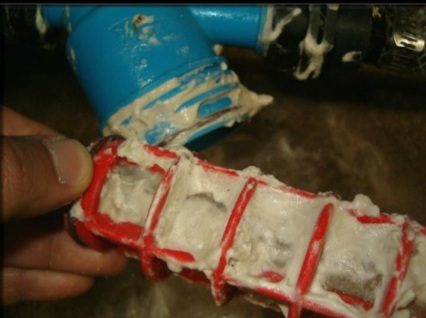 Filter clogging by mineral deposits
Biological clogging: algae, bacteria, and biofilms
Biological clogging is driven by algae, bacteria, fungi, and the sticky biofilms they produce. Open reservoirs, canals, and ponds are vulnerable to algae growth. Iron bacteria and sulfur bacteria may also develop in specific groundwater conditions. Their biomass traps fine particles and mineral precipitates, making the final blockage a mixed physical, chemical, and biological deposit.
Chlorination is commonly used, but its effectiveness depends on dose, contact time, pH, water demand, and where residual chlorine is measured. A chlorine reading at the pump station does not prove that an effective residual reaches the last lateral. Organic matter, iron, manganese, and biofilm consume chlorine before it reaches the target area. Overdosing can damage equipment, create worker-safety risks, and affect sensitive crops, so treatment must be verified rather than applied by habit.
As a practical benchmark, iron above 1 ppm in the source water is a red flag for iron-bacteria slime formation, and the operating target for chlorination is a free residual of at least 0.5 ppm measured at the last emitter on the line – not at the pump station.
In one case, greenhouse crops on a well with iron above 1 ppm developed a slimy iron-bacteria buildup that clogged emitters throughout the block. The existing drip system was damaged badly enough that it had to be replaced entirely. Chlorination was then added and maintained at a 0.5 ppm free residual at the end of the dripline, which resolved the problem. The case is a useful illustration that acid injection would not have fixed it – acid addresses carbonate scale, not iron-bacteria slime, and applying it here would have missed the actual cause.
Diagnosing the real cause before choosing treatment
Repeated flushing without diagnosis is expensive and rarely solves persistent clogging. Start by comparing pressure and discharge across representative zones, including the first and last laterals. Measure actual emitter flow, not just operating pressure. A pressure gauge can show a clean mainline while emitters are progressively restricted.
Then inspect deposits from filters, pipe ends, valves, and clogged emitters. Their appearance can guide the investigation: gritty material suggests sand or silt; white, hard deposits may indicate carbonate scale; reddish-brown material often points to oxidized iron; black deposits can be associated with manganese or anaerobic conditions; gelatinous material indicates biological activity. These are clues, not final diagnoses.
Water analysis should include pH, electrical conductivity, alkalinity or bicarbonate, calcium, magnesium, iron, manganese, suspended solids, and microbial indicators where biological clogging is suspected. For fertigation systems, analyze source water and the final irrigation water under operating conditions when possible. The chemistry after injection is what reaches the field.
Seasonality matters. A single laboratory result collected in winter may not represent late-summer reservoir water, a new well, or canal water following a storm. Farms should establish a sampling schedule tied to source variability and crop risk, not merely annual compliance requirements.
Prevention is a management program, not a filter purchase
Effective prevention combines source-water management, properly sized filtration, compatible fertigation, treatment protocols, and disciplined flushing. Filters must be cleaned based on differential pressure and inspection, not only on a fixed calendar. Backflushing too late allows contaminants to break through; backflushing too often wastes water and can reduce effective filtration.
Flushing laterals at adequate velocity is equally important. Opening line ends briefly may release some water without removing settled solids. The required duration and velocity depend on pipe diameter, lateral length, sediment type, and hydraulic design. Field teams need a written protocol stating which blocks to flush, when to flush, what pressure conditions are required, and how results are recorded.
Chemical treatment should follow confirmed causes. Acidification may control carbonate precipitation, while oxidation, filtration, and disinfection may be needed for iron-related biological clogging. Chlorination can suppress biofilm, but it will not remove a heavy mineral scale problem. Treatments also have trade-offs: acid changes water chemistry and requires strict handling; chlorine performance falls as pH rises; aggressive programs can shorten the life of components. The goal is not to add chemicals routinely, but to maintain clean flow paths with the lowest effective intervention.
Managing clogging across multiple farms and field teams
At scale, the weak point is often execution rather than technical knowledge. One grower may record filter differential pressure, another may only react after visible crop stress, and a third may apply an unverified chemical treatment. This makes it difficult for a cooperative, food company, or agricultural program to compare irrigation performance across locations.
A standardized operating protocol should define water sampling, filtration checks, pressure measurements, flushing intervals, treatment authorization, and emitter-uniformity tests. It should also capture the source water, product used, dose, date, operator, block, and result. This creates traceability between a water-quality event and a later irrigation or yield problem.
For organizations coordinating distributed farms or grower networks, yieldsApp can turn these field protocols into assigned workflows, verified records, agronomic alerts, and block-level follow-up. The value is not simply digital recordkeeping. It is the ability to identify recurring failure patterns, confirm whether a recommendation was implemented, and direct technical teams toward the blocks where water quality is reducing irrigation performance.
Commercial growers facing chronic emitter blockage benefit from an integrated review of water analysis, filtration, fertigation compatibility, irrigation design, and field uniformity. Cropaia consulting and technical training can help teams build that review into routine decision-making rather than relying on emergency cleaning after crop variability appears.
The most useful next step is to collect deposits from several points in the system, test the water under real operating conditions, and compare emitter discharge across the block. Those three actions usually replace guesswork with a clear, field-specific correction plan.









About Post Author
