

Drip Versus Sprinkler Irrigation
A vineyard block with shallow soils, a processing tomato field under water allocation pressure, and a leafy vegetable farm facing foliar disease do not need the same irrigation answer. That is why drip versus sprinkler irrigation is not a simple efficiency contest. The right choice depends on crop physiology, field layout, water quality, labor capacity, disease pressure, energy costs, and the grower’s tolerance for management complexity.
For commercial agriculture, irrigation system selection is a production decision, not just an engineering one. It affects root distribution, nutrient delivery, canopy microclimate, weed pressure, machinery access, and the consistency of crop performance across variable soils. A system that looks better on a spec sheet can still underperform if it does not fit the agronomy of the field.
Drip versus sprinkler irrigation in commercial farming
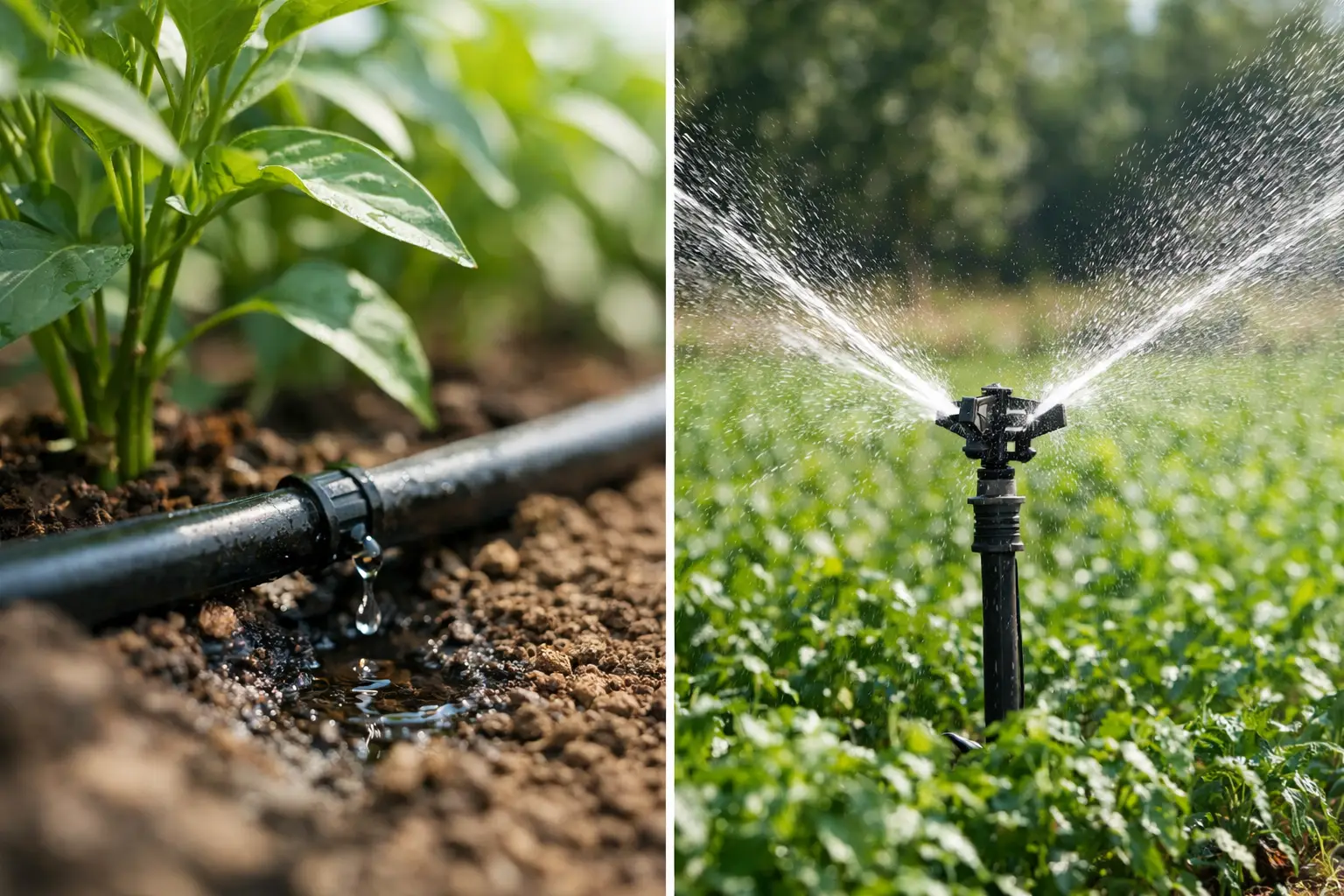
Drip irrigation applies water in a localized pattern near the root zone through emitters, drip tape, or dripline. Sprinkler irrigation applies water overhead or above the crop through nozzles that simulate rainfall, whether through solid-set systems, center pivots, lateral moves, or set-move sprinklers. That difference sounds basic, but it drives most of the agronomic trade-offs.
Drip usually gives the manager tighter control over where water goes and when it arrives. Sprinkler systems typically wet a larger soil volume and can cover irregular field variability with less infrastructure at the plant row. In practice, drip is often favored where precision, water scarcity, or fertigation matter most, while sprinkler systems remain strong where broad coverage, establishment needs, or operational flexibility are more important.
Water use efficiency is only one part of the decision
Drip systems often achieve higher application efficiency because they reduce evaporation and wind drift. More of the applied water reaches the intended root zone, which is especially valuable in arid regions, in high-value crops, and under tight pumping or water-right constraints. When managed well, drip also reduces non-productive wetting between rows, limiting weed growth and unnecessary evaporation.
That advantage is real, but it is not automatic. Poor filtration, pressure variation, emitter clogging, inadequate flushing, or bad irrigation scheduling can erode the benefit quickly. A drip system with uneven distribution or neglected maintenance may look efficient on paper while creating dry spots, salinity concentration, or inconsistent plant growth.
Sprinkler systems generally lose more water to evaporation and drift, especially in hot, windy conditions. However, they can still perform well when matched to climate, nozzle package, and scheduling discipline. In coarse-textured soils or broad-acre crops, a properly designed pivot or linear system can deliver acceptable uniformity at scale, often with lower management intensity per acre than drip.
Crop type changes the answer
Crop architecture and market objectives matter. In orchards and vineyards, drip is often the stronger fit because it supports precise irrigation, controlled deficit strategies, and targeted fertigation without wetting the canopy. That helps when fruit quality, canopy disease management, and water use efficiency are central goals.
In row crops and vegetables, the answer is more nuanced. Processing tomatoes, peppers, onions, and many fresh-market systems often benefit from drip because irrigation timing can be tightly aligned with crop stage and nutrient uptake. Uniformity near the root zone can improve packout and reduce fruit disorders in some settings. Subsurface drip can also reduce field traffic interference.
Sprinklers still have important use cases in vegetables and field crops. Germination and stand establishment often favor overhead application because the entire seed zone can be wetted more evenly. For crops planted densely or over broad acreage, the capital and maintenance profile of sprinkler systems may be more practical. Crops such as alfalfa, small grains, corn, and pasture are commonly irrigated successfully with pivots and other sprinkler formats because full-field coverage aligns with crop spacing and farm economics.
Disease, canopy wetting, and field sanitation
One of the clearest agronomic differences in drip versus sprinkler irrigation is canopy wetting. Sprinklers raise leaf wetness duration, which can increase pressure from foliar diseases in susceptible crops. In many vegetables, orchards, and seed production systems, that can influence fungicide programs, re-entry planning, and quality outcomes.
Drip helps keep foliage dry, which is a major advantage where mildew, blight, bacterial diseases, or fruit rots are recurring constraints. It can also reduce splash dispersal of soilborne pathogens onto low-growing crops. That said, drip is not a disease-free option. If overirrigated, it can still create root-zone oxygen stress, promote root diseases, and complicate salinity movement.
Field sanitation is also part of the picture. Sprinklers can wash dust and residues from foliage and may support crop cooling under heat stress. In specific cases, overhead irrigation can help with frost protection or chemigation logistics. Those are not small benefits, especially in regions where establishment and climate risk management are priorities.
Fertigation, salinity, and root-zone control
Drip gives a clear advantage where fertigation precision matters. Nutrients can be delivered in smaller doses, timed closer to crop demand, and placed where active roots are concentrated. For intensive production systems, this can improve nutrient use efficiency and reduce losses, particularly with nitrogen and potassium programs.
This precision also increases the need for discipline. Fertigation through drip demands water testing, injector calibration, filtration, line maintenance, and regular verification in the field. Without those controls, the farm can shift from precise feeding to uneven nutrient delivery across zones and sets.
Salinity management is another place where conditions matter. Drip can maintain a favorable root-zone moisture pattern, but salts tend to move to the edge of the wetted bulb. That requires monitoring, especially where irrigation water has moderate to high salinity or where rainfall is limited. Sprinkler systems may provide broader leaching across the surface profile, which can be useful in some soils and rotations, although that comes with higher water use.
Cost is not just installation cost
Drip systems often require higher management intensity and, depending on the design, substantial upfront investment in pumps, filtration, mainlines, submains, dripline, automation, and monitoring. Seasonal drip tape adds recurring material and labor costs. Permanent systems reduce annual replacement but raise repair and long-term maintenance demands.
Sprinkler systems can also be capital-intensive, especially center pivots and linear moves, but the cost structure is different. One machine can cover a large area, and many operations are already organized around that model. For broad-acre production, the labor and supervision required per acre may be lower than with drip.
Energy cost depends on system pressure, layout, and pumping conditions. Many drip systems operate at lower pressure than conventional sprinklers, which can reduce energy demand. But filtration, injection, flushing, and complex zone management add operational layers. The better economic question is not which system is cheaper in isolation, but which system produces the best return under the farm’s crop mix, labor model, and water constraints.
Management capacity is often the deciding factor
The strongest irrigation system is usually the one the farm can manage consistently. Drip rewards close attention to pressure, flow, filtration, clogging risk, irrigation pulse timing, and field-by-field scheduling. It fits operations that are ready to use soil moisture data, crop stage models, and frequent system checks.
Sprinkler systems can be simpler to monitor at scale, although they are far from automatic. Nozzle wear, pressure loss, poor overlap, drift, and runoff still require agronomic and mechanical oversight. Yet in some enterprises, sprinkler irrigation is more resilient because the team already has the skills, spare parts, and operating routines to keep it performing.
This is where unbiased agronomic assessment matters. A farm should not adopt drip simply because it is perceived as more modern, and it should not stay with sprinklers simply because that is what the operation has always used. The right system is the one that supports measurable improvement in yield stability, resource efficiency, and execution quality.
When drip is usually the better choice
Drip tends to be the stronger option in high-value crops, water-limited regions, fields with significant foliar disease pressure, and operations that need precise fertigation. It also fits permanent crops and intensive vegetable systems where root-zone control has direct economic value. If the farm has strong technical management and can maintain filtration and scheduling discipline, drip often delivers superior agronomic control.
When sprinkler irrigation still makes more sense
Sprinklers often remain the better fit for broad-acre crops, stand establishment, frost protection, crop cooling, and fields where uniform surface wetting is useful. They may also be the more practical option where labor for drip maintenance is limited, field geometry suits pivots or linear systems, and the crop value does not justify high per-acre infrastructure. In those conditions, a well-managed sprinkler system can outperform a poorly managed drip system every season.
For farm managers, agronomists, and agribusiness decision-makers, the real question is not which system wins the debate. It is which system fits the crop, the field, the water source, and the management reality well enough to deliver repeatable results. That is where technical comparison becomes useful – not as theory, but as a way to avoid expensive mismatches before they reach the field.











About Post Author
