


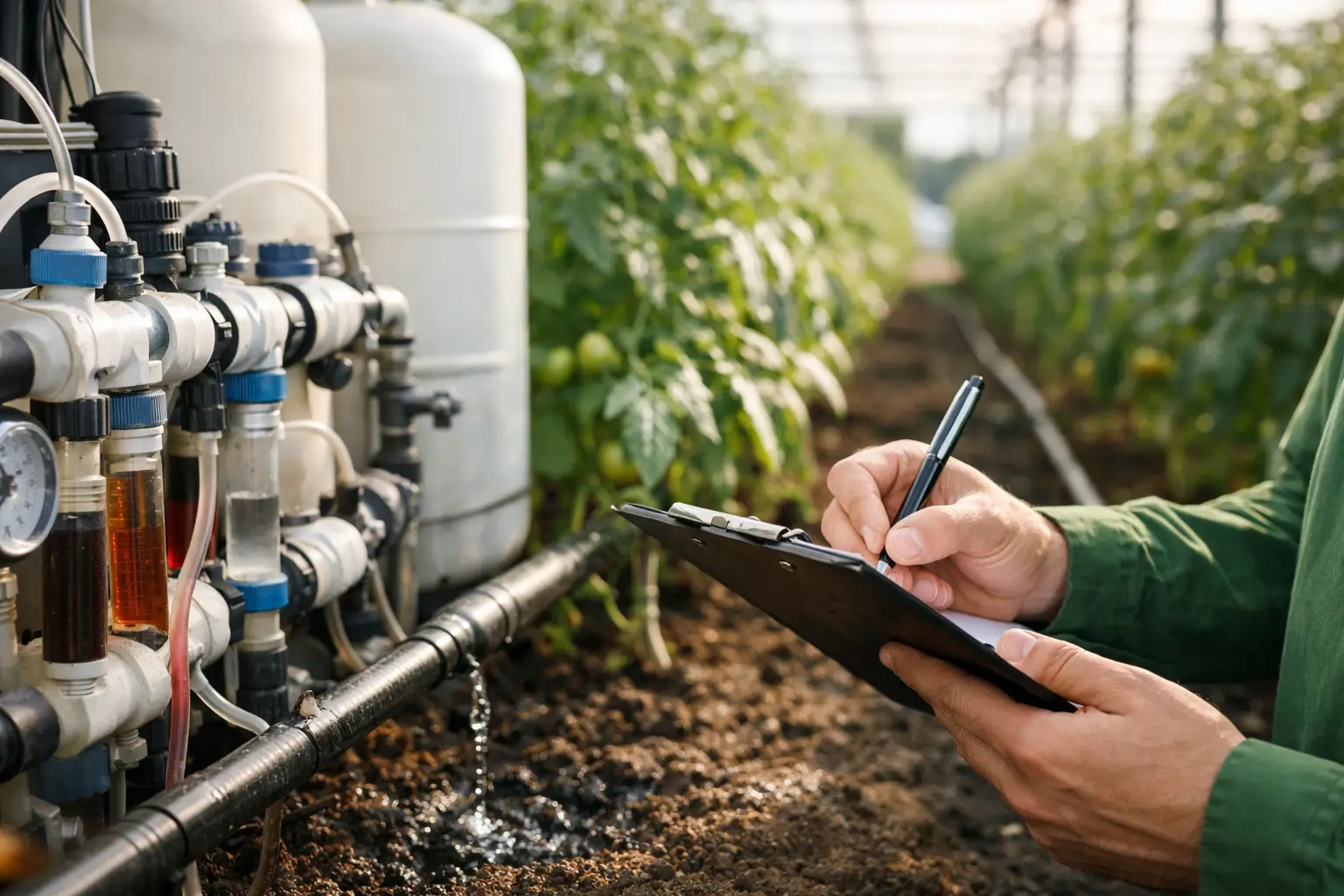
Fertigation Best Practices for Growers
A fertigation program usually looks fine on paper right up to the point when the field starts showing variability, emitters begin to clog, or tissue tests come back out of line. That is why fertigation best practices are not just about injecting fertilizer into irrigation water. They are about matching water, nutrients, timing, and system performance closely enough that the crop receives what it needs, when it can actually use it.
Fertigation can improve nutrient use efficiency, reduce labor, and support more precise crop management. It can also magnify mistakes. If irrigation scheduling is weak, if water quality is ignored, or if fertilizer compatibility is assumed rather than verified, the system can distribute problems very efficiently. Good fertigation management starts with that reality.
What fertigation best practices really depend on
The strongest fertigation programs are built on three things working together: crop demand, irrigation performance, and fertilizer behavior in water. If one of those is poorly understood, the program becomes reactive instead of controlled.
Crop demand changes by growth stage, rooting depth, expected yield, and environmental conditions. A young crop with a limited root system needs a different fertigation strategy than a mature crop in a high-demand reproductive stage. This sounds obvious, but many programs still apply nutrients in flat weekly patterns that do not follow actual uptake curves.
Irrigation performance matters just as much. A perfectly designed nutrient recipe cannot compensate for poor distribution uniformity, pressure variation, or short cycling that leaves parts of the root zone too dry and others too wet. Fertigation should never be planned as a standalone nutrition task. It belongs inside irrigation management.
Then there is fertilizer behavior. Solubility, compatibility, pH effect, and sensitivity to water composition all influence whether a nutrient remains available and deliverable. The practical question is not only how much nutrient to apply, but whether the chosen source will move cleanly through the system and remain available in the wetted root zone.
Start with water quality, not the fertilizer tank
Many fertigation problems begin before fertilizer is added. Water analysis should be routine, especially in groundwater systems, mixed water sources, or areas with seasonal variability. Bicarbonates, calcium, magnesium, sodium, chloride, iron, manganese, suspended solids, and pH all affect fertigation performance.
High bicarbonate water can shift pH upward and contribute to precipitation, especially when phosphate or sulfate fertilizers are used. Calcium-rich water may react with certain fertilizer sources and form insoluble compounds. Iron and biological load can accelerate clogging in drip systems. In these situations, the right response is not simply more maintenance. It is redesigning the fertigation approach around actual water chemistry.
This is where many growers save money or lose it. A lower-cost fertilizer source is not cheaper if it increases clogging risk, reduces nutrient availability, or forces repeated acid treatments. Source selection should reflect both nutrient cost and system compatibility.
Match nutrient delivery to crop uptake
One of the most reliable fertigation best practices for growers is to move away from infrequent, heavy applications and toward smaller, more frequent doses aligned with crop demand. This reduces leaching risk, improves nutrient availability, and gives the grower more control.
Nitrogen is the clearest example. Applying large amounts too early often creates losses before peak uptake begins. In contrast, spoon-feeding nitrogen through the season allows rates to increase during periods of rapid vegetative growth or fruit filling, then taper as demand declines. The same principle applies to potassium in many fruiting and vegetable crops.
That said, frequency is not automatically better. Very small injections with poor mixing, unstable injection equipment, or weak irrigation scheduling can create inconsistency. The right frequency depends on the crop, soil type, irrigation method, and management capacity. Sandy soils and shallow root systems usually benefit from more frequent fertigation than heavier soils with greater buffering capacity.
Phosphorus requires more caution. In some systems, especially where precipitation risk is high, it may be better to apply phosphorus strategically rather than continuously. Micronutrients also need crop-specific judgment. Some are suitable for regular low-dose fertigation, while others are better corrected in targeted applications based on tissue testing and visible response.
Keep irrigation scheduling in control
Fertigation follows water. If irrigation timing and depth are poorly managed, nutrient placement will also be poor. The goal is not just to apply fertilizer through irrigation, but to place nutrients in the active root zone without pushing them beyond it.
In drip systems, this means understanding the wetting pattern and rooting depth through the season. Short irrigation events may leave nutrients too concentrated near the emitter and too shallow for stable uptake. Excessively long events may move mobile nutrients below the effective root zone. Both reduce efficiency.
A practical approach is to inject fertilizer after the system reaches full operating pressure and stable flow, then continue irrigation long enough to distribute nutrients uniformly and flush the lines. The exact timing depends on system size and hydraulics. What matters is avoiding injection into an unstable system and avoiding shutoff before nutrients clear the lines.
Uniformity testing should not be treated as an engineering formality. Pressure variation, clogged emitters, and poor maintenance turn fertigation into uneven crop feeding. In high-value crops, small distribution issues can become visible quickly in vigor, fruit size, quality, and maturity spread.
Choose fertilizer sources with the system in mind
Not all soluble fertilizers behave the same way in all systems. Selection should consider nutrient concentration, compatibility with other materials, effect on solution pH, and risk of precipitation in the existing water source.
Calcium and phosphate should be handled carefully, especially in concentrated stock solutions. Sulfates can also create compatibility issues in calcium-rich conditions. If multiple stock tanks are used, their separation is not just good practice but often necessary to prevent precipitation before injection. Mixing order matters as well.
Acidifying fertilizers can be useful where bicarbonates are high, but they should be managed with a clear understanding of the target water chemistry and system materials. Overcorrection can create safety issues, corrosion, or unintended shifts in nutrient availability.
This is also a place for restraint. Adding too many products to a fertigation program often makes it harder to diagnose problems and maintain consistency. A simpler nutrient program, well matched to crop demand and supported by testing, usually performs better than a complex program built around assumptions.
Monitor with data, not guesswork
A good fertigation plan should be adjusted during the season, not defended after problems appear. Soil testing, water analysis, and plant tissue analysis each answer different questions. Used together, they help distinguish between insufficient supply, poor placement, root stress, salinity effects, and uptake limitations.
Tissue testing is especially valuable because it reflects what the plant has actually taken up. But interpretation matters. A tissue result is not a fertilizer prescription by itself. It should be read in the context of growth stage, recent weather, crop load, irrigation history, and visual field conditions.
Electrical conductivity and pH measurements in irrigation water, stock solutions, and sometimes in the root zone can also provide early warning. Rising salinity near the emitter, for example, may point to insufficient leaching, overly concentrated applications, or mismatch between irrigation volume and evaporative demand.
For larger operations, digital monitoring and recordkeeping can improve consistency across blocks and operators. Cropaia often emphasizes measurable improvement for exactly this reason: when fertigation decisions are documented against crop response, management becomes more precise and less dependent on memory or habit.
Common mistakes that reduce fertigation performance
The most common mistakes are rarely dramatic. They are usually small operational gaps repeated over time. Applying the same nutrient ratio all season, ignoring water chemistry, injecting incompatible materials, and assuming uniform irrigation are frequent examples.
Another common issue is treating visible deficiency symptoms as proof of fertilizer shortage. Sometimes the problem is not lack of nutrient in the system but restricted uptake caused by root damage, poor aeration, salinity, pH imbalance, or cold soil conditions. Adding more fertilizer in those cases can make the system less stable.
There is also a trade-off between precision and complexity. More tanks, more products, and more frequent adjustments can improve control, but only if the team can manage them accurately. The best fertigation program is not the most complicated one. It is the one that can be executed consistently, monitored properly, and corrected quickly when field conditions change.
Building a better fertigation program over time
Strong fertigation management is usually built season by season. The process starts with a sound baseline: reliable water analysis, irrigation uniformity testing, crop-stage nutrient planning, and fertilizer compatibility checks. From there, the program improves through observation and measured adjustment.
Growers who get the best results tend to ask practical questions throughout the season. Are nutrients reaching the active root zone? Does the application pattern reflect current uptake, not last month’s schedule? Is the water source changing? Are tissue levels and field performance moving in the same direction? Those questions create better decisions than any fixed recipe.
The real value of fertigation is not only efficiency. It is control. When water and nutrients are managed as one system, growers gain a more precise way to influence crop performance under real field conditions. That precision is earned through discipline, testing, and attention to detail – and those are still the factors that separate a functioning fertigation program from a high-performing one.










About Post Author
