

Irrigation Scheduling Methods for Crops
A field can look uniform from the road and still have three different irrigation needs by noon. One block may be holding water from a heavier soil layer, another may be losing moisture quickly under wind exposure, and a third may be under mild stress because root development never fully caught up after transplanting. That is why irrigation scheduling methods for crops matter so much. Irrigation timing is not just about when to turn the system on. It is about deciding when, how much, and how often to apply water so crop demand is met without wasting water, energy, nutrients, or yield potential.
For growers and agronomists, scheduling is where irrigation management becomes measurable. A good schedule reduces uncertainty. A poor one often stays hidden until the season is compromised by yield loss, fruit defects, root disease, leaching, or unnecessary pumping costs.
What irrigation scheduling methods for crops are really trying to solve
At its core, irrigation scheduling is an attempt to match water application with crop water use over time. That sounds straightforward, but in practice it requires balancing crop stage, rooting depth, soil texture, irrigation system performance, weather, and management constraints.
The wrong scheduling method is often not technically wrong. It is simply incomplete for the field conditions. A calendar-based program may work reasonably well in a stable environment with deep soils and moderate weather, but fail in sandy soils, shallow-rooted crops, or peak demand periods. On the other hand, a sophisticated sensor-based approach can produce poor decisions if sensors are installed badly, interpreted incorrectly, or not integrated with field observations.
That is why experienced irrigation management usually relies on more than one source of information. The best method is often a combination of approaches, with one method leading the decision and another validating it.
Calendar-based scheduling
The simplest method is scheduling irrigation by fixed intervals, such as every two days or twice a week. This approach is common because it is easy to organize, especially where labor, pumping windows, or water delivery schedules limit flexibility.
Calendar scheduling can be useful as a baseline. It helps standardize operations and may be acceptable where crop demand changes slowly and soils provide a wide buffer. But it has serious limitations. Crops do not use water according to the calendar. They respond to weather, canopy size, root growth, and fruit load. A schedule that fits spring conditions can become inadequate in summer heat or excessive after a cool period.
For this reason, calendar scheduling should be treated as an operational framework rather than a true agronomic method. It is best used only when adjusted regularly with weather, soil, or plant feedback.
Weather-based scheduling using evapotranspiration
Weather-based scheduling is one of the most widely accepted irrigation scheduling methods for crops because it connects irrigation decisions to actual atmospheric demand. The principle is simple. Estimate crop water use from reference evapotranspiration, then adjust it with a crop coefficient that reflects crop type and growth stage.
This method is especially useful for field crops, orchards, vineyards, and vegetable production where reliable weather data is available. It allows growers to estimate how much water the crop has likely used since the last irrigation and replace that amount while considering irrigation efficiency and allowable depletion.
Its strength is that it responds to changing weather. Hot, dry, windy conditions increase demand. Cool or humid periods reduce it. The method is also scalable, which makes it valuable for large operations and institutional programs.
The limitation is that ET-based scheduling is still an estimate. If the crop coefficient is not well calibrated, if the rooting depth is assumed incorrectly, or if the irrigation system applies water unevenly, the schedule can drift away from reality. It also does not directly show whether the root zone is actually wet or dry. That is why ET works best when supported by field validation.
Where ET-based scheduling performs well
ET-based scheduling tends to perform best when crop stages are well defined, weather data is local and reliable, and the irrigation system has predictable application rates. It is particularly effective for strategic planning across larger acreages because it gives farm managers a consistent way to prioritize irrigation blocks and estimate weekly water demand.
Soil moisture-based scheduling
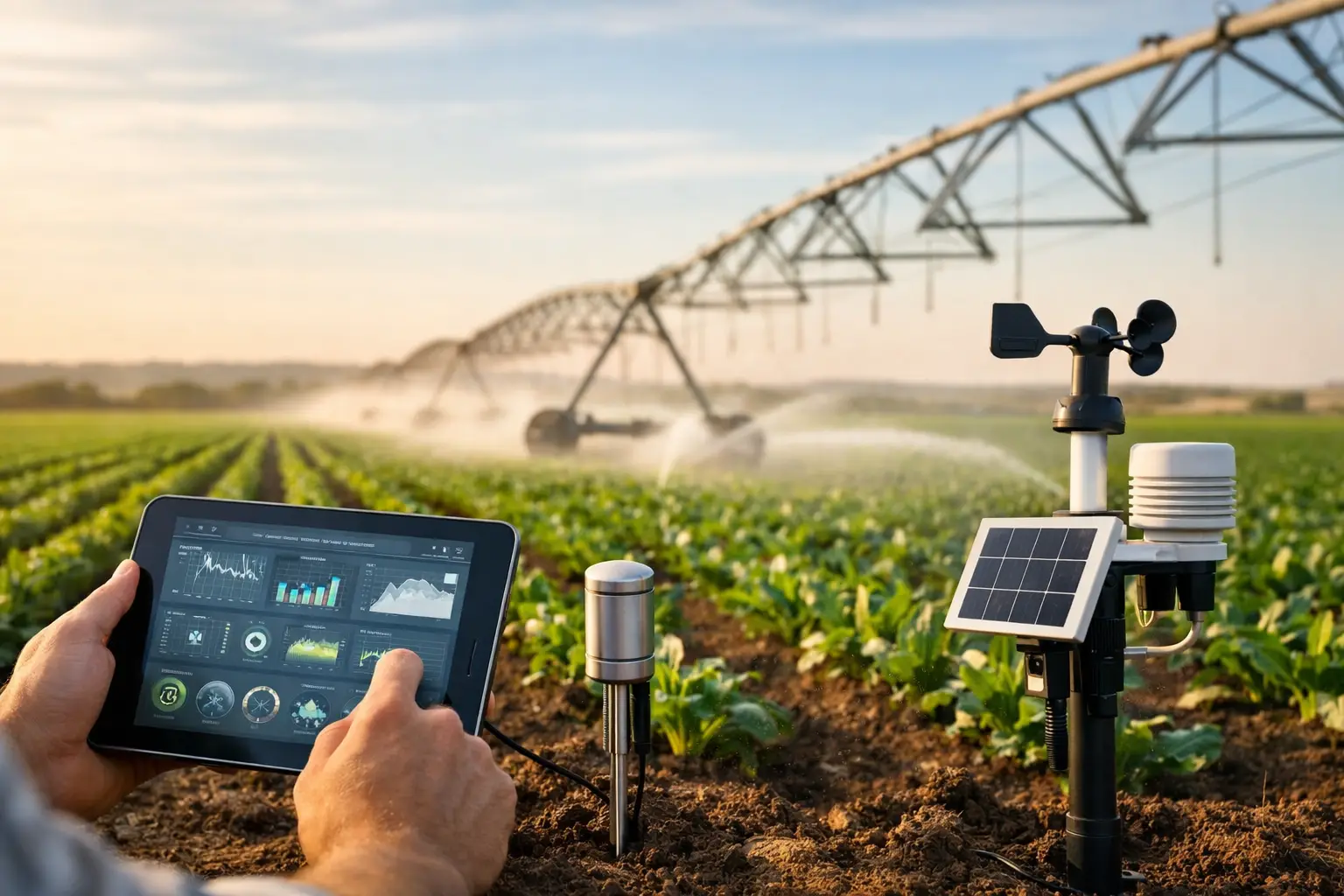
Soil moisture monitoring shifts the question from estimated crop water use to actual water status in the root zone. This can be done through feel-and-appearance methods, tensiometers, capacitance probes, gypsum blocks, or other sensor technologies.
For many operations, soil-based scheduling is the most practical way to improve decisions because it answers two critical questions directly: how much water is available now, and how deep the irrigation event actually wetted the soil profile.
This method is powerful because it reflects field variability better than weather alone. It captures the effect of soil texture, compaction, rooting restrictions, and irrigation non-uniformity. In drip-irrigated systems, it can show whether short, frequent irrigations are maintaining adequate moisture in the active root zone or causing excessive drying between events. In sprinkler or surface systems, it helps evaluate refill depth and the risk of deep percolation.
Still, sensor-based scheduling is not automatic just because technology is present. Sensor location is critical. One probe in an unrepresentative spot can mislead an entire block. Data interpretation also matters. A rising water content reading after irrigation is useful, but only if it is linked to crop stage, root depth, and expected depletion rates. The method is strongest when the user understands both the equipment and the soil profile.
Plant-based irrigation scheduling methods
Plant-based methods measure the crop response itself rather than relying only on weather or soil data. These methods include stem water potential, leaf water potential, trunk diameter variation, canopy temperature, and visual stress indicators such as wilting or reduced turgor.
This is often the most biologically relevant approach because the plant integrates all the conditions affecting water uptake, including salinity, root health, and atmospheric demand. In perennial crops, plant-based measurements can be especially valuable for fine-tuning irrigation under deficit strategies or quality-driven production goals.
The trade-off is that plant measurements often require more skill, more time, or more expensive tools. They are also less suited to broad routine scheduling if labor is limited. Visual crop stress, while useful, usually appears after the crop has already experienced some level of water limitation. That makes it a poor primary scheduling method in high-value crops where avoiding stress is the goal.
When plant indicators add the most value
Plant-based methods are particularly useful when growers need to verify whether the crop is actually comfortable under the current schedule. They can also reveal cases where the soil appears wet enough but the plant is still under stress due to root disease, poor distribution uniformity, salinity, or oxygen deficiency.
Water balance approaches
Water balance scheduling combines several concepts into one operational method. It starts with the available water-holding capacity in the effective root zone, subtracts estimated crop use each day, adds rainfall and irrigation, and triggers irrigation when allowable depletion is reached.
This approach is practical because it turns irrigation into a running account. It is more structured than simple calendar scheduling and often easier to implement than a fully sensor-driven program. When paired with ET estimates and periodic soil checks, it can be highly effective.
The challenge is discipline. A water balance is only as good as the assumptions behind it. Rooting depth changes over the season. Rainfall may not infiltrate as expected. Irrigation amounts may differ from planned application times. If records are not updated consistently, the method loses value quickly.
Choosing the right method for your operation
No single scheduling method fits every crop, soil, and management system. A sandy vegetable field under drip irrigation may benefit most from frequent soil moisture monitoring combined with ET tracking. A mature orchard may rely on ET for baseline planning and plant-based measurements to refine timing. A large field crop operation may use water balance scheduling supported by weather data and occasional soil verification.
The right choice depends on the consequences of error. If overirrigation threatens nutrient leaching, disease pressure, or waterlogging, root-zone monitoring becomes more important. If underirrigation can reduce fruit size, kernel fill, or marketable yield within a few days, plant and weather feedback deserve closer attention. If labor and technical capacity are limited, a simpler method that is applied consistently may outperform an advanced method used poorly.
In practice, the strongest programs are layered. Weather tells you what demand should be. Soil tells you what happened in the root zone. The plant tells you whether the crop agrees. That combination supports better decisions than any single data source on its own.
Turning scheduling into better field decisions
Better irrigation scheduling does not begin with more data. It begins with a clearer decision process. Define the effective root zone. Understand the soil’s usable water-holding capacity. Measure actual system output. Then select a scheduling method that matches the crop value, field variability, and management capacity.
For operations looking to improve both technical accuracy and practical execution, this is where structured agronomic support can make a real difference. Cropaia’s approach has long emphasized combining field knowledge, technical training, and unbiased advisory work so irrigation decisions are not based on guesswork or equipment claims alone.
The most useful schedule is the one that helps you act at the right time, with the right amount of water, for the right agronomic reason. When irrigation decisions become more deliberate, yield and efficiency tend to follow.











About Post Author
