

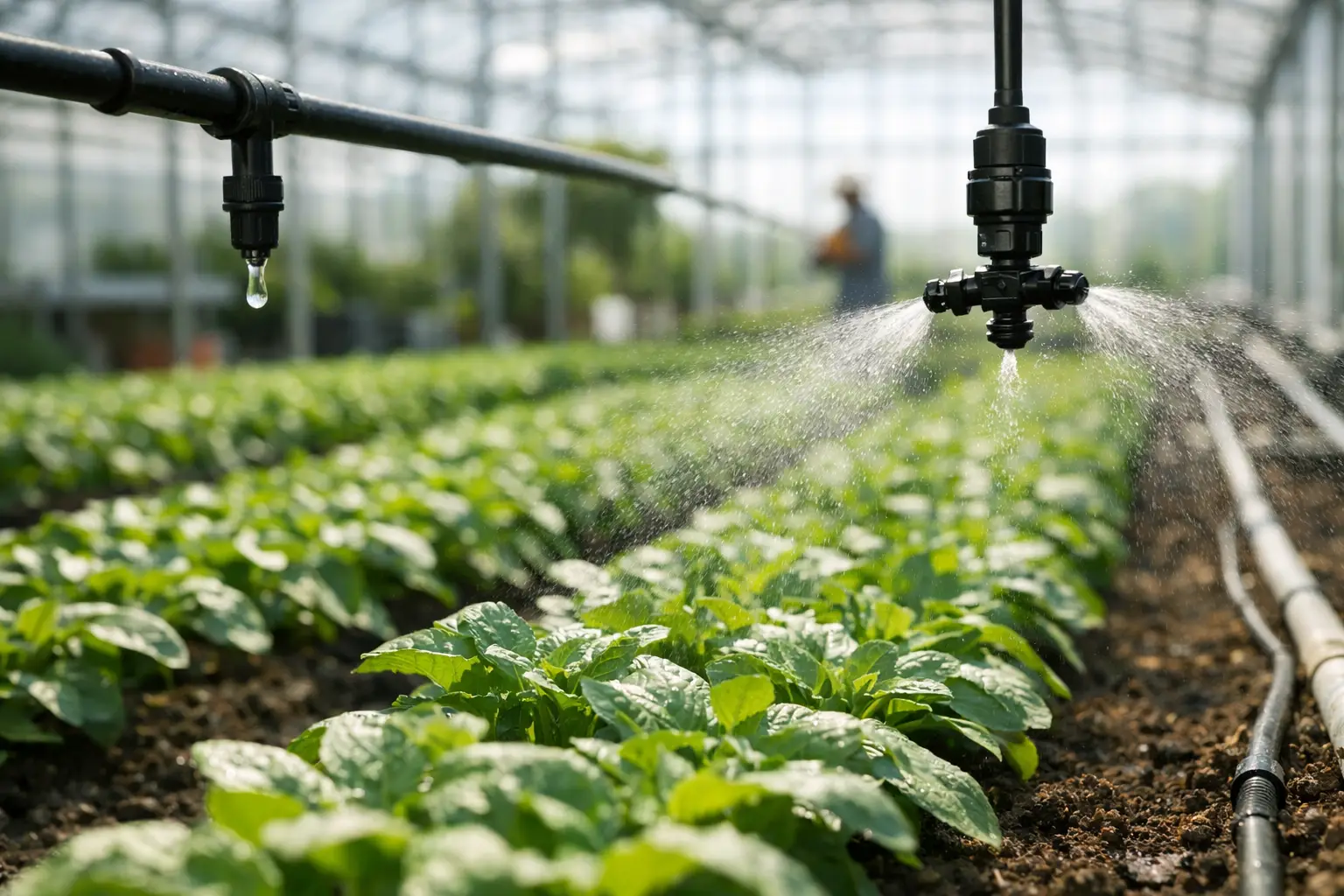
Best Practices for Greenhouse Irrigation
A greenhouse can look uniform from the walkway and still irrigate unevenly by a wide margin. One zone runs a little longer, one line has lower pressure, one substrate dries faster near the fan, and by the time symptoms appear, yield and quality have already moved. That is why best practices greenhouse irrigation are less about applying water and more about controlling variability.
In protected cultivation, growers apply irrigation every day, often multiple times a day. Small mistakes therefore repeat quickly and amplify over time. Overwatering, hidden water stress, nutrient imbalance, root disease pressure, and unnecessary leaching often begin with irrigation management. Strong irrigation programs do not rely on fixed recipes. Growers should instead adjust irrigation according to crop demand, substrate behavior, water quality, system performance, and close observation.
What best practices greenhouse irrigation really means
The goal is not to keep the growing media constantly wet. The goal is to maintain the right root-zone conditions for uptake, oxygen availability, and stable plant performance. In practical terms, that means applying the right volume, at the right frequency, with high distribution uniformity and a drainage strategy that fits the crop and the production system.
This matters because greenhouse irrigation affects much more than water status. It shapes nutrient concentration in the root zone, root development, transpiration, fruit sizing, vegetative vigor, and disease susceptibility. A good irrigation strategy supports consistency. A poor one forces the grower to keep correcting downstream problems that started with water management.
Start with crop, climate, and substrate – not with the timer
Many irrigation problems begin when scheduling is based mainly on habit. A program that worked last month may be wrong this week because radiation, crop load, rooting volume, or plant size changed. Irrigation timing should reflect actual water use.
In greenhouse crops, demand is driven primarily by solar radiation, vapor pressure deficit, air temperature, plant stage, and canopy size. Young plants in a small rooting volume can require frequent but small events. A mature fruiting crop may need a different pulse strategy to maintain stable moisture and nutrient supply across the day.
Substrate properties are equally important. Coir, peat, rockwool, perlite mixes, and soil all differ in air-filled porosity, water-holding capacity, capillary behavior, and rewetting characteristics. The same irrigation volume can create very different root-zone conditions in each one. Best practice is to match pulse size and frequency to the physical behavior of the media, not just to the crop species.
A useful rule is simple: if the substrate stays too wet between irrigations, oxygen declines and roots become vulnerable. If it swings too dry, water uptake and nutrient flow become unstable. The target is a controlled moisture range, not saturation.
Uniformity comes before fine-tuning
No irrigation schedule performs well if the system itself is uneven. Before adjusting strategy, verify that the hardware is delivering what you think it is delivering.
Pressure variation across zones, partially clogged emitters, worn drippers, incorrect pipe sizing, poor filtration, and elevation differences all reduce distribution uniformity. In greenhouses, even moderate non-uniformity can create visible differences in crop growth because root volumes are small and irrigation is frequent.
A strong management program includes routine checks of dripper discharge, pressure at the beginning and end of laterals, irrigation duration accuracy, and actual collected volume per plant or slab. This should not be treated as a one-time commissioning task. Systems drift over time, especially where water contains suspended solids, iron, manganese, or biological load.
If one area gets 15% less water than another, sensor data and crop observations may seem contradictory. The issue is not the data. The issue is that the greenhouse is no longer irrigating as a single environment.
Scheduling best practices greenhouse irrigation by data and observation
The strongest irrigation decisions combine measurement with agronomic judgment. Sensors are valuable, but they do not replace field interpretation. Visual crop signals are useful, but they often appear after avoidable stress has already occurred. A balanced approach is more reliable.
For most greenhouse operations, scheduling improves when it is based on several inputs: solar radiation or climate trends, substrate moisture status, EC and pH in the root zone or drainage, irrigation volume per plant, and daily drainage percentage where applicable. These parameters help answer the real questions: when should irrigation start, how large should each event be, how often should pulses run, and when should they stop.
Start times deserve special attention. Irrigating too early can limit the beneficial overnight dry-back that helps maintain root-zone oxygen and generative balance in some crops. Starting too late can create morning stress that reduces transpiration stability and growth. The ideal timing depends on crop, substrate, and climate strategy, so there is no universal hour that works everywhere.
The same is true for drainage targets. Some systems benefit from a controlled amount of drainage to manage salinity and maintain substrate balance. Others lose water and fertilizer unnecessarily because excess drainage is used as a substitute for precision. Leaching is a tool, not a strategy.
In many greenhouse systems, growers should typically target about 15-30% drainage, depending largely on water quality and salinity management requirements. However, drainage percentage alone is not enough. A crop may still produce drainage while experiencing avoidable stress if irrigation frequency is too low and events are too large. Drainage data should always be interpreted together with irrigation frequency, substrate behavior, and root-zone EC trends. If drainage EC climbs more than about 0.7 dS/m above dripper EC, irrigation management usually needs adjustment through higher frequency, greater volume, or both..
Water quality is part of irrigation management
A technically sound irrigation schedule can still perform poorly if source water quality is not well understood. Bicarbonates, sodium, chloride, sulfur, hardness, and pathogen risk all influence system design and crop response. Water quality also affects fertigation chemistry, emitter reliability, and root-zone EC trends.
For example, high bicarbonates can push pH upward and interfere with nutrient availability. Elevated sodium or chloride may accumulate in low-leaching systems and reduce crop performance over time. Poor microbiological quality can increase biofilm formation and compromise sanitation.
Best practice starts with a full water analysis, repeated at intervals when the source is variable. Treatment decisions should then be based on actual risk, whether the issue is filtration, acidification, disinfection, blending, or managing recirculated water. In professional greenhouse production, irrigation water should be treated as a production input, not a background condition.
Fertigation and irrigation should be managed together
In greenhouse crops, irrigation and plant nutrition are tightly linked. Frequent low-volume irrigation means nutrients are delivered in repeated doses. That creates an advantage – high control – but also raises the cost of inaccuracy.
If irrigation frequency is too high without enough dry-back, nutrient uptake patterns can shift and root activity may decline. If irrigation is too sparse, EC can rise quickly in the root zone, especially under high transpiration. The correct nutrient concentration depends partly on the irrigation strategy. You cannot optimize one while ignoring the other.
This is why growers should routinely compare feed EC and pH with drainage EC and pH, and relate those values to irrigation timing, drainage volume, and plant behavior. A rising drainage EC does not always mean the feed is too strong. It may indicate insufficient volume, poor pulse timing, or excessive afternoon dry-down. The interpretation depends on the full irrigation context.
Preventing disease pressure through irrigation discipline
Overirrigation is one of the most common contributors to root disease pressure in greenhouses. Saturated media reduces oxygen, weakens roots, and favors pathogens such as Pythium and Phytophthora. Wet surfaces and uncontrolled splash can also increase foliar disease risk in some production systems.
That does not mean the safest strategy is to irrigate conservatively at all times. Underirrigation creates its own problems, including root damage, salt buildup, and irregular growth. The better approach is disciplined control of moisture range, sanitation, and drainage handling.
This includes maintaining clean tanks and lines, preventing stagnant water zones, monitoring recirculated solution quality, and avoiding irrigation practices that leave the root zone chronically wet late into the day. Disease management is stronger when irrigation management is precise.
Adjust by zone, variety, and season
A greenhouse rarely behaves as one uniform block. Edge rows, hanging gutters, fan-side plants, and different varieties may each require adjustment. Crops with different vigor, fruit load, or rooting habits do not always respond well to a single irrigation recipe.
Seasonal transitions are especially risky because the previous schedule often remains in place too long. A winter strategy may create excessive moisture in spring. A summer program may be too aggressive on a cloudy stretch. Best practice is to review irrigation logic whenever radiation pattern, crop stage, or greenhouse climate changes materially.
For larger operations, this is where standard operating procedures and decision thresholds make a real difference. Clear rules for checking distribution, reviewing drainage, calibrating sensors, and adjusting start and stop times reduce guesswork and improve consistency across teams.
Where growers usually lose efficiency
The biggest losses are often not dramatic failures. Growers usually lose efficiency through repeated small errors: scheduling by calendar, ignoring poor uniformity, collecting drainage data without acting on it, and treating all zones the same. These issues waste water and fertilizer, but more importantly, they reduce crop consistency.
Professional irrigation management improves when growers ask a tighter set of questions each week. Is the crop receiving a uniform dose? Is the root zone moving through the right moisture range? Are EC and pH trends aligned with plant performance? Is drainage serving a purpose or covering for poor control? That mindset usually produces better results than chasing isolated symptoms.
For growers and agronomists working to improve irrigation performance, the most valuable gains usually come from disciplined measurement, careful interpretation, and timely adjustment. Greenhouse irrigation rewards precision, but it also rewards humility. The crop will keep showing you where the system is wrong if you are willing to read it closely.









About Post Author
