

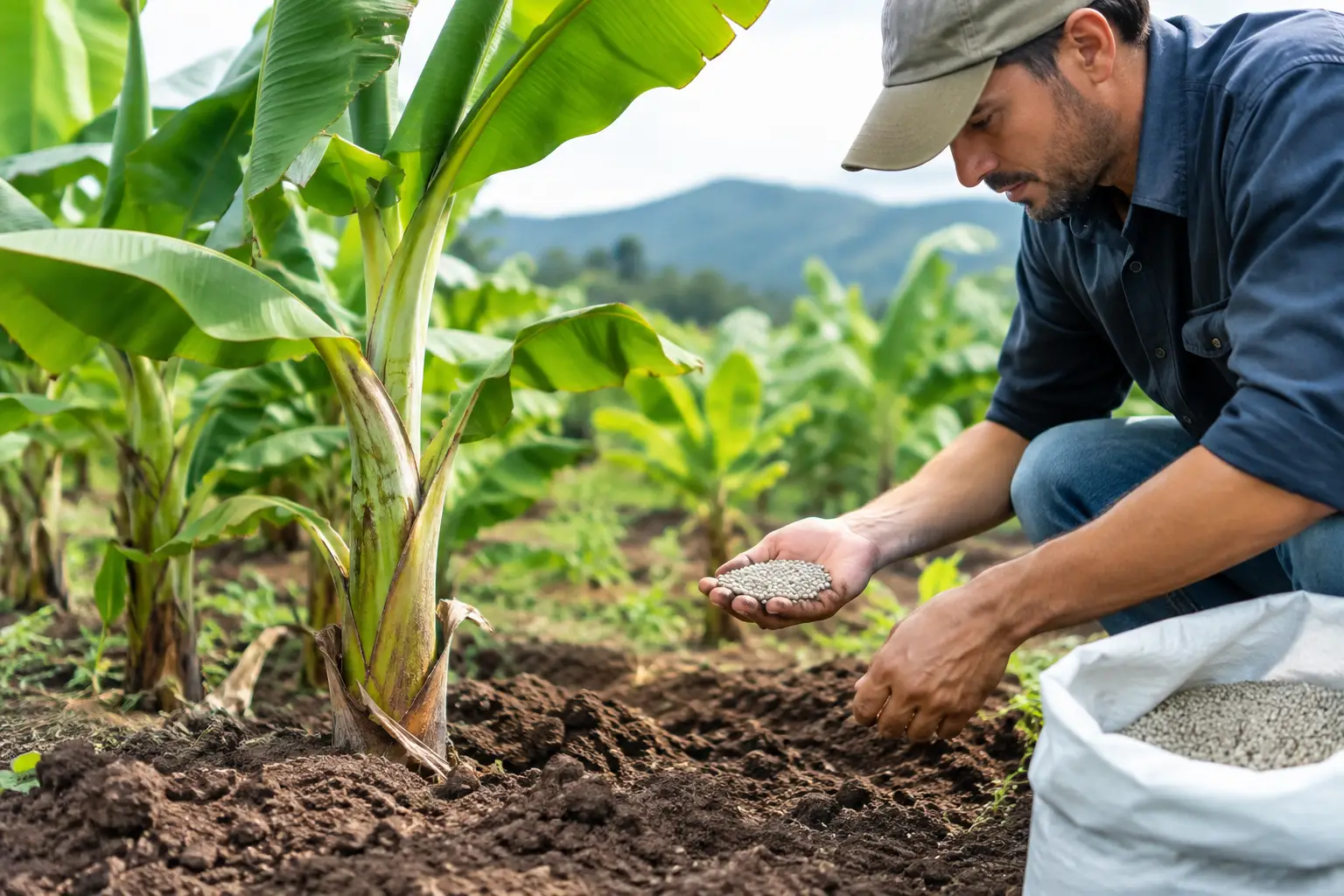
Banana Nutrient Management Guide for Commercial Farms
A banana block can look uniform from the road while carrying major differences in root activity, water availability, potassium supply, and salt accumulation. That is why a banana nutrient management guide must be built around measured field conditions, not a standard fertilizer rate copied from another farm. In commercial production, nutrition affects bunch weight, finger length, peel quality, harvest interval, packout, and the productive life of the mat.
The starting point is to define the production system clearly: cultivar, planting density, expected bunch yield, crop age, rainfall pattern, irrigation method, soil texture, water chemistry, and disposal or return of crop residues. A high-yield Cavendish plantation under frequent fertigation requires a different program from a rainfed banana operation or a field irrigated with moderately saline water. The nutrient requirement may be similar in principle, but timing, source selection, application frequency, and risk management are not.
Banana Nutrient Management Starts With a Field Diagnosis
A fertilizer program is only as reliable as the diagnosis behind it. Soil testing establishes the chemical and physical constraints that influence nutrient supply and root performance. Tissue analysis shows what the plant has actually taken up. Irrigation-water analysis identifies salts, bicarbonates, sodium, chloride, and nutrients entering the field with every irrigation event. None of these tools should be interpreted alone.
For bananas, representative sampling matters. Soil samples should separate management zones with meaningful differences in soil type, elevation, irrigation uniformity, previous yield, drainage, or salinity. Sampling only the easiest locations often hides the constraints causing poor performance. In established plantations, samples should be taken at appropriate depths in the active wetted root zone rather than treated as a one-time pre-plant exercise.
Leaf sampling also needs discipline. Use the defined diagnostic leaf and sample at a consistent phenological stage. A leaf result from vigorous vegetative plants cannot be compared casually with a result from plants approaching flowering. The value lies in repeated, standardized sampling tied to block yield, bunch characteristics, fertilizer records, and irrigation volumes.
A soil test with adequate potassium does not automatically mean the crop has enough available potassium during rapid bunch filling. Conversely, a low leaf concentration does not prove that more fertilizer is the only answer. Restricted roots, excess moisture, compaction, poor aeration, low water application, high sodium, or an antagonism with calcium and magnesium can all limit uptake. This distinction is where fertilizer program reviews and agronomic second opinions add value.
Set targets before calculating rates
Nutrient rates should begin with a realistic yield target, not an aspirational number. Estimate nutrient removal through harvested bunches, then account for nutrient cycling through pseudostems, leaves, and other residues retained in the field. Bananas recycle substantial potassium when residues are returned and decomposed effectively, but that recycling is not immediate, uniform, or sufficient to justify ignoring fertilizer replacement.
The target should also reflect packout rather than gross field tonnage alone. A crop producing large bunches with poor hand quality or inconsistent maturation may consume water and nutrients without delivering the expected commercial return. Farm managers should track marketable yield, average bunch weight, fingers per hand, fruit size distribution, reject reasons, and harvest interval alongside nutrient applications.
The Nutrients That Most Often Set Banana Performance
Nitrogen and potassium are commonly supplied in the largest quantities, but a banana nutrition program fails when it treats them as independent inputs.
Nitrogen supports canopy development, leaf area, and sustained growth. Too little nitrogen reduces vigor and limits the photosynthetic capacity needed to fill the bunch. Too much, particularly late or under weak light conditions, can produce excessive vegetative growth, delay crop cycles, increase soft tissue, and reduce nutrient-use efficiency. Nitrogen should be divided through the crop cycle and adjusted to plant growth, rainfall, irrigation performance, and organic matter mineralization.
Potassium has a central role in water relations, carbohydrate movement, bunch filling, and fruit quality. Its demand rises sharply as the plant moves from flowering through bunch development. A program that supplies potassium heavily early but cannot sustain supply during filling often underperforms despite an acceptable annual fertilizer total. Potassium source matters as well. Where chloride is high in irrigation water or soil, potassium sulfate or other lower-chloride strategies may be justified, despite their higher cost.
Calcium deserves particular attention in intensive systems. It contributes to cell-wall strength, root health, and fruit quality, but it moves largely with water flow and is difficult to redistribute within the plant. Inconsistent irrigation, low root activity, or high salinity can limit calcium delivery even when soil calcium appears ample. Calcium nitrate can fit a fertigation strategy, but its nitrogen contribution must be counted within the full nitrogen budget.
Magnesium is essential for chlorophyll and photosynthesis and is frequently overlooked where high potassium applications dominate. The classic risk is not simply low magnesium in the soil. It is an imbalance in which abundant potassium suppresses magnesium uptake, particularly in light-textured soils or blocks with strong leaching. Sulfur, boron, zinc, and other micronutrients should be supplied on the basis of analysis, known soil risk, and crop response. Routine micronutrient packages can be convenient, but they are not a substitute for diagnosis.
Fertigation Must Follow Water and Root Activity
Banana roots are concentrated in a relatively shallow, active soil volume, making frequent nutrient delivery through well-managed irrigation highly effective. It also makes the crop sensitive to errors. A short irrigation can leave nutrients above the active root zone. An excessive event can leach nitrate, potassium, magnesium, and boron beyond it, especially in sandy soils.
Match fertigation frequency to soil texture, emitter flow, irrigation interval, root distribution, and climate demand. In coarse soils under high evapotranspiration, smaller and more frequent applications normally reduce concentration swings and leaching risk. In heavier soils, the same frequency may create persistently wet conditions that reduce oxygen around roots. The correct program depends on infiltration, drainage, and measured soil-water behavior, not on a fixed number of weekly injections.
Compatibility in the fertilizer tank is operationally important. Calcium products should be kept separate from concentrated phosphates and sulfates unless the injection system and water chemistry have been verified. Precipitation can clog filters and emitters, creating nutrition variability that may be mistaken for a crop problem. Monitor pH, electrical conductivity, pressure, flow, filter condition, and injection calibration routinely.
Water quality also changes the fertilizer calculation. Irrigation water can add nitrate, calcium, magnesium, sulfate, chloride, sodium, and bicarbonate. Ignoring these inputs can lead to oversupply, salinity buildup, or unnecessary fertilizer expense. Where salinity is a concern, calculate the full salt load, maintain a justified leaching fraction, and confirm that drainage can actually remove salts from the root zone. Applying more water without adequate drainage only moves the problem downward or spreads it across the block.
Turning the Guide Into Consistent Field Execution
The weakest point in many banana nutrition programs is not the recommendation. It is execution across blocks, farms, field teams, and growing regions. One manager may adjust fertilizer rates after tissue results; another may continue the original schedule. Irrigation repairs, water-quality changes, product substitutions, and missed applications may remain undocumented until yield losses become obvious.
A practical operating system should connect each block to a seasonal nutrient plan, irrigation targets, approved fertilizer sources, sampling calendar, application records, and exception workflow. Field teams need clear instructions on what to measure, when to escalate a deviation, and who can change a recommendation. This is particularly relevant for cooperatives, exporters, input companies, and sourcing programs working with many growers.
Digital coordination is useful only when it reduces ambiguity in the field. yieldsApp can structure block-level protocols, assign agronomic tasks, record observations and applications, monitor adoption, and provide visibility across distributed banana operations. The underlying data still need agronomic interpretation. A dashboard cannot decide whether low potassium is caused by insufficient supply, a blocked emitter line, root disease, salinity, or poor sampling.
For complex plantations or grower networks, Cropaia can support fertilizer and irrigation program review, soil, water, and tissue interpretation, and technical capability development for agronomy and extension teams. The objective is not to impose a universal recipe. It is to establish a defensible decision process that can be repeated, audited, and improved across seasons.
The best banana nutrition program becomes more precise over time: compare planned versus applied nutrients, relate results to water use and crop phenology, investigate weak blocks early, and revise only when evidence supports the change. That discipline protects both yield potential and the margin required to produce it.












About Post Author
