

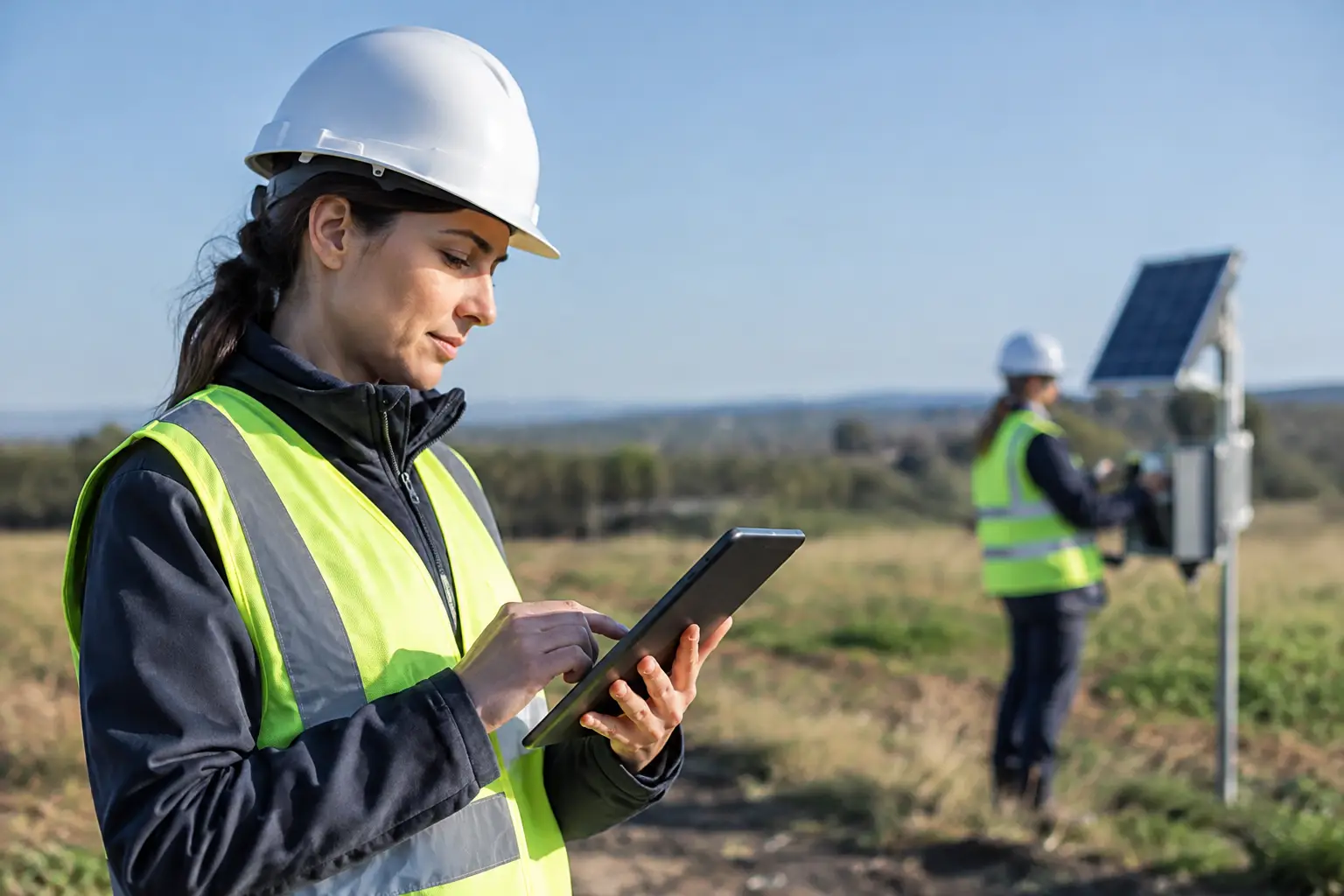
Field Monitoring Rollout That Works in Practice
A field monitoring rollout fails long before the first field visit when an organization has not decided what observations must change. A team may collect photos, soil moisture readings, pest observations, and grower comments for months, yet still lack a clear answer to a basic management question: what should happen next, who owns it, and how will completion be verified?
For commercial farms and organizations managing large grower networks, monitoring is not the same as visiting fields. It is an operational discipline that connects field evidence to irrigation adjustments, fertilizer applications, crop-protection actions, grower advice, quality controls, and traceable records. The rollout must therefore be designed around decisions and execution, not around forms or dashboards.
Why field monitoring programs lose value
Many programs begin with a long checklist. The checklist is intended to create consistency, but it often produces the opposite result. Field staff are asked to document every visible condition, regardless of crop stage, production risk, or whether the observation can lead to a practical action. In response, they shorten visits, enter generic comments, or postpone reporting until the data no longer supports timely decisions.
The other common failure is separating agronomy from operations. An agronomist may identify early nitrogen deficiency, rising root-zone salinity, uneven irrigation, or a disease-risk period. But if the recommendation is issued outside the workflow used by field teams and growers, the organization cannot tell whether it was received, understood, applied correctly, or effective.
A useful rollout accepts a hard reality: not every field can be visited at the same frequency, and not every signal is equally reliable. The goal is not complete surveillance. It is better allocation of agronomic attention and faster control of production risks.
Define the decisions before designing forms
The first deliverable should be a decision map for each priority crop and production system. In irrigated orchards, the high-value decisions may concern irrigation duration, fertilizer timing, water quality constraints, salinity management, and fruit-quality risks. In open-field vegetables, the focus may shift rapidly by crop stage toward stand establishment, fertigation uniformity, pest thresholds, foliar nutrient status, and harvest readiness.
For every monitored item, define four elements: the field observation required, the decision it supports, the person authorized to act, and the evidence needed to close the action. This prevents the program from gathering information simply because it is easy to collect.
A workable monitoring protocol usually distinguishes among three types of observations. Routine observations confirm that a crop is progressing within expected limits. Trigger observations signal a threshold that requires intervention, such as soil electrical conductivity above an agreed range or irrigation uniformity below the accepted standard. Diagnostic observations are initiated when performance has already departed from the expected trajectory and require deeper investigation, often including soil, water, tissue, or irrigation-system analysis.
This distinction matters commercially. Routine monitoring can often be standardized across many farms. Diagnostic work requires higher technical capability and sometimes laboratory data, field measurements, or an independent agronomic review.
Set boundaries for each monitoring unit
A “field” is not always the right unit of management. A large block can contain different soil textures, irrigation zones, planting dates, varieties, or water sources. Treating it as one unit can hide the cause of uneven growth and lead to broad recommendations that waste inputs.
At the same time, dividing every block into many units can make a program too expensive to sustain. The right level of detail depends on variability, crop value, risk exposure, and the action that can realistically be applied. If separate irrigation management is impossible, mapping small differences may have limited immediate value. If irrigation zones can be controlled independently, the same differences may justify separate monitoring and recommendations.
Pilot the field monitoring rollout under real conditions
A pilot should test operational behavior, not only data collection. Select a representative set of farms, crops, regions, and field-team profiles. Include difficult conditions: remote locations, variable connectivity, growers with different levels of engagement, and blocks with known irrigation or nutrition challenges. A pilot conducted only with highly cooperative growers and experienced agronomists can produce false confidence.
During the pilot, measure more than the number of submitted reports. Track whether reports are completed on time, whether mandatory observations are credible, how long it takes to issue a recommendation, whether the action is acknowledged, and whether a follow-up visit confirms implementation. These are the measures that reveal where the process breaks.
The first protocol should be concise enough to use during a real field day. Crop stage, phenology, irrigation status, visible nutrient or salinity symptoms, pressure from priority pests or diseases, and a small number of crop-specific measurements may be sufficient. A tomato program, for example, may require different checkpoints before flowering, fruit set, and harvest than a citrus program managing seasonal water stress and chloride accumulation.
Photos can be valuable, but only when they are structured. Require the crop area, symptom location, and a reference for scale where relevant. A photograph of chlorosis without field location, crop stage, recent fertigation history, and irrigation context is rarely enough to diagnose the cause. It may reflect nitrogen shortage, root damage, poor aeration, salinity, disease, or sampling bias.
Turn observations into accountable execution
The core workflow is simple in principle: observe, assess, recommend, assign, verify. In practice, each step needs rules.
An observation should be tied to a specific block, date, crop stage, and responsible person. Assessment may be automated for simple thresholds, but it should preserve agronomist review for complex cases. Recommendations need a defined owner and due date, particularly when they involve fertilizer rate changes, irrigation corrections, water treatment, or a crop-protection response.
Verification is where many organizations lose traceability. A recommendation marked “sent” is not an outcome. The program should distinguish between communicated, accepted, completed, and verified actions. For some practices, a grower confirmation may be adequate. For high-risk actions, such as correcting excessive salinity or changing a fertigation program, the next field visit should assess whether the action was performed and whether crop or root-zone conditions changed as expected.
This also creates a more honest view of adoption. Low adoption may indicate grower resistance, but it can also indicate impractical timing, insufficient labor, unavailable inputs, unclear technical instructions, or recommendations that do not fit the farm’s irrigation infrastructure. The response should differ in each case.
Protect data quality without slowing the team
Field data quality has two dimensions: technical validity and operational completeness. A tissue sample may be correctly labeled but collected from the wrong plant part or at an unsuitable phenological stage. A report may be technically sound but submitted too late to influence irrigation or nutrient management.
Build quality controls into the workflow. Use required fields only where omission makes the record unusable. Standardize measurement units. Define acceptable ranges and flag implausible values for review. Train staff to record uncertainty rather than invent precision. A soil moisture reading from one sensor location should not be presented as a definitive description of an entire variable block.
Remote sensing, weather data, ETc estimates, and crop models can help prioritize visits and identify deviations. They do not replace field diagnosis. Satellite imagery may identify uneven vigor, but it cannot by itself separate poor irrigation distribution from root disease, nutrient limitation, compaction, or cultivar differences. Digital signals should direct attention, while field observations and agronomic interpretation determine the intervention.
Establish roles, service levels, and escalation paths
A rollout requires a named owner for protocol design, field-team performance, technical review, grower communication, and data governance. When these responsibilities are diffuse, urgent cases sit in a queue while routine reporting continues.
Set service levels according to risk. A suspected irrigation failure during peak water demand may need review the same day. A seasonal fertilizer-program review can follow a planned weekly cadence. Escalation rules should identify when a field officer can advise independently, when a regional agronomist must review, and when laboratory work or external technical input is justified.
For organizations expanding across regions, standardization should not mean identical recommendations everywhere. The monitoring framework can be common while thresholds, crop calendars, irrigation guidance, and nutrient programs are adapted to local soils, water quality, climate, varieties, and market requirements. This balance is essential for a cooperative, sourcing company, or development program working across diverse production areas.
Build capability before scaling coverage
Technology cannot compensate for weak diagnostic skills. Field teams need practice connecting symptoms to irrigation history, fertilizer sources, water analysis, soil conditions, and crop stage. They also need to know when not to prescribe. For example, leaf burn in a high-value vegetable crop may justify an immediate review of water quality, fertigation concentration, root conditions, and recent weather before attributing the problem to a single nutrient deficiency.
Cropaia can support this capability through advanced agronomy consulting and customized training for agronomy, technical-service, and extension teams, particularly where irrigation, fertigation, crop nutrition, salinity, or field diagnosis must be translated into consistent commercial decisions.
Once protocols and responsibilities are proven, yieldsApp can provide the operational structure for coordinating field teams, standardizing recommendations, tracking grower actions, and maintaining field-level visibility across distributed programs. The value is not the digital record alone. It is the ability to identify delayed actions, recurring production constraints, and gaps between technical advice and field execution while there is still time to respond.
A field monitoring program becomes valuable when a regional manager can see more than visit volume: which blocks are at risk, which recommendations remain unresolved, where adoption is weak, and which recurring issues demand a change in protocol or training. Start with decisions that matter in the current crop cycle, prove that the team can close the loop, and then expand coverage without losing agronomic judgment.










About Post Author
