

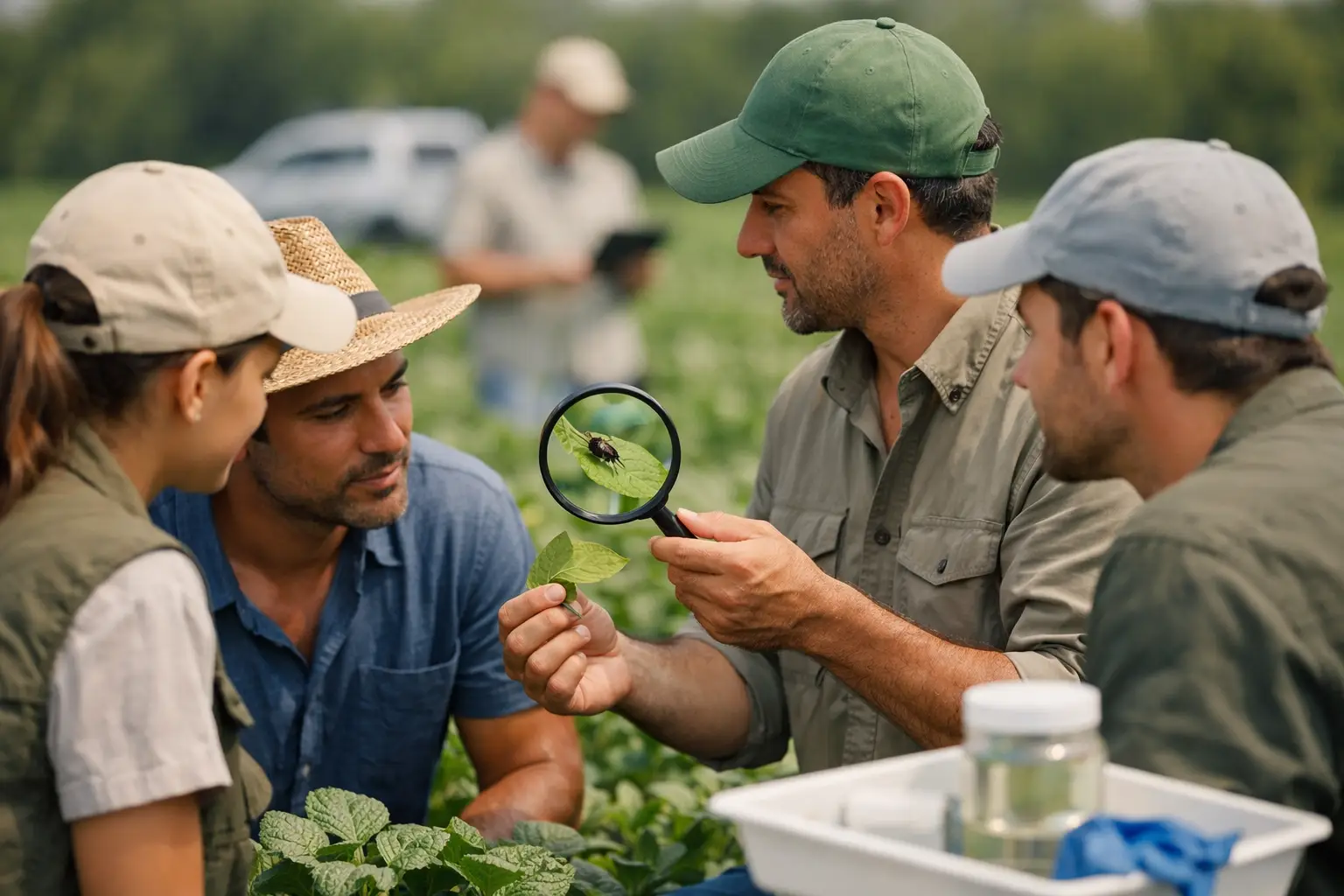
Pest and Disease Management Course for Field Teams
A pest and disease management course should do more than help agronomists identify a leaf spot, an insect, or a damaged fruit. In commercial production, the costly failures usually occur earlier or later: a risk signal is missed, a diagnosis is assumed rather than verified, an intervention is poorly timed, or field teams apply different standards across the same crop program.
For commercial farms, technical service teams, and organizations managing grower networks, pest and disease management is an operational discipline. It combines crop biology, field scouting, weather interpretation, irrigation and nutrition management, product stewardship, and disciplined follow-through. A strong course must teach participants how to make defensible decisions under field uncertainty, then turn those decisions into consistent action.
What a Pest and Disease Management Course Must Teach
The first requirement is diagnostic discipline. Symptoms are not diagnoses. Chlorosis can result from nutrient deficiency, salinity, poor root function, waterlogging, root disease, herbicide injury, or insect feeding. Necrotic margins may reflect potassium imbalance, excess salts, heat stress, poor irrigation uniformity, or a pathogen. Recommending a crop-protection treatment before separating these possibilities wastes money and can delay the real correction.
Effective training teaches a structured diagnostic sequence: define the affected area, assess distribution within the field, examine symptom progression, inspect roots and plant tissues, review irrigation and fertigation records, and consider recent weather and field operations. Samples, laboratory analysis, and field history are used where the economic risk justifies them. The objective is not perfect certainty in every case. It is to reduce uncertainty enough to choose the lowest-risk, highest-value next action.
A useful course also distinguishes between presence and threat. Finding an insect, spore, or suspicious lesion does not automatically justify treatment. Decisions depend on crop stage, pest pressure, disease incidence and severity, expected weather, crop value, market requirements, natural enemies, preharvest intervals, and the probability that the problem will spread or cause irreversible loss.
Disease Risk Is Often Built Before Symptoms Appear
Many disease outbreaks are managed poorly because teams begin scouting only after visible symptoms are widespread. By then, the favorable conditions may have existed for days or weeks. In grapes, vegetables, orchards, and protected crops, disease pressure often develops from the interaction of susceptible plant tissue, inoculum, leaf wetness or humidity, temperature, canopy density, and irrigation practices.
A course for experienced professionals should therefore connect disease management with crop production decisions. Excess nitrogen can produce dense, susceptible growth. Frequent shallow irrigation may prolong humidity in the lower canopy or weaken root systems. Poor drainage can intensify root diseases. Water quality and salinity can reduce plant vigor, making a crop less able to tolerate pest damage or secondary infection.
This does not mean irrigation or nutrition replaces crop protection. It means pest and disease programs cannot be separated from the production system. A fungicide program may be technically sound and still underperform if the canopy remains poorly ventilated, irrigation timing supports leaf wetness, or spray coverage is inadequate.
Pest Management Requires Thresholds, Not Habit
Routine calendar spraying remains common in high-value crops because it appears simple to organize. It can also create resistance pressure, disrupt beneficial populations, raise residue risk, and generate unnecessary cost. Yet threshold-based management is not a simplistic alternative. It requires reliable monitoring, correct identification, consistent sampling methods, and a clear understanding of crop-specific economic risk.
A serious course should cover how to establish action thresholds when published thresholds do not fit local conditions. The appropriate trigger may differ by variety, market destination, crop stage, field history, expected harvest date, and available control options. A low pest population in an early vegetative stage may be tolerable, while the same pest near a quality-sensitive harvest period may require immediate action.
Participants should learn to document not only counts, incidence, and severity, but also the decision logic. Why was treatment delayed? Why was a biological option selected? Why was an area treated separately? These records improve future recommendations and allow technical managers to review whether the program is producing results.
From Field Scouting to Repeatable Decisions
The gap between a knowledgeable agronomist and a reliable operation is usually standardization. One agronomist may recognize early powdery mildew risk from canopy conditions and weather patterns. Another may record only visible symptoms. One field team may inspect defined scouting points weekly; another may visit only problem areas. The organization then receives inconsistent data and cannot compare performance across farms or regions.
A pest and disease management course for field teams should build practical operating standards, including scouting frequency, sampling locations, pest counts, severity scales, photo requirements, escalation rules, and recommendation formats. The standard must be detailed enough to produce comparable observations but simple enough to be used under real field conditions.
Four elements are particularly valuable in a commercial training program:
- Crop-specific scouting protocols that define where, when, and how observations are collected.
- Decision trees that separate likely nutritional, irrigation, physiological, insect, and disease causes.
- Risk-based treatment protocols that account for crop stage, weather, resistance management, and market restrictions.
- Verification procedures that confirm whether the intervention worked and whether the underlying driver was corrected.
These tools prevent a common failure: recording an activity as completed without verifying the agronomic outcome. A treatment can be applied on time and still fail because of poor coverage, unsuitable water pH, incompatible tank mixes, wrong product selection, advanced disease development, or unfavorable weather after application.
The Limits of Digital Risk Alerts
Weather-based disease models, satellite observations, phenology estimates, and pest alerts can improve prioritization. They are especially useful where agronomists cover large areas or organizations manage dispersed growers. But an alert is not a diagnosis, and a model is not a field inspection.
Model quality depends on local weather data, calibration, crop stage accuracy, disease biology, and the relevance of the underlying assumptions to the production environment. A station located far from the field, inaccurate irrigation records, or unreported canopy conditions can weaken the result. Teams need training to interpret alerts as risk signals that guide scouting and prevention, not as automatic spray instructions.
This is where digital operations become practical rather than theoretical. yieldsApp can support organizations that need standardized field observations, coordinated recommendations, task follow-up, and visibility across farms or grower networks. Its value depends on the agronomic protocol behind the system. Digitizing inconsistent scouting merely creates faster inconsistent data.
Training Should Use the Crops and Constraints You Actually Manage
Generic pest and disease content rarely changes performance in commercial operations. A citrus team needs different diagnostic priorities than a greenhouse tomato operation. A grape program must address canopy management, disease forecasting, residue restrictions, and harvest quality. In irrigated vegetables, water quality, salinity, fertigation, and frequent crop cycles may be central to both disease pressure and treatment decisions.
The most effective courses use actual crop calendars, local pest complexes, production records, and field cases. Participants should practice interpreting ambiguous symptoms, reviewing spray histories, assessing resistance risk, and deciding when more evidence is needed. This is more demanding than memorizing pest names, but it produces better recommendations.
Cropaia develops practical pest and disease training within the wider agronomic context of irrigation, crop nutrition, salinity, field diagnosis, and production management. For agricultural companies, cooperatives, and extension programs, customized training can align technical teams around the same scouting standards, decision rules, and reporting language.
Measuring Whether the Course Changed Field Performance
Attendance and completion rates do not show whether training worked. Better measures include time from risk detection to field verification, consistency of scouting records, reduction in repeat outbreaks, percentage of recommendations verified after application, crop-loss patterns, and compliance with resistance-management protocols.
The right metrics vary by crop and organization. A high-value export program may prioritize residue compliance and traceability. A cooperative may focus on improving advisory consistency across growers. A commercial farm may need faster diagnosis of recurring root-zone and canopy problems. The course should begin with these operating objectives, not treat them as an afterthought.
When pest and disease management is taught as a connected field system, teams stop treating symptoms in isolation. They become better at seeing how water, nutrition, crop stage, weather, monitoring quality, and execution discipline shape the final result. That is the capability that protects yield, quality, and commercial decisions when conditions become less predictable.










About Post Author
