

Soil Sensors Versus Weather-Based Irrigation
A block can receive 0.24 inches of calculated crop water use this week and still have a wet root zone at 24 inches, a dry shoulder row, or a restrictive layer that prevents roots from reaching the water profile. That is the practical issue behind soil sensors versus weather-based irrigation. The question is not which technology is more advanced. It is which source of information can support a sound irrigation decision for a specific crop, soil profile, irrigation system, and operating structure.
For commercial production, both methods can improve on fixed calendar irrigation. Neither is self-sufficient in every situation. A weather-based schedule estimates how much water the crop has used. Soil sensing shows, with important qualifications, what is happening in selected locations in the root zone. The strongest programs use each method for the job it can do well, then verify the result through field observation, plant performance, irrigation records, and analysis of water quality and salinity.
What Weather-Based Irrigation Actually Measures
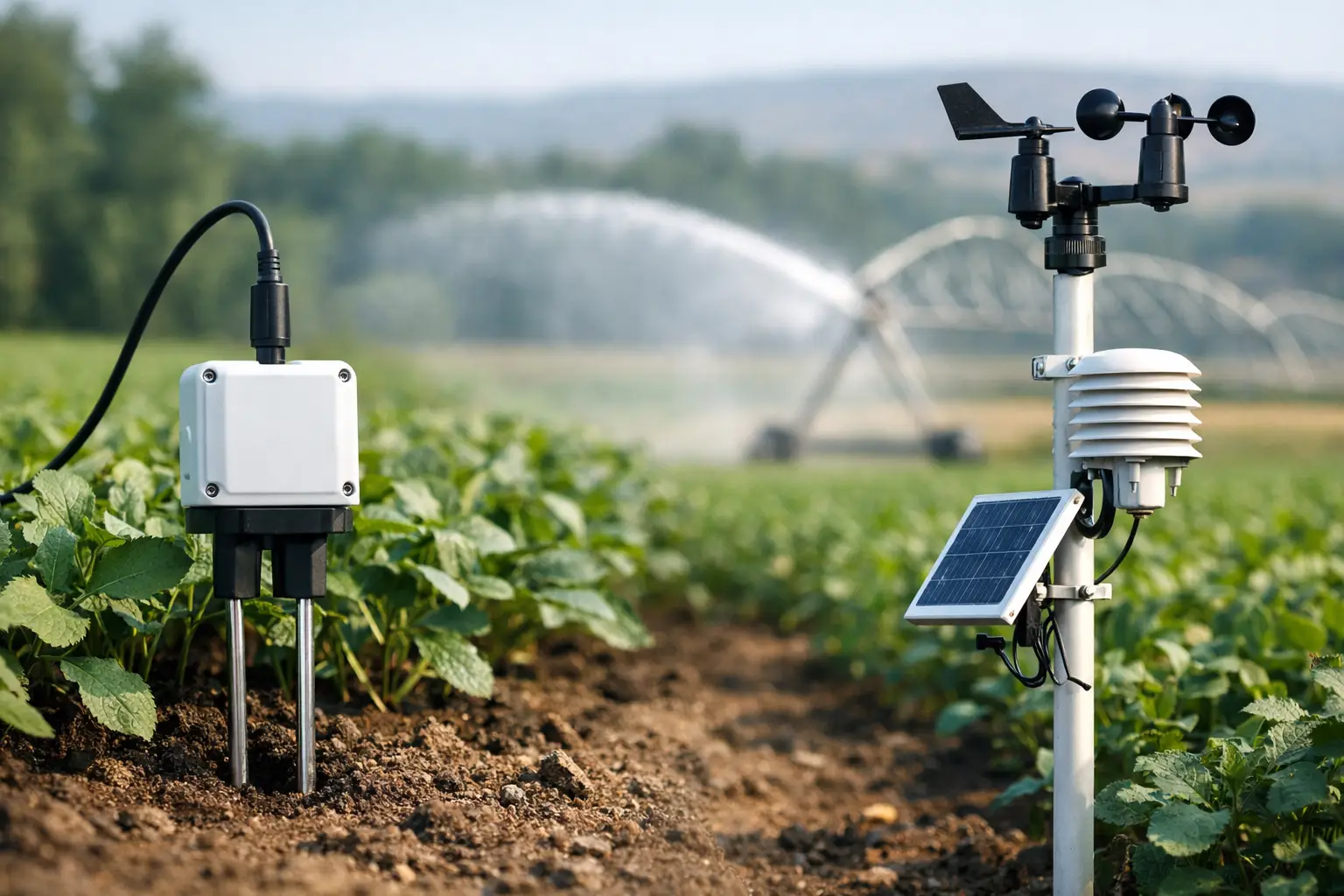
Weather-based irrigation begins with reference evapotranspiration, or ETo. ETo is calculated from weather variables such as solar radiation, temperature, humidity, and wind. A crop coefficient converts ETo to crop evapotranspiration, or ETc: ETc = ETo × Kc. Effective rainfall, irrigation efficiency, canopy development, and the target soil-water depletion are then considered to determine a replacement volume and timing.
This approach is especially valuable because it provides a continuous water-balance framework. It can estimate demand across every block covered by a reliable weather source, including blocks with no installed hardware. It also supports planning: managers can forecast pumping demand, labor requirements, and likely irrigation intervals before a water deficit becomes visible.
Its weakness is that ETc is an estimate, not a direct measurement of soil-water status. The result depends on representative weather data, appropriate crop coefficients, accurate irrigation and rainfall records, and a realistic estimate of rooting depth and available water-holding capacity. Errors compound quickly. A mature almond orchard, processing tomato field, or greenhouse pepper crop may have a crop coefficient that differs materially from a published standard because of canopy cover, cultivar, planting geometry, pruning, or local management.
Weather-based irrigation can also miss irrigation nonuniformity. If a filter problem, pressure variation, clogged drippers, or poor set duration leaves part of a block underirrigated, the weather model may still report that the calculated replacement was applied. The model can be correct while the crop is stressed.
Where Soil Sensors Add Agronomic Value
Soil sensors measure a physical condition at their installation point. Depending on the technology, they may report volumetric water content, soil-water tension, electrical conductivity, temperature, or a combination of these. Their greatest value is not a single moisture number. It is the change over time at several depths in a known soil profile.
A well-positioned sensor set can show whether irrigation reaches the active root zone, whether water moves below it, whether a deeper reserve is being depleted, and whether the wetting pattern is changing after a system adjustment. In drip-irrigated citrus, grapes, vegetables, and tree crops, this information is often decisive. It turns a generic irrigation recommendation into a field-specific assessment of duration, frequency, and root-zone refill.
Sensors are particularly useful when soil variability is high, root depth is uncertain, salinity risk is present, or irrigation events are short and frequent. They can reveal a pattern that a weather calculation cannot: a shallow sensor repeatedly refills while deeper sensors continue to dry. That may indicate too-frequent, too-short irrigation, limited infiltration, a compacted layer, or roots concentrated near the surface. The response should not automatically be to apply more water. The agronomist must first determine whether the crop needs a deeper wetting front, a different pulse strategy, or investigation of a soil or system constraint.
But sensors also have limitations. A sensor represents a small volume of soil, not an entire management zone. Placement outside the effective wetting pattern, at an unrepresentative depth, or in an atypical soil can lead to confident but wrong decisions. Installation quality, calibration, telemetry reliability, and interpretation matter as much as the device itself. A graph with no field context is not an irrigation program.
Soil Sensors Versus Weather-Based Irrigation: The Real Trade-Off
Weather-based scheduling has broad coverage and relatively low marginal cost once data services and crop models are established. It is practical for organizations managing many farms, growers, or dispersed production areas. Soil sensing provides direct root-zone verification, but it requires capital investment, physical maintenance, disciplined placement, and a process for reviewing exceptions.
The choice also depends on the decision being made. If the objective is to estimate daily demand across 500 grower blocks, weather and crop-model data are the logical starting point. If the objective is to determine whether a high-value blueberry block is being over-irrigated on a layered soil, a properly installed sensor profile is likely more informative. If the objective is to investigate declining yield, poor fruit size, nutrient uptake issues, or increasing root-zone salinity, neither data source should be interpreted alone.
A useful rule is simple: use weather data to calculate the expected water balance and soil sensors to test whether the field is behaving as expected. When the two disagree, do not choose the more convenient answer. Investigate the gap.
For example, weather data may indicate that an avocado block should be approaching its allowable depletion level, while sensors show stable moisture at all measured depths. Possible explanations include overestimation of Kc, rainfall not recorded in the irrigation account, excess irrigation, a sensor placed in a wetter-than-average zone, or a root zone deeper than assumed. The discrepancy is valuable because it directs the next field check.
Build a Combined Irrigation Control System
The combined approach starts with agronomic characterization, not technology procurement. Define irrigation management zones using crop age, soil texture and depth, topography, irrigation design, water source, and known performance differences. A single sensor station should not be expected to represent an entire farm simply because the crop is the same.
For each zone, establish a water-balance schedule using local weather, crop phenology, and a crop coefficient curve that reflects actual canopy development. Record applied irrigation by block, including set time, flow rate, and any system constraints. Without reliable application data, ET-based scheduling becomes theoretical.
Then install soil sensors to answer specific questions. In a deep-rooted orchard, a shallow, mid-root-zone, and deeper sensor can help distinguish active uptake from drainage or profile depletion. In shallow-rooted vegetables, the depth intervals should be closer and aligned with the expected root distribution. Place sensors in a representative productive area, within the intended wetting pattern, while avoiding unusual wheel tracks, leaks, field edges, and visibly weak plants unless the purpose is diagnosis.
Set review rules before the season begins. A manager should know who reviews irrigation recommendations, what deviations require a field visit, and when a recommendation can be changed. This matters even more when an organization coordinates multiple agronomists or contracted growers. Consistent action requires more than a dashboard. It requires agreed protocols, documented decisions, and accountability for execution.
Scaling Irrigation Decisions Across Grower Networks
At network scale, the operational problem is rarely a lack of data. It is the lack of a common method for turning data into timely, traceable field action. Different agronomists may use different Kc values, sensor thresholds, irrigation units, and reporting formats. As a result, leadership cannot easily distinguish a justified field-specific exception from inconsistent technical practice.
This is where a platform such as yieldsApp can organize standardized irrigation protocols while allowing approved adjustments by crop, phenological stage, soil class, and irrigation system. Weather, ETc, phenology, irrigation records, sensor observations, satellite signals, and field reports can be connected to a common workflow. The practical outcome is not automatic irrigation for every block. It is better visibility into which recommendation was issued, whether it was implemented, what evidence supported it, and where follow-up is required.
For cooperatives, food companies, extension programs, and input suppliers, this structure also supports technical service at scale. Teams can identify blocks with missing irrigation records, abnormal sensor trends, repeated overapplication, or low adoption of recommendations. Those exceptions become priorities for field visits and coaching rather than buried data points.
Do Not Ignore Salinity, Water Quality, and Nutrition
Irrigation volume cannot be separated from water quality and nutrient management. In saline conditions, a sensor showing adequate moisture may not indicate whether salts are accumulating in the active root zone. Electrical conductivity trends, irrigation-water analysis, drainage conditions, soil texture, and fertilizer sources must be evaluated together. A leaching event may be justified, but indiscriminate extra irrigation can worsen nutrient losses, increase pumping cost, and create oxygen limitations.
Likewise, fertigation programs should follow the actual irrigation pattern. If water is not reaching the intended root volume, fertilizer placement will not be correct either. When yield or quality problems persist despite apparently adequate ET replacement, a structured review of irrigation distribution, soil and tissue analyses, root health, salinity, and nutrient delivery is more productive than simply increasing the irrigation target.
Cropaia supports this type of irrigation and fertigation diagnosis through independent agronomic consulting, practical professional training, and advanced guidance for teams that need to interpret field data rather than merely collect it.
The best irrigation system is one your team can maintain, interpret, and act on consistently. Start with the uncertainty that is costing the most – inaccurate demand estimates, unknown root-zone behavior, uneven application, or inconsistent execution – and build the measurement and decision process around that problem.











About Post Author
