

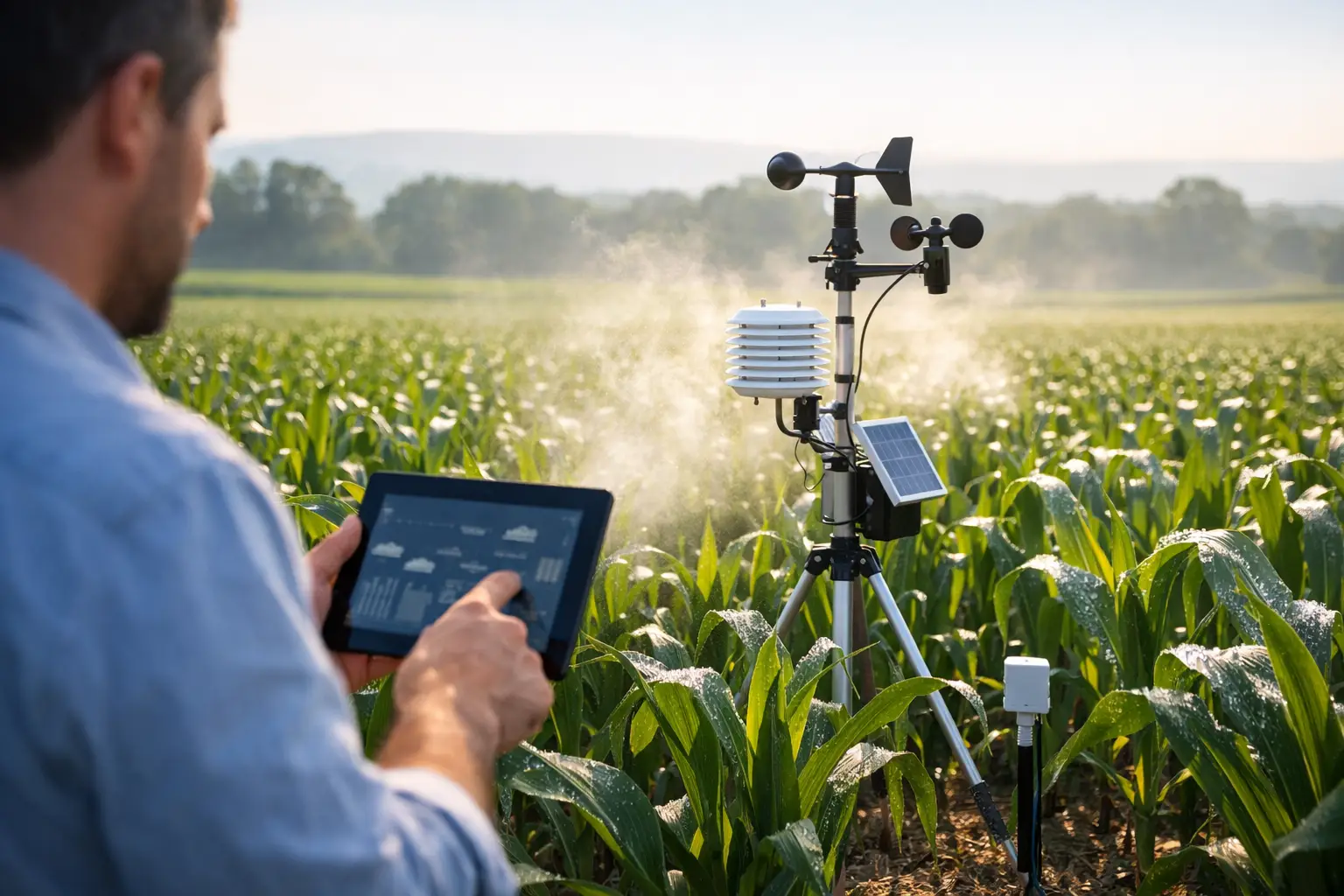
How to Monitor Crop Evapotranspiration
A field can look uniform from the road and still be losing water at very different rates within the same week. That is why knowing how to monitor crop evapotranspiration matters so much in commercial agriculture. Irrigation timing, pump runtime, fertigation efficiency, and even disease pressure can all shift when evapotranspiration, or ET, is misread.
For farm managers, agronomists, and agribusiness teams, ET monitoring is not just a technical exercise. It is a decision framework for matching water application to actual crop demand. Done well, it improves irrigation precision. Done poorly, it can create hidden stress, leaching losses, runoff, and unnecessary energy costs.
What crop evapotranspiration actually tells you
Crop evapotranspiration is the combined water loss from soil evaporation and plant transpiration. In practical terms, it represents how much water the crop-soil system is using over a given period, usually expressed in inches or millimeters per day.
That number matters because irrigation planning based only on the calendar or a fixed weekly schedule rarely tracks real field conditions. ET responds to solar radiation, temperature, humidity, wind, canopy development, soil cover, and irrigation method. A corn field at full canopy in hot, windy weather behaves very differently from a newly planted vegetable block or a mature orchard with partial ground cover.
The first operational distinction to make is between reference ET and crop ET. Reference ET, often called ETo or ETr, estimates atmospheric demand from a standardized reference surface. Crop ET, often called ETc, adjusts that reference number using a crop coefficient, or Kc, to better reflect the actual crop stage and canopy behavior.
The basic relationship is straightforward: ETc = ETo x Kc. The challenge is that neither side of that equation should be treated as static.
How to monitor crop evapotranspiration in practice
If the goal is better irrigation decisions, ET monitoring should combine weather data, crop-stage knowledge, and field verification. Relying on only one source usually creates blind spots.
Start with reliable reference ET data
Most ET programs begin with weather-based reference ET. This is calculated from variables such as solar radiation, temperature, wind speed, and relative humidity. The most widely accepted methods use standardized equations, and the quality of the output depends heavily on weather station quality and distance from the field.
For large operations, the first question is not whether ET data is available, but whether it is representative. A station located many miles away, at a different elevation, near urban influence, or outside the crop production zone may distort irrigation demand. Even a good regional station can miss local wind patterns, marine influence, or heat accumulation.
If a farm uses weather-based irrigation scheduling, station siting and data validation deserve real attention. A bad ET input creates a polished but inaccurate schedule.
Apply crop coefficients carefully
Reference ET alone does not tell you what the crop used. You need a crop coefficient that reflects crop type and growth stage. Early season Kc values are lower because canopy cover is limited and transpiration is modest. Midseason values often peak as full canopy drives maximum demand. Late-season coefficients may decline as the crop matures or senesces.
This is where many irrigation programs drift off course. Teams often use generic Kc tables without adjusting for planting date, variety, spacing, pruning system, mulch, residue cover, or wetting pattern. The difference can be meaningful, especially in orchards, vineyards, and drip-irrigated row crops where exposed soil and canopy architecture alter the evaporation-transpiration balance.
In other words, ET monitoring works best when the crop coefficient is treated as a managed agronomic variable, not a default spreadsheet value.
Field tools that improve ET monitoring
Weather-based ET is a strong backbone, but field tools help confirm whether the irrigation program matches actual root zone conditions. The best approach is usually not weather versus sensors. It is weather plus sensors, with each source checking the other.
Soil moisture sensors
Soil moisture sensors show whether ET-based water replacement is keeping pace with depletion in the root zone. They are especially useful for detecting over-irrigation, uneven infiltration, or poor irrigation set design.
Their strength is direct feedback from the soil profile. Their limitation is interpretation. A sensor installed too shallow, too deep, or in an unrepresentative location can mislead the entire irrigation program. In heavy soils, readings may also lag behind operational decisions. For this reason, sensor placement and depth selection should match crop rooting pattern, emitter placement, and management objective.
Plant-based measurements
Stem water potential, leaf water potential, sap flow, canopy temperature, and stomatal conductance can add another layer of confidence. These methods move closer to actual crop response than weather data alone.
But they also require more discipline. Plant-based measurements are powerful when the team understands timing, sampling protocol, and crop-specific thresholds. They are less useful when taken inconsistently or interpreted without considering vapor pressure deficit, crop stage, or recent irrigation events.
Remote sensing and imagery
Satellite and drone imagery can support ET monitoring by revealing canopy variability, stress patterns, and spatial differences in crop vigor. Indices such as NDVI or EVI do not measure ET directly, but they can improve Kc adjustment and zone-based irrigation management.
Their value is strongest when used to identify where ET assumptions may be wrong. A weak zone with reduced canopy development should not be irrigated as if it has the same water demand as a high-vigor zone. The trade-off is timing and resolution. Satellite data may arrive too slowly or too coarsely for rapid irrigation adjustments, while drone programs require more operational effort.
Common mistakes when monitoring crop evapotranspiration
The biggest mistake is treating ET as a single number instead of a decision process. Daily ET can be calculated precisely and still lead to poor irrigation if field capacity, allowable depletion, rooting depth, and irrigation system performance are not considered.
Another common problem is assuming uniformity across fields. One ranch may have multiple soil textures, different irrigation hardware, and variable drainage. A single ET replacement target can oversupply one block and undersupply another.
There is also a tendency to ignore effective rainfall, runoff, and irrigation inefficiency. ET tells you crop water use. It does not tell you how much of an irrigation application actually reached and stayed in the active root zone. Distribution uniformity, application rate, and soil infiltration still matter.
Finally, many programs fail because monitoring is not tied to action thresholds. If ET accumulates for several days, when does the field get irrigated? How much depletion is acceptable at this growth stage? What changes under heat stress, salinity pressure, or deficit irrigation strategy? Without those operational rules, ET data remains informational rather than useful.
Building an ET-based irrigation workflow
A workable system is usually simpler than people expect. Start with validated weather-based ETo from a representative station. Apply crop- and stage-specific Kc values. Track cumulative ETc between irrigation events. Then compare that estimate against soil moisture trends, irrigation application records, and periodic plant stress observations.
For higher-value crops or complex operations, build management zones rather than using one field average. Separate blocks by soil, variety, irrigation system, vigor, or topography where those differences materially affect water use. The goal is not more dashboards. The goal is fewer irrigation mistakes.
It also helps to review ET performance after each irrigation cycle. If the model suggests the crop should be balanced but sensors show persistent saturation or excessive depletion, something is off. The issue may be the Kc curve, station representativeness, rooting assumptions, application efficiency, or simply set duration.
This is where unbiased agronomic review becomes valuable. Cropaia and similar professional agronomy teams often see that the problem is not lack of data. It is poor integration of weather, crop, soil, and irrigation information into one practical scheduling process.
When ET monitoring delivers the most value
ET monitoring is especially valuable where irrigation costs are high, water supply is limited, quality premiums matter, or uniform crop performance is essential. That includes permanent crops, seed production, processing vegetables, and large-acreage field crops where small scheduling errors scale into major financial impact.
It is also increasingly relevant for food and beverage supply chains that need credible water management practices at field level. ET-based irrigation records can support better resource stewardship, but only if the numbers reflect actual agronomic conditions rather than generic assumptions.
A strong ET program will not eliminate uncertainty. Heat spikes, root disease, salinity, compaction, and poor distribution uniformity can still disrupt the relationship between estimated demand and crop response. But ET monitoring gives farm teams a disciplined starting point for irrigation decisions, and that is often the difference between reactive watering and controlled crop management.
The most useful ET system is the one your team can trust, verify, and act on consistently throughout the season.











About Post Author
