

How to Treat Hard Irrigation Water
A fertigation tank that keeps plugging, drip lines that lose uniformity midway through the season, and leaf tissue tests that do not match the fertilizer budget often point to the same underlying issue: water quality. If you are figuring out how to treat hard irrigation water, the real job is not just softening water. It is protecting system performance, preserving nutrient availability, and keeping irrigation decisions aligned with crop response.
Hard irrigation water is defined mainly by dissolved calcium and magnesium, usually reported as ppm or mg/L of calcium carbonate. In production agriculture, hardness rarely acts alone. It often comes with bicarbonates, elevated pH, sodium, chloride, sulfate, iron, manganese, or suspended solids. That is why a simple label like hard water can be misleading. The treatment plan has to match the actual chemistry, the irrigation method, and the crop sensitivity.
What hard irrigation water actually does in the field
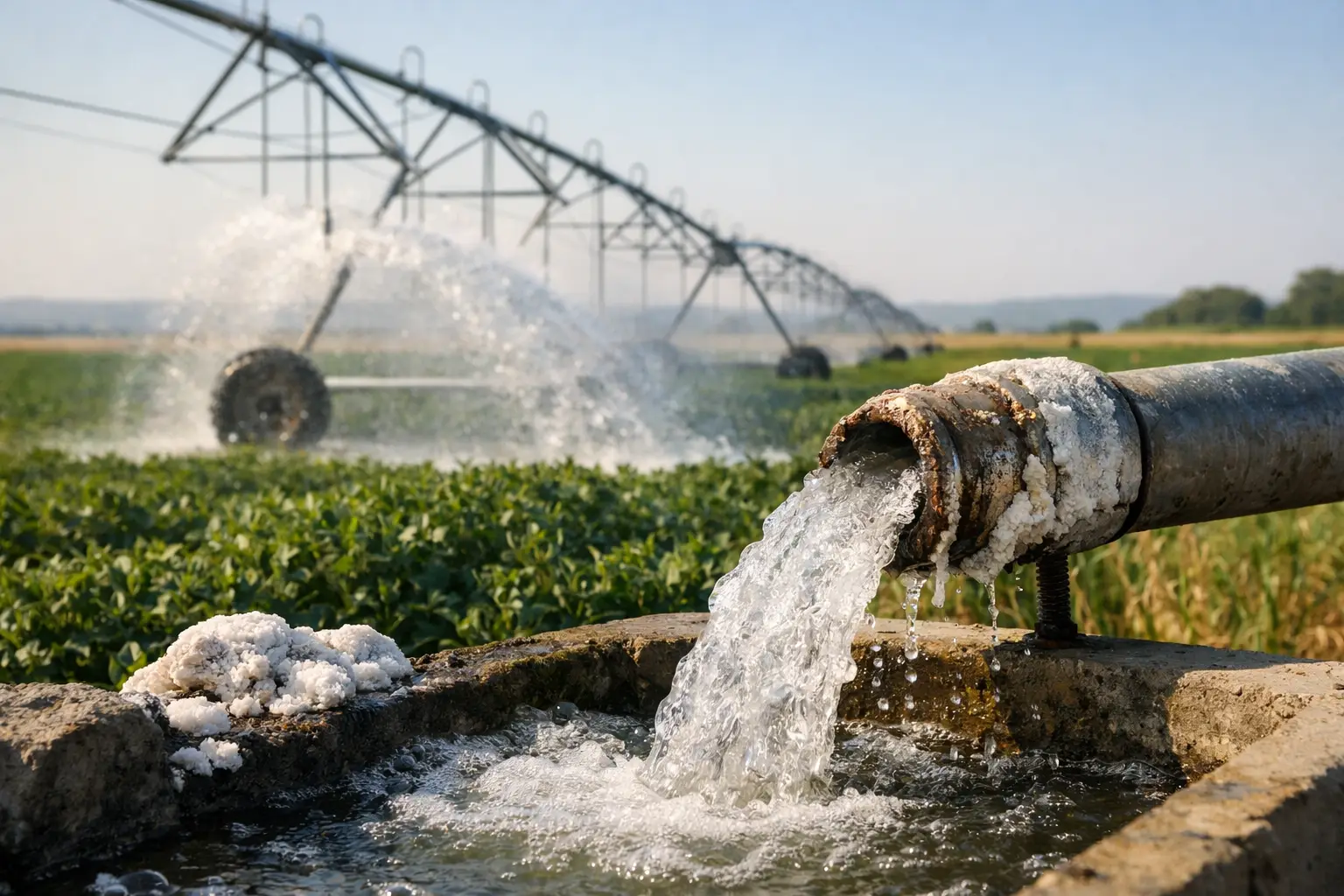
The first problem is physical. Hard water increases the risk of scale formation inside pipelines, emitters, filters, pressure regulators, and injection equipment. Under drip and microirrigation, that can quickly become a distribution issue rather than a water quality issue alone. A system may still be operating, but not uniformly. Once application uniformity drops, irrigation scheduling and fertigation rates become less reliable.
The second problem is chemical. High bicarbonates and carbonates can push water pH up and cause calcium phosphate, calcium sulfate, and micronutrient precipitation. That affects tank compatibility and nutrient availability. In practical terms, you may be applying nutrients that never stay soluble long enough to reach the root zone in the intended form.
The third problem is agronomic. Some crops tolerate marginal water quality reasonably well under certain soils and climates. Others do not. Tree crops under drip irrigation, high-value vegetables, berries, nursery crops, and greenhouse systems are less forgiving because localized irrigation concentrates salts and precipitates around emitters and in the wetted root zone.
Start with analysis before deciding how to treat hard irrigation water
Treatment should never begin with equipment selection. It should begin with a complete irrigation water analysis and a review of system performance. At a minimum, evaluate total hardness, calcium, magnesium, bicarbonate, carbonate, pH, EC, sodium, chloride, sulfate, iron, manganese, and total suspended solids. If fertigation is used, review the full fertilizer program as well, because the treatment target may be compatibility rather than hardness itself.
A lab report on its own is not enough. You also need field context. A source with moderate hardness can be manageable under sprinkler irrigation and problematic under drip. Seasonal shifts matter too. Well water chemistry is often more stable than surface water, but blending sources or pumping changes can alter treatment needs during the season.
When interpreting results, bicarbonate level is often more important than hardness alone for scaling risk. Hardness tells you calcium and magnesium load. Bicarbonates tell you how likely those minerals are to precipitate, especially as pH rises or water warms. Many growers focus on ppm hardness and miss the bicarbonate story, which is where many emitter plugging and fertilizer incompatibility problems begin.
The main treatment options and when they fit
For most commercial irrigation systems, acidification is the primary treatment approach. The goal is not to make water soft in the domestic sense. The goal is to reduce bicarbonates, lower pH to a manageable range, and keep minerals in solution long enough to reduce scale formation and improve nutrient compatibility. Sulfuric, phosphoric, and sometimes nitric acid are used, depending on crop stage, fertilizer plan, safety protocols, and local availability.
This approach works well when bicarbonates are driving scaling and high pH. It is also usually more practical at field scale than traditional ion-exchange softening. But acid choice matters. Sulfuric acid is often cost-effective for water treatment, yet it adds sulfate. Phosphoric acid contributes phosphorus, which can be useful or problematic depending on the crop and the rest of the fertility program. Nitric acid adds nitrate and may fit certain production phases better than others. The right decision depends on the nutrient budget, not just the treatment target.
Injection must be engineered correctly. Poor acid dosing can create safety risks, damage equipment, and push water chemistry too far. It is not enough to lower source-water pH at the wellhead and assume the problem is solved. Confirm pH and pressure at representative field points, and verify that the treatment is actually improving distribution and reducing precipitation.
A second option is periodic acid flushing instead of continuous acidification. This is often used in drip systems when scaling has already started or where water quality is marginal but not severe enough to justify constant adjustment. Periodic flushing can restore some system performance, but it is usually a maintenance tactic rather than a complete solution. If the underlying chemistry remains unchanged, deposits often return.
Mechanical or media filtration should also be part of the conversation, but filtration does not remove dissolved hardness. It helps when hard water problems are combined with sand, silt, algae, bacterial slime, iron precipitates, or other particulates that worsen clogging. In many field systems, growers overestimate what filters can solve chemically and underestimate how much suspended material accelerates a hardness-related plugging issue.
Reverse osmosis can remove dissolved salts and hardness very effectively, but for open-field agriculture it is usually justified only in high-value specialty systems or protected cultivation due to cost, energy demand, reject water management, and maintenance complexity. It can be appropriate in greenhouse, nursery, or propagation settings where water quality must be tightly controlled. For broad-acre or large orchard acreage, it is rarely the first economic choice.
Ion-exchange softeners, common in buildings and light commercial use, are generally not the preferred solution for agricultural irrigation. They replace calcium and magnesium with sodium or potassium. That may reduce hardness, but added sodium can create a different agronomic problem, especially on sensitive soils or where sodium hazard is already elevated. For irrigation, solving one water quality issue by increasing another is usually a poor trade.
Treatment must match the irrigation system
Drip and microirrigation systems are the most sensitive to hard water because small emitter pathways plug quickly and localized precipitation has immediate hydraulic effects. In these systems, proactive treatment is usually easier and less expensive than trying to recover uniformity later. Monitoring pressure differentials, flush performance, and emitter flow variation should be part of the treatment program.
Sprinkler systems are generally more tolerant, but hard water can still cause nozzle wear, scaling, and foliar residue. In overhead irrigation for vegetables, ornamentals, or nursery crops, mineral deposits on leaves and fruit can create quality concerns. In chemigation programs, precipitation in the mixing and delivery pathway remains a risk regardless of the application method.
Surface irrigation has fewer emitter-plugging concerns, but hard water still matters through soil chemistry interactions and nutrient availability. If the water also carries high sodium or bicarbonates, infiltration and soil structure issues may become part of the decision framework.
Fertigation compatibility is where many mistakes happen
Knowing how to treat hard irrigation water means understanding the fertilizer chemistry moving through that water. Calcium-rich hard water mixed with phosphate or sulfate fertilizers can form insoluble compounds. High-pH water can also reduce micronutrient availability or destabilize certain formulations.
This is why treatment should be coordinated with the fertigation schedule, stock solution design, and injection sequence. Separate tanks, staged injections, and compatibility testing are often more valuable than simply adding more acid or switching products. If your program includes calcium, phosphorus, sulfur, and micronutrients in the same delivery system, water chemistry should be part of every formulation decision.
In practice, the best result often comes from combining moderate acidification, disciplined tank management, regular line flushing, and a fertilizer program built around actual source water. That is less dramatic than installing a large treatment unit, but it is usually more effective in commercial production.
How to treat hard irrigation water without overtreating it
Not every hard water source needs aggressive correction. If the system is maintaining uniformity, filters are stable, nutrient compatibility is acceptable, and crop response is on target, treatment can remain minimal. Over-acidification adds cost, increases handling risk, and may create corrosion issues in pumps, injectors, valves, and metal components.
The better approach is threshold-based management. Use water analysis, system inspection, and field performance data to define when intervention is justified. That means watching for increasing pressure differential, visible precipitates, reduced emitter discharge, unexplained nutrient inefficiency, or persistent high-pH irrigation water that conflicts with the fertility program.
For agronomists and farm managers, this is where unbiased technical review matters. The right answer is not always a product. Sometimes it is a change in fertilizer source, injection timing, flushing frequency, or irrigation method. Sometimes it is acidification. Sometimes it is accepting a manageable level of hardness while addressing the actual limiting factor.
Water treatment should serve agronomy, not the other way around. When hard irrigation water is managed correctly, the result is not just cleaner lines. It is better control over irrigation uniformity, nutrient delivery, and crop performance, which is where the economics start to make sense.











About Post Author
