

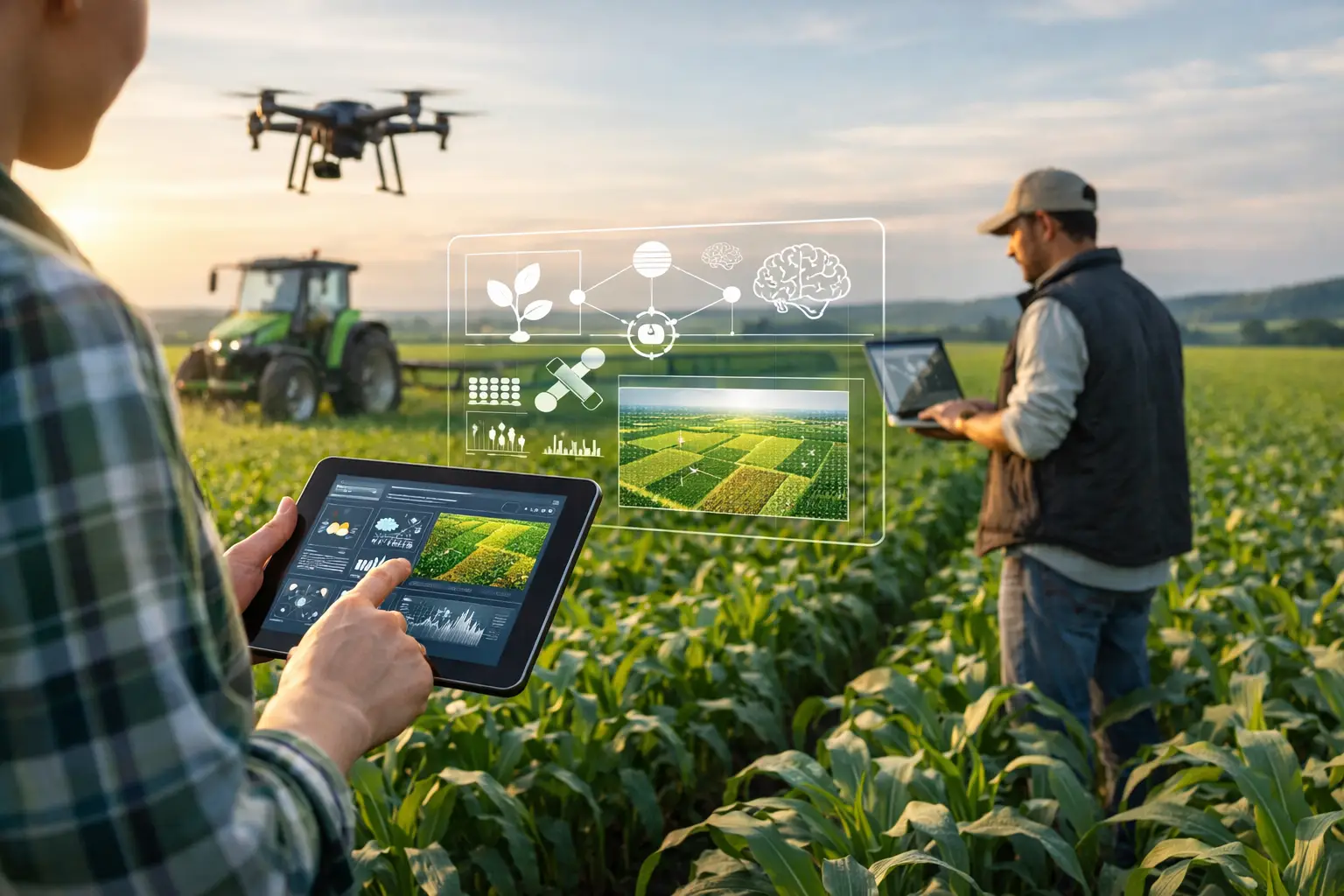
How to Choose an AI Crop Management Platform
When a platform flags a nitrogen issue, predicts irrigation demand, and highlights a pest hotspot in the same field, the real question is not whether the software looks advanced. It is whether the recommendation is agronomically sound, timely, and usable by the people responsible for field execution. That is the standard an ai crop management platform must meet on a commercial farm.
For growers, agronomists, and agribusiness teams, the value of AI is rarely in generating more dashboards. It is in improving decisions that affect yield, quality, input efficiency, labor coordination, and risk. The difference matters. A polished interface can impress in a demo. A useful system must perform under variable soils, changing weather, imperfect field data, and the practical constraints of farm operations.
What an AI crop management platform should actually do
An AI crop management platform is software that combines farm data, agronomic models, and machine learning to support field-level decisions. In practice, that usually means bringing together weather, satellite imagery, sensor data, crop stage, soil information, historical performance, scouting records, and operational logs.
The best platforms do more than describe what has already happened. They help users decide what to do next. That may include irrigation timing, fertility adjustments, disease risk alerts, pest scouting priorities, harvest forecasting, or identifying zones for variable-rate application.
Still, AI is not magic. In agronomy, recommendation quality depends heavily on data quality, crop specificity, and local calibration. A platform built around generalized patterns may perform adequately for broad acreage monitoring but fall short when the decision requires crop-specific thresholds, nutrient interactions, irrigation system constraints, or disease pressure linked to microclimate.
Where AI helps most in commercial crop management
The strongest use cases tend to be narrow enough to solve a real problem and broad enough to scale across fields. Irrigation management is a clear example. AI can process evapotranspiration, forecast weather, soil moisture trends, and crop stage to improve irrigation scheduling. But even here, the recommendation is only as good as the system’s understanding of root depth, soil variability, irrigation uniformity, and operational limits such as set times and water delivery windows.
Nutrient management is another area with real potential. Platforms can combine imagery, yield history, soil tests, and tissue or sap data to identify likely deficiencies or prioritize sampling. That can improve timing and field targeting. However, nutrition decisions still require agronomic judgment. A spectral signal may suggest stress, but it does not automatically distinguish between nitrogen deficiency, compaction, salinity, root disease, or waterlogging.
Pest and disease management can also benefit, especially through risk forecasting and scouting prioritization. If the system can integrate humidity, leaf wetness proxies, temperature, crop stage, and recent field observations, it may improve timing for scouting or preventive action. But disease models are highly crop- and pathogen-specific. A broad risk score with weak local validation is not enough for spray decisions on high-value crops.
How to evaluate an AI crop management platform
The first test is whether the platform is built around agronomic decisions or around data visualization. Those are not the same thing. Many systems aggregate layers well but stop short of delivering clear, defensible recommendations. A farm team needs to know whether the platform can support action, not just display variability.
Look closely at crop coverage. A platform may perform reasonably in corn, soybeans, or wheat and still be weak in almonds, potatoes, tomatoes, citrus, or other crops with more complex irrigation, disease, and nutrition demands. Crop-specific logic matters. Growth stages, nutrient uptake patterns, canopy behavior, and pest pressure are not interchangeable across crops.
You should also ask how the platform handles ground truth. Does it learn from scouting records, tissue results, irrigation logs, and yield maps, or does it mostly rely on remote sensing and weather feeds? Satellite imagery is useful, but it has limits. Cloud cover, revisit intervals, mixed pixels, and delayed stress detection can reduce field value. Drone imagery may improve resolution but adds operational cost and workflow complexity. The right platform is not the one with the most data layers. It is the one that uses the right layers for the decision at hand.
AI crop management platform features that matter most
An effective AI crop management platform should fit into real agronomic workflows. That starts with field segmentation and zone management that align with how the farm actually operates. If recommendations cannot be tied to irrigation blocks, management zones, ranch boundaries, or spray units, adoption usually fades quickly.
Decision support should also be traceable. Users need to understand why the platform produced a recommendation. Black-box alerts are difficult to trust, especially when the recommendation conflicts with field experience. Explainability does not require the user to inspect the code. It means the system shows the variables, thresholds, and recent field conditions behind the output.
Integration matters just as much. If the platform cannot connect with sensor feeds, weather stations, equipment data, farm management records, or scouting apps, the team ends up managing duplicate workflows. That increases labor and reduces data quality over time.
For larger operations and agribusiness teams, multi-user collaboration is essential. Agronomists, irrigators, farm managers, and executives do not need the same dashboard. They need the same source of truth presented in a way that supports their role. A scouting alert for the field team should translate into a management decision and then into a record of execution.
Common weaknesses buyers overlook
One common mistake is overvaluing image analytics while undervaluing agronomy. A platform may detect variability very well and still provide weak interpretation. Variability is not diagnosis. In many fields, the key challenge is separating water stress from nutrient stress, soil constraints, disease onset, or application error. Without crop-specific agronomic logic, AI can generate attractive but low-confidence recommendations.
Another weakness is poor handling of local context. Recommendations that ignore water quality, salinity, soil texture shifts, rootstock differences, planting dates, hybrid or variety effects, or irrigation system limitations tend to lose credibility fast. Commercial farming is operationally constrained. The best decision on paper may be impossible to implement on schedule or at the required precision.
There is also a tendency to assume more automation means better outcomes. In reality, fully automated recommendations can be risky when model confidence is low or field conditions are changing quickly. Many operations benefit more from ranked priorities and decision support than from automatic prescriptions. It depends on the crop, the cost of error, and the farm’s internal agronomic capacity.
What good platform selection looks like
A disciplined selection process starts with two or three high-value decisions you want to improve. That might be irrigation timing in processing tomatoes, in-season nitrogen management in corn, disease scouting prioritization in potatoes, or yield forecasting for harvest planning. If the use case is vague, platform evaluation becomes a software beauty contest.
Next, test the platform against one season of your own data if possible. Historical validation is more informative than vendor screenshots. Can the system identify known problem zones, track stress progression, and produce recommendations that match field outcomes? If not, the issue may be weak data integration, poor crop fit, or limited local calibration.
It is also worth evaluating who on your team will use it every week. A technically impressive tool can fail if it requires too much manual setup or too much interpretation. Ease of use is not a secondary issue. It is part of agronomic performance because a recommendation that is ignored has zero value.
This is where unbiased technical review matters. At Cropaia, the most useful digital tools are treated as part of a broader agronomic system, not as a replacement for expertise. That distinction protects against a common failure in digital agriculture: collecting more data without improving decisions.
The real benchmark is field execution
An AI platform should not be judged only by prediction accuracy or dashboard design. The more important measure is whether it improves timing, targeting, and consistency in the field. Did irrigation runs change in time to protect yield? Did nutrient applications become more precise? Did scouts reach the right fields earlier? Did managers gain enough confidence to act faster and document results better?
That is also why trade-offs matter. A highly sophisticated platform may offer stronger analytics but demand cleaner data and more staff engagement. A simpler tool may deliver fewer insights but better adoption. The right choice depends on crop value, operational complexity, internal expertise, and the cost of delayed or incorrect decisions.
For professional agriculture, AI should earn its place the same way any agronomic input or service does – by delivering measurable improvement. If a platform helps your team make better decisions under real field conditions, it deserves serious attention. If it mainly produces more maps, more alerts, and more noise, the technology is ahead of its value.
The farms that benefit most from AI will not be the ones chasing the most features. They will be the ones choosing tools that match their crops, their constraints, and the decisions that actually move performance.












About Post Author
