

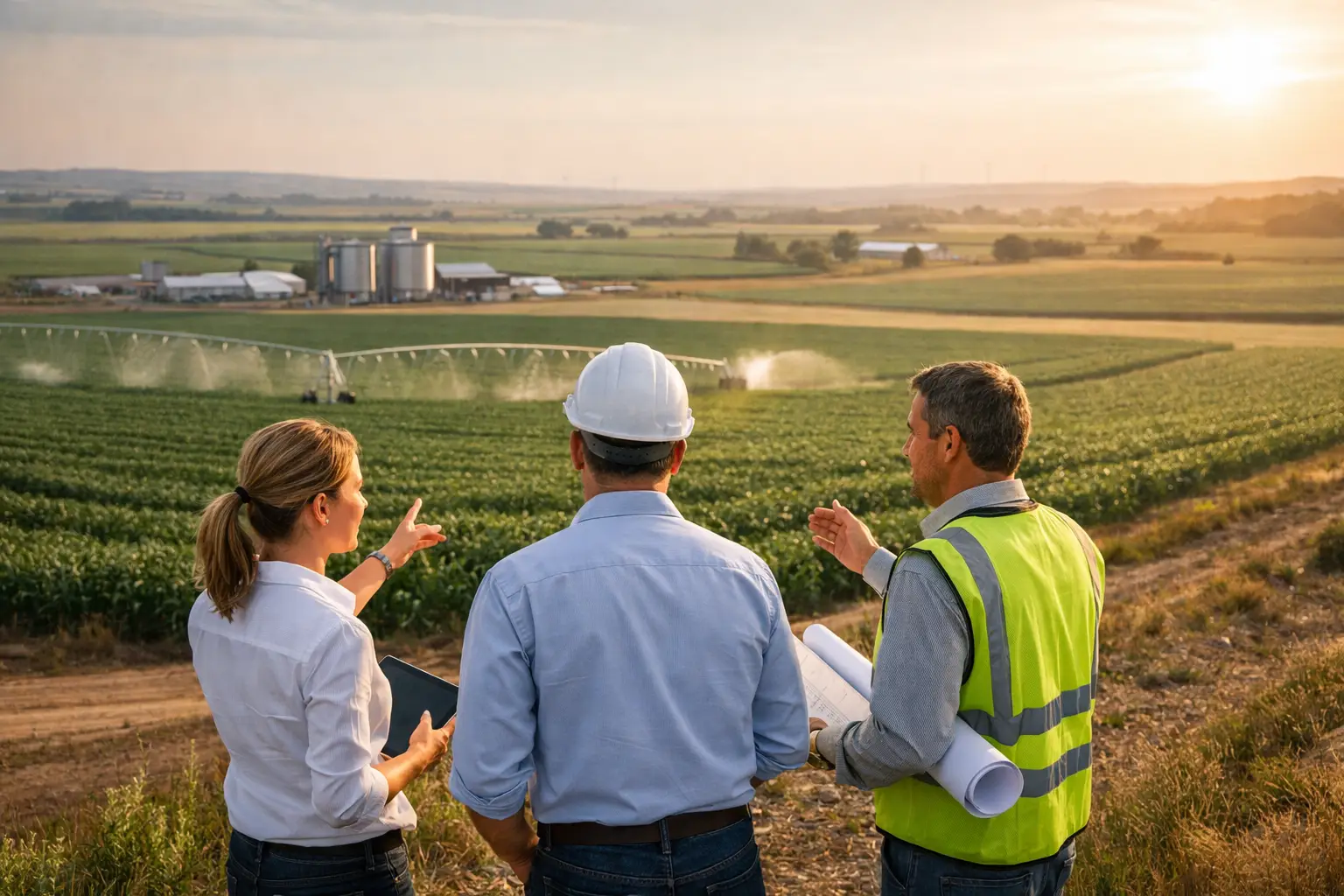
Large Scale Agricultural Project Advisory
A large farming project rarely fails because of one dramatic mistake. More often, it underperforms because early assumptions go untested – water supply is overestimated, soil variability is underestimated, crop choice is driven by market optimism rather than agronomic fit, or management systems are too thin for the scale being built. That is where large scale agricultural project advisory becomes decisive. It brings technical scrutiny to the points where capital, agronomy, infrastructure, and operations intersect.
For commercial growers, investors, food companies, NGOs, and public-sector organizations, the stakes are high. A planning error on 20 acres is inconvenient. The same error on 2,000 or 20,000 acres can lock in years of weak yield, poor irrigation performance, nutrient inefficiency, labor pressure, and avoidable financial loss. Sound advisory work is not an administrative layer added after strategy. It is part of how a project becomes technically viable, operationally manageable, and economically defensible.
What large scale agricultural project advisory actually covers
At this level, advisory is broader than crop consulting and more technical than general project management. It starts before planting and often before land is developed. The central question is simple: can this project perform consistently under local agronomic, water, labor, infrastructure, and market conditions?
That requires looking at the whole production system. Land suitability matters, but so do irrigation design criteria, pumping capacity, water quality, fertigation strategy, drainage behavior, cultivar fit, mechanization logic, pest pressure, storage limitations, and management capability. A good advisory process does not isolate these issues. It evaluates how they affect one another in the field and on the balance sheet.
This is especially important in projects led by institutions rather than growers. Corporate investors, development agencies, processors, and governments often work with sound strategic goals but limited on-the-ground agronomic visibility. In those cases, advisory provides an unbiased technical bridge between project ambition and field reality.
Why large projects need different decision-making
Large-scale agriculture is not just small-farm agronomy repeated many times. Scale changes the economics of mistakes and also changes how fast those mistakes spread. If irrigation scheduling is weak on a few plots, it may still be corrected manually. If scheduling is weak across thousands of acres, water application errors become systemic. The same is true for fertilizer programs, pest monitoring, labor deployment, and harvest timing.
Scale also reduces tolerance for informal management. A project may have excellent soils and a strong crop plan, but still struggle because standard operating procedures are unclear, field data is inconsistent, and department responsibilities are not well defined. Many agricultural projects are designed as production systems but operated as collections of separate activities. Advisory helps close that gap.
There is also a timing issue. Large projects often have long procurement cycles, phased infrastructure development, and external reporting requirements. That means poor early decisions are harder to reverse later. Choosing the wrong irrigation method, underbuilding filtration, or misjudging water treatment requirements can create technical bottlenecks that persist for years.
The most common failure points in project development
The first recurring problem is weak feasibility work. Some projects move too quickly from concept to implementation, relying on partial soil data, a single water test, or broad regional assumptions. But one promising district can contain serious differences in texture, salinity, infiltration, slope, and water holding capacity. Without enough field-level validation, the project model may look sound on paper and fail under commercial conditions.
The second problem is treating infrastructure as separate from agronomy. Irrigation systems are sometimes designed around capital budgets or supplier preferences rather than crop demand, water characteristics, field layout, and labor capacity. This is where underperforming projects often show early symptoms – nonuniform application, clogging, drainage stress, unstable fertigation, and poor response to climate variation.
The third problem is overconfidence in crop transferability. A crop that performs well in one country or region will not necessarily perform the same way under different radiation levels, water chemistry, disease pressure, labor conditions, or market windows. Advisory should challenge assumptions about yield targets, seasonality, and management intensity before the operation is locked into an unrealistic model.
The fourth problem is underestimating management complexity. Large farms need more than technical recommendations. They need repeatable systems for scouting, irrigation monitoring, nutrition correction, pest response, field records, and performance review. Agronomy without management discipline is rarely enough at scale.
What good advisory looks like in practice
Strong advisory work is evidence-based, field-oriented, and specific to the project stage. During pre-investment, the focus is usually on feasibility, site evaluation, water assessment, cropping strategy, and infrastructure requirements. During development, attention shifts toward design review, operational planning, standard protocols, and training. Once production begins, the priority becomes performance optimization and troubleshooting.
The best advisors also resist the temptation to oversimplify. Not every project should maximize acreage immediately. In some cases, phased development is the better path because it allows irrigation performance, nutrition programs, labor systems, and variety behavior to be validated before expansion. That can look slower to stakeholders in year one, but it often protects long-term returns.
A credible advisor should also be independent in judgment. Product-driven recommendations can distort project design, especially in irrigation, fertilizers, and crop protection. Large operations benefit most from advice that starts with agronomic fit and operating conditions, then selects tools accordingly. That distinction matters when capital commitments are large and technical reversals are expensive.
Key technical areas that deserve early scrutiny
Water is usually the first limiting factor, even when supply appears adequate. Quantity is only one side of the issue. Quality, seasonal reliability, filtration needs, treatment requirements, pumping energy, distribution losses, and leaching implications all affect the production model. A project with marginal water quality may still be viable, but only if irrigation design, nutrition planning, and soil management are built around that reality from the start.
Soil assessment should go beyond fertility snapshots. For project planning, the critical questions include rooting depth, spatial variability, salinity risk, compaction layers, drainage behavior, and how much management intensity different blocks will require. Uniform recommendations across highly variable land usually lead to uneven performance and wasted inputs.
Crop and variety selection should be tested against agronomy and logistics at the same time. Yield potential matters, but so do market access, harvest concentration, storage life, packout expectations, and sensitivity to water stress or nutrient imbalance. High-value crops are not automatically the best project choice if management capacity is still developing.
Operational design is often overlooked until late stages. Field road layout, irrigation zoning, fertigation capacity, labor flow, workshop organization, spare-parts planning, and data collection protocols may sound secondary, yet they directly affect how consistently agronomic recommendations are executed. At scale, operational friction becomes an agronomic problem.
Advisory, training, and technology work better together
One reason large projects stall after a promising launch is that knowledge remains external. Consultants visit, recommendations are issued, but site teams do not fully understand the reasoning behind the program or how to adapt it when conditions shift. That is why the strongest project models combine advisory with technical training and decision-support systems.
Field managers, agronomists, and irrigation teams need practical competence, not just instructions. When teams understand irrigation principles, plant nutrition dynamics, water treatment constraints, and crop protection logic, execution improves and problems are identified earlier. This is where structured learning, targeted workshops, and technically grounded references can make a measurable difference.
For organizations building long-term capacity, the combination of consulting, training, and digital monitoring is especially effective. A platform such as yieldsApp can support better tracking and decision consistency, but software alone is not enough. It performs best when the project already has sound agronomic logic, clean field processes, and trained people using the data correctly.
How to judge whether an advisory approach is credible
The simplest test is whether the advisor asks difficult questions early. If the process jumps straight to recommendations without probing water constraints, management structure, variability across fields, labor realities, and likely failure points, the advisory is probably too shallow for a large project.
It is also worth looking for global field experience without generic thinking. Experience across many countries can be valuable, but only if it sharpens local judgment rather than replacing it. Strong advisors bring pattern recognition from multiple production systems while still adapting recommendations to local climate, infrastructure, and operating limits.
Finally, credibility shows in the balance between technical depth and implementation clarity. A project does not improve because a report is detailed. It improves because the recommendations are agronomically sound, economically realistic, and executable by the team on site. That is the standard serious agricultural projects should expect.
Organizations that need this level of support often benefit from partners that combine field consulting with deeper technical education. Cropaia has built that model around unbiased agronomic guidance, practical training, and specialized expertise in irrigation, nutrition, crop protection, and water treatment.
The real value of advisory is not that it removes uncertainty. Agriculture does not work that way. Its value is that it helps decision-makers face uncertainty with better data, stronger assumptions, and a production system that can hold up under real operating pressure.











About Post Author
