


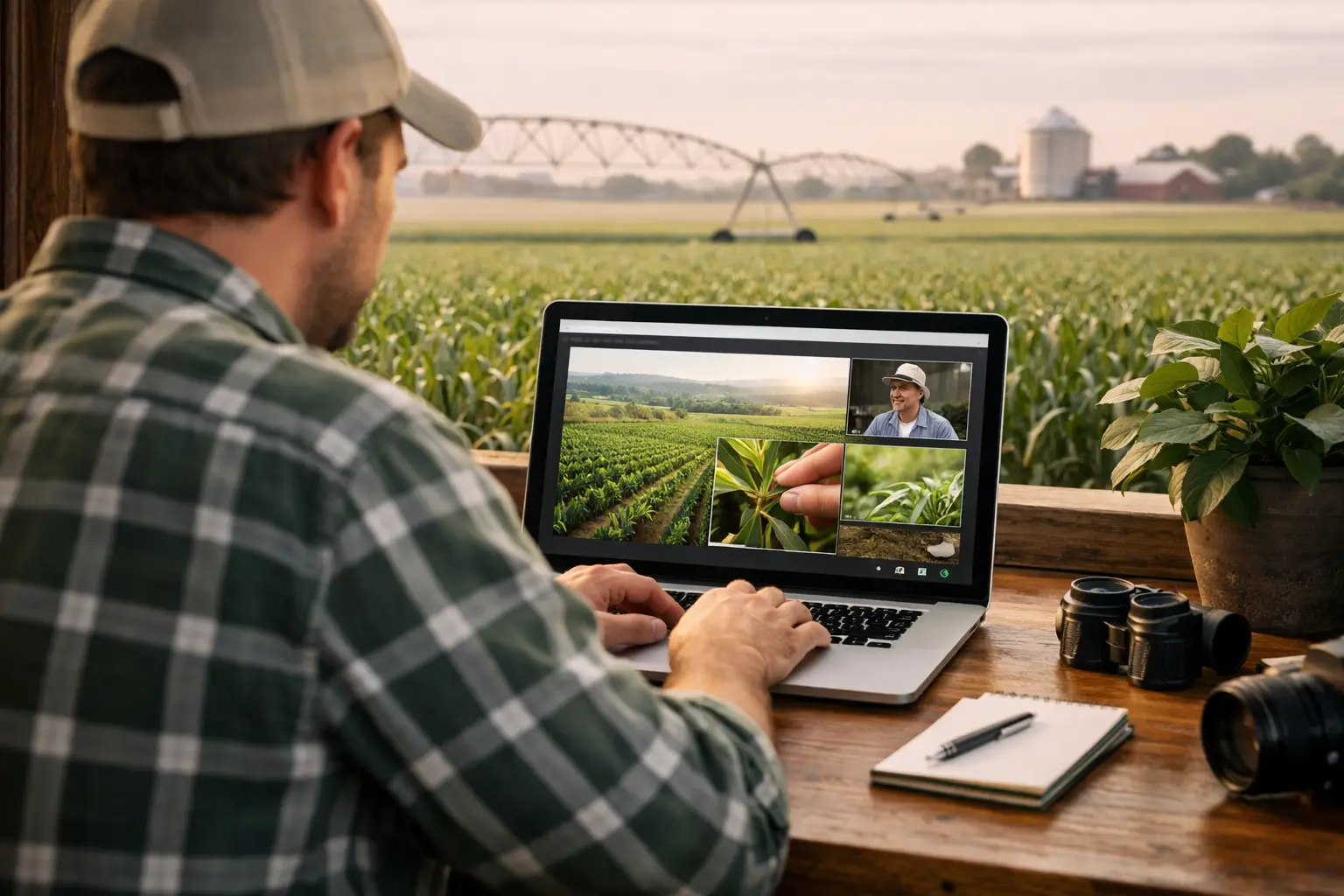
Online Agronomy Courses
A production problem rarely waits for a training calendar. When irrigation uniformity drops in peak season, tissue analyses start showing hidden deficiencies, or pest pressure shifts faster than expected, professionals need answers they can apply immediately. That is exactly why online agronomy courses for professionals have become a serious tool for growers, farm managers, consultants, and technical teams who need to improve decisions without stepping away from operations for days at a time.
The value is not just convenience. The right course gives structure to problems that often feel fragmented in the field. Irrigation, plant nutrition, water quality, root-zone management, pest pressure, and environmental conditions do not operate in isolation. Professionals who can connect those factors usually make better recommendations, reduce costly trial and error, and improve consistency across seasons.
Why online agronomy courses matter
Agronomy is practical by nature, but practical work still depends on strong technical foundations. Many experienced professionals know how to react to visible symptoms in the field. Fewer are equally confident in tracing those symptoms back to hydraulic performance, nutrient interactions, salinity patterns, disease-conducive conditions, or management timing.
That gap matters. A farm can spend heavily on fertilizer and still underperform because water distribution is uneven. A crop protection program can look complete on paper and still fail because diagnosis was late or the root cause was nutritional rather than pathological. For consultants and agronomists, these are not academic distinctions. They affect yield, input efficiency, labor allocation, and grower trust.
Online learning works well in this environment because it fits the way agricultural professionals actually build expertise. They learn a concept, compare it with a current field issue, test the logic against real conditions, and then refine their decision-making. A strong online course supports that process with technical clarity and field relevance, rather than broad theory alone.
What professionals should look for in an online agronomy course
Not all courses are built for the same audience. Some are introductory and useful for orientation, but too general for someone responsible for commercial decisions. Others are technically sound but disconnected from field realities. The best online agronomy courses for professionals sit in the middle of those extremes. They translate science into operational choices.
Depth matters more than volume. A short module that explains how water quality affects nutrient availability, emitter performance, and long-term soil conditions is often more valuable than hours of surface-level content. The same applies to pest and disease education. Professionals need frameworks for diagnosis, thresholds, timing, and prevention, not just image libraries of symptoms.
Course design also matters. Busy practitioners do better with content that can be taken in sections, revisited when needed, and used as a working reference during the season. If a participant can return to a lesson before adjusting a fertigation program or reviewing a crop protection strategy, the course becomes part of the operation rather than a one-time exercise.
The source of instruction is another key factor. Product-driven training can be useful, but it may narrow the discussion around a specific solution. Independent, evidence-based education is often better for professionals who need to evaluate options objectively across crops, climates, and production systems.
The difference between general education and decision support
A useful test is simple: does the course help you make a better recommendation next week?
For a grower or farm manager, that might mean understanding whether low performance is caused by irrigation scheduling, poor infiltration, nutrient imbalance, or root damage. For an agronomist, it may mean building a more defensible fertigation recommendation, interpreting field variability more accurately, or identifying when a disease risk is environmental rather than infectious.
The strongest courses do not just transfer knowledge. They sharpen judgment.
Structured agronomy training for operational decisions
For professionals who want to move from general understanding to field-level decision frameworks, structured agronomy training can bridge the gap between theory and execution.
- Fertilization and irrigation course – irrigation scheduling, fertigation logic, water-nutrient interactions
- Pest and disease management course – diagnosis frameworks, monitoring logic, timing, and prevention strategies
- Regenerative agriculture course (contact us) – soil health systems, long-term productivity, and input efficiency
- Digital agronomy & decision intelligence (contact us) – integrating field data, models, and operational decision workflows
The subjects that deliver the highest return
Professionals usually benefit most from training that addresses the highest-cost agronomic decisions. Irrigation is one of the clearest examples. Small errors in timing, volume, distribution, or water quality can cascade into nutrient inefficiency, disease pressure, weak root systems, and inconsistent yield. A course that explains irrigation from both theory and field application can improve performance far beyond the irrigation system itself.
Plant nutrition is another high-return topic. Fertilizer programs are often built from habit, supplier guidance, or broad crop tables. That can work reasonably well under stable conditions, but it often breaks down when water quality changes, weather patterns shift, or the crop enters a sensitive stage. Professionals need a deeper understanding of nutrient mobility, antagonism, uptake patterns, and how fertigation interacts with soil and water conditions.
Pest and disease management is equally important, especially for professionals responsible for crop protection planning across multiple fields or regions. The most valuable training goes beyond identifying pests and products. It addresses monitoring, conducive conditions, timing, and the operational logic behind prevention and intervention.
Water treatment can also be highly relevant, especially where clogging, salinity, bicarbonates, or microbiological issues are affecting system performance. While not every agricultural role requires advanced water treatment knowledge, professionals working with irrigation infrastructure or marginal water sources often gain significant value from it.
Who benefits most from online agronomy courses
Commercial growers and farm managers often need training that improves direct operational control. They are usually less interested in academic breadth and more interested in avoiding mistakes that reduce yield or waste inputs. For them, the best course is one that supports daily and seasonal decisions.
Applied agronomy training aligned with these high-impact topics
These are exactly the domains covered in advanced operational training programs designed for field professionals.
- Fertilization and irrigation course – decision rules for fertigation and irrigation under real constraints
- Pest and disease management course – structured crop protection logic beyond product selection
- Regenerative agriculture course (contact us) – soil-driven productivity systems
- AI agronomy & field decision systems (contact us) – data-driven field execution frameworks
Independent agronomists and consultants need another layer. They are expected to explain cause and effect, defend recommendations, and adapt principles across clients, crops, and environments. Their training should be more analytical and should strengthen their ability to diagnose, compare options, and communicate clearly.
Enterprise teams and public-sector professionals often need training that creates consistency. If several agronomists, extension agents, or technical managers are responsible for multiple sites, a structured course can align terminology, methodology, and decision criteria. That has real value in large-scale programs where inconsistency between teams can become expensive.
Trade-offs professionals should consider
Online education is efficient, but it does have limits. It cannot fully replace field observation, hands-on system evaluation, or crop-specific mentoring. A course may explain how to assess irrigation performance, for example, but the quality of the outcome still depends on what the professional measures and observes on site.
That is why the best approach is usually blended. Use online training to build the technical framework, then apply it in the field, compare it against actual crop response, and refine decisions over time. For many professionals, that model is more effective than classroom-only learning because it keeps education tied to live agronomic problems.
How to choose the right course for your role
Start with the decisions you are responsible for, not the topics that sound most interesting. If you manage irrigation-intensive crops, irrigation and fertigation training will likely produce faster returns than broad agronomy overviews. If your main challenge is repeated crop protection issues, prioritize courses that improve diagnosis and management logic.
Then look closely at the level of instruction. A professional course should assume some prior knowledge and should respect the complexity of real production systems. If the content feels simplified to the point that trade-offs disappear, it may not be advanced enough for operational use.
It is also worth considering whether the provider has real field experience across regions and cropping systems. Agronomic principles are universal, but recommendations always interact with climate, water source, soil conditions, infrastructure, labor capacity, and market realities. Providers with broad field exposure tend to teach with more nuance and fewer one-size-fits-all claims.
For professionals seeking both technical depth and practical application, Cropaia’s approach is especially relevant because it combines structured education with consulting-based agronomic expertise. That matters when the goal is not just to complete a course, but to improve real decisions in production environments.
For organizations, agronomy teams, and consultants, training can be tailored to crops, regions, and operational systems.
Explore courses or contact us for tailored programs.
The real measure of value
The success of an online agronomy course is not the certificate, the platform, or even the number of lessons. It is whether the training changes the quality of decisions under pressure.
If a grower starts diagnosing variability earlier, if a consultant builds more precise nutrient programs, if a technical manager improves irrigation performance across multiple sites, the course has done its job. In professional agriculture, useful education should show up in better crop response, stronger consistency, and fewer preventable mistakes.
That is the standard worth using when evaluating online agronomy courses for professionals. The best ones do not just make knowledge more accessible. They make agronomic thinking sharper where it matters most – in the field, during the season, when decisions still have time to change the outcome.
The right course should leave you better prepared for the next difficult question your crop, client, or operation puts in front of you.










About Post Author
