

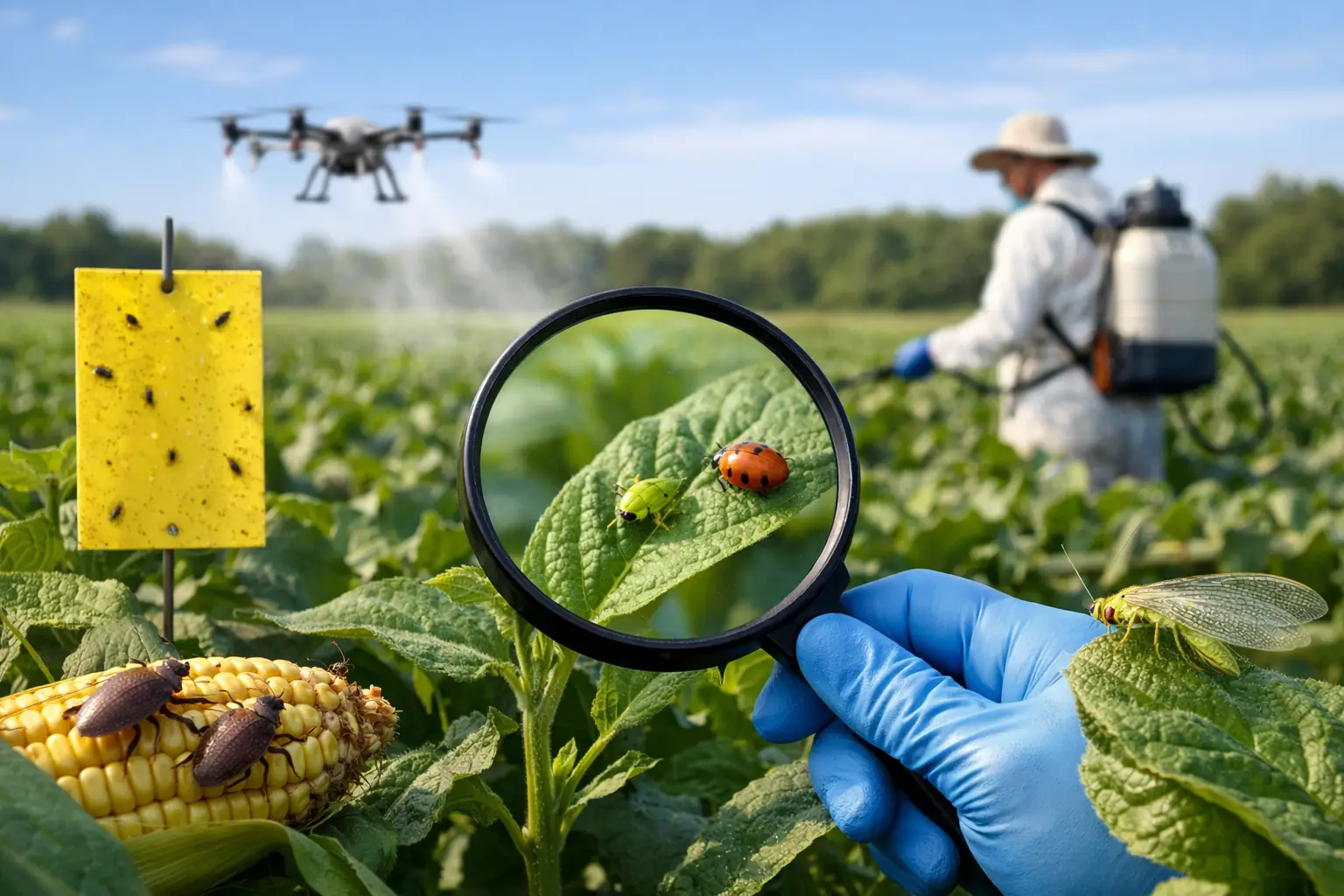
Integrated Pest Management for Crops
A field can look clean on Monday and cross an economic threshold by Friday. That is exactly why integrated pest management for crops is not a theory exercise. It is a decision system that helps growers act early enough to protect yield, but not so early that they waste money, disrupt beneficial insects, or accelerate resistance.
For commercial production, pest control is rarely just about killing a pest. It is about protecting the crop with the lowest practical risk to yield, quality, labor efficiency, residue compliance, and long-term field performance. Good IPM brings those objectives into one framework. It replaces habit-based spraying with observation, thresholds, timing, and strategy.
What integrated pest management actually means
Integrated pest management for crops is a structured approach that combines prevention, monitoring, biological understanding, and targeted intervention. The goal is not zero pests in every field at every moment. The goal is to keep pest pressure below the level where economic damage occurs.
That distinction matters. Many pests can be present without causing meaningful losses. If every detection triggers treatment, costs rise quickly and control often gets worse over time. Natural enemies are suppressed, resistance selection increases, and secondary pests can emerge after broad-spectrum applications.
IPM works best when it is built around the crop, the local production system, and the specific pest complex. A greenhouse vegetable operation, a high-value orchard, and a broadacre row crop will not use the same thresholds, scouting intensity, or treatment options. The principle is consistent, but execution depends on field reality.
The core logic of an IPM program
An effective IPM program starts before the first pest appears. Prevention is the first line of defense because it reduces the chance that pressure reaches damaging levels. Crop rotation, sanitation, resistant varieties, balanced nutrition, irrigation management, and weed control all influence pest development. In many cases, plant stress is part of the problem. Weak plants attract more damage and recover more slowly.
The second pillar is monitoring. If a field is not being scouted properly, management becomes reactive and imprecise. Monitoring includes direct inspection, trap counts, crop stage assessment, weather conditions, and knowledge of pest biology. Timing matters as much as presence. A small early infestation during a vulnerable crop stage may deserve more attention than a larger population later in the cycle.
The third pillar is decision-making. This is where economic thresholds, action thresholds, and field history come together. Not every pest has a well-defined threshold in every crop, and that is one of the practical limits of IPM. In those situations, growers and advisors rely on local experience, research data, and the likely risk to marketable yield. The process still needs discipline. Decisions should be based on evidence, not anxiety.
The fourth pillar is intervention. When action is needed, the best option is the one that solves the problem with the least unnecessary disruption. That may be a biological control release, a selective pesticide, mechanical removal, sanitation, or a change in irrigation or canopy management. Chemical control remains an important tool in many systems, but in IPM it is used with intention, not as the default answer.
Scouting is where most programs succeed or fail
Many farms say they practice IPM when what they really have is a spray program with occasional scouting. The difference is significant. True scouting is systematic. It follows a schedule, uses consistent sampling methods, records findings, and tracks changes over time.
Scouts need to identify the pest correctly, but also the life stage, distribution, and level of crop injury. A few moths in a trap do not automatically justify treatment. They may indicate the need for closer field inspection. Similarly, leaf damage without identifying the active pest can lead to the wrong product and poor timing.
Good records are essential. Patterns often repeat by field, variety, planting date, irrigation block, or surrounding vegetation. Once that history is documented, management becomes more precise. Resources go where risk is highest, and unnecessary applications decline.
Prevention is agronomy, not just pest control
One of the most overlooked strengths of IPM is that it forces pest management back into agronomy. Excess nitrogen can increase susceptibility to certain insects and diseases. Poor drainage can favor root problems. Dusty conditions may worsen mite outbreaks. Weed hosts can maintain insect populations between crop stages. These are not separate issues. They are connected.
This is why integrated programs often perform better than pesticide-centered programs. They treat the field as a production system. Improving irrigation uniformity, correcting nutrient imbalances, and reducing plant stress can make pest pressure easier to manage. The effect is not always immediate, but it is often more durable.
There is also a financial advantage. Preventive agronomic improvements can reduce repeated control costs across multiple seasons. That said, prevention has trade-offs. Some changes require upfront investment, more labor, or longer planning horizons. Not every farm can redesign rotations, install new monitoring tools, or shift varieties in one season. IPM should be built in stages, starting with the highest-value improvements.
Biological control and selective chemistry
Biological control is a major component of IPM, especially in protected agriculture and high-value crops, but it is not limited to those systems. Conserving predators, parasitoids, and microbial antagonists can reduce pest outbreaks and improve stability. However, biological control is not automatic. It depends on habitat, timing, climate, pest density, and compatibility with other inputs.
This is where product selection becomes critical. A pesticide that controls the target pest but eliminates beneficial populations may create a larger problem two weeks later. Selective products usually fit better in IPM, even when their knockdown appears less dramatic than broad-spectrum alternatives. Residual activity, mode of action, re-entry intervals, pre-harvest intervals, and resistance risk all need to be considered together.
Resistance management deserves special attention. Repeating the same mode of action because it worked once is one of the fastest ways to shorten the useful life of a product. Rotating modes of action and avoiding unnecessary applications are basic IPM discipline. When pressure is high, that discipline becomes harder to maintain, which is why planning matters before the season starts.
Technology improves IPM when it supports decisions
Digital tools can strengthen integrated pest management for crops by making monitoring more timely and more consistent. Field data, trap trends, weather signals, remote observations, and historical records help teams detect patterns earlier and prioritize scouting. On larger operations, this can improve coordination across farms and reduce the delay between pest detection and response.
But technology is only useful if it supports agronomic judgment. Models can estimate risk, not replace field verification. Trap data can suggest pressure, not confirm economic damage. The best systems combine digital visibility with local knowledge of crop stage, field conditions, and market requirements. That is where measurable improvement happens.
For enterprises managing multiple sites, standardized protocols are especially valuable. When scouting methods, thresholds, and reporting formats differ from one team to another, decision quality drops. A well-designed IPM system creates comparability. It also makes post-season review much more useful.
Common mistakes that weaken IPM
The most common mistake is acting too late. Once a pest is widely established, options narrow and costs rise. The second is acting too early without evidence, often because of calendar habits or fear of missing the window. Both errors are expensive in different ways.
Another frequent problem is treating symptoms instead of causes. If a field has recurring outbreaks, the answer may not be another product. It may be poor sanitation, unmanaged alternate hosts, uneven irrigation, or lack of monitoring during a critical stage. IPM requires enough discipline to ask why the problem keeps returning.
Misidentification is also a major issue. Different pests can produce similar injury, and beneficial insects are sometimes mistaken for harmful ones. Training matters here. Teams that understand pest biology make faster and better decisions in the field.
Building a practical IPM program
A workable program begins with a clear pest list by crop and season. Then define who scouts, how often, what gets recorded, and what thresholds trigger action. Review prevention measures before planting, not after problems appear. Choose intervention options in advance, including selective products and rotation plans for resistance management.
Just as important, review results after harvest. Which pests caused actual economic damage? Which treatments paid off? Where was timing missed? An IPM program improves when it is measured against yield, quality, cost, and field performance, not just against whether a spray was applied.
For growers and advisors, the real value of IPM is control over decisions. It creates a more disciplined process, reduces avoidable losses, and supports better use of labor and inputs. That is why evidence-based agronomy matters. When pest pressure rises, the strongest operations are usually not the ones that spray first. They are the ones that know exactly why they are acting, when to act, and when not to.











About Post Author
